
Early Childhood Development: Your Helpful and Social 5 Year Old
Your five-year-old is coming into their own and soaking up everything like a sponge! They might enjoy potty humor and love to tell wild, imaginative stories, but they also want to contribute in real ways to your family. Whether they’re following your instructions on how to set the table or pulling weeds from the garden, they love to help out in meaningful ways.

Your five year old is coming into their own and soaking up everything like a sponge! They might enjoy potty humor and love to tell wild, imaginative stories, but they also want to contribute in real ways to your family. Whether they’re following your instructions on how to set the table or pulling weeds from the garden, they love to help out in meaningful ways.
Early Childhood Development: Your 5 Year Old Preschooler and What to Expect
Vocabulary Development
Your child’s vocabulary is still growing and growing! On average, a five year old will know roughly 2,000 words.(2) The back-and-forth conversations are also getting longer, and typically five-year-olds say sentences that are at least five words long.(2) And boy do five year olds love to share their opinions!(1) Ask them questions, listen closely to their thoughtful explanations, and encourage them to tell stories. At this age, children also have longer attention spans, so they can follow multi-step instructions and do more complex projects.(1)
Motor Skills Development
Your five-year-old may have impressive gross motor skills! They’ll jump and climb, run and dance. You may find they’re interested in doing gymnastics, karate or ballet.(7) They’re also developing fine motor skills by using scissors, practicing writing their name, and drawing shapes.(7)
Whiney Behavior
If you have a five year old, you’ve certainly heard them whine. It’s an annoying behavior, but also completely normal at this development stage.(7) Whining peaks between ages 2 and 4, but your five year old may also whine when they’re expressing, “I need you and your help.”(7) Consider whether your child is tired, stressed, hungry, uncomfortable, or cranky.(7) It may also be a signal that they need more connection.
Early Childhood Development: 5 Year Old Milestones
Social/Emotional Checklist(3)
Knows how to follow rules and take turns when playing with other children
Can do simple chores like matching socks when sorting the laundry
Likes to sing, dance, or act for you
Wants to be liked and tries to please their friends(4)
Demonstrates independence(4)
Follows rules (most of the time)(4)
Language/Communication Checklist(3)
After you read or tell a story to them, can answer simple questions about it
Tells stories with at least two events
Has conversations with more than three back-and-forth exchanges
Recognizes or says simple rhymes, like cat and rat
Uses the future tense(4)
Talk about people by their relationship to others, like “Melissa’s mom” or “Justin’s cat”(4)
Understands the relationship between people and objects, such as “the girl who is kicking the ball”(4)
Movement and Physical Development Checklist(3)
Can hop on one foot
Able to button some buttons
Can swing, climb, do somersaults, and maybe skip(4)
Toilet trained, though they may still wet the bed occasionally(4)
Eats with a fork and spoon(4)
Is able to dress/undress themselves(4)
Cognitive Checklist(3)
Can write some of the letters in their name
Recognizes most of the letters in the alphabet 4)
Knows their address and phone number by heart(4)
Can draw people with a head, body, arms and legs(4)
Can count to 10
When you point to numbers between 1 and 5, can name some of them
Uses words to show an understanding of time, like “yesterday” or “night”
Knows what basic household objects are used for(4)
Can focus for 5 to 10 minutes on an activity like arts and crafts, story time, or another non-screen activity
Knows their colors and directional words like “over” or “next to”(2)
Follows instructions with three or fewer steps like, “Grab your lunch, put on your coat, and wait by the door”(2)
What You Can Do to Encourage Healthy Development in Your 5 Year Old
Give Your Child Meaningful Tasks
Preschoolers love to be helpful. They enjoy feeling like they’re contributing in a meaningful way. Give your child simple household chores to build their self-esteem and teach cooperation and responsibility.(5) Let them set the table, bring in the newspaper, water the flowers, or do other age-appropriate chores around the house.
Encourage Movement
Recreational sports are a great way for your child to learn how to be a good sport, play fairly, cooperate with teammates, and take turns. (5) Even if your child isn’t signed up for team sports, encourage them to move! Preschoolers are recommended to get at least three hours of physical activity per day.(6)
Play Together
While recreational sports are a fun way to move, make friends, and learn how to play on a team, they don’t replace the importance of playing with you! Spending quality time together will allow you to bond and give your child a chance to express their thoughts and share their feelings with you.(5) And don’t forget that playtime is an excellent sign to practice learning, too! When you’re at the park or talking a walk around your neighborhood, ask your child to practice reading signs to you! Or if you’re playing hopscotch, ask your child to draw the numbers with sidewalk chalk.
Set up Play Dates With Friends
By the time they’re five years old, children show an interest in being social, interacting with other children, and communicating back and forth with others.(7) But even outgoing, gregarious children can sometimes feel shy in new or uncertain situations. Setting up play dates before your child goes to kindergarten can help ease the transition to school.
Every Stage Comes With Joys and Challenges
Each step of the way, you have the opportunity to help your child learn and grow. Subscribe to my newsletter for more helpful parenting tips, and don’t miss the other blogs in the infant and early childhood development series!
References
https://www.verywellfamily.com/5-year-old-developmental-milestones-620713
https://www.cdc.gov/ncbddd/actearly/milestones/milestones-5yr.html
https://myhealth.alberta.ca/Health/Pages/conditions.aspx?hwid=ue5316
https://raisingchildren.net.au/school-age/development/development-tracker/5-6-years
https://www.parents.com/kids/development/behavioral/developmental-milestones-age-five/
https://www.psychologytoday.com/us/blog/joyful-parenting/201712/5-great-ways-respond-kids-whining

Is My Child Learning in Preschool? Yes, Your Child is Learning When They Play
Children learn many valuable skills during the preschool years. They’re learning how to communicate with and listen to others and how to follow directions. They’re developing fine and gross motor skills, and engaging with other children in cooperative play.
The point of preschool is to teach children important skills that will lay the groundwork for their future success. Skills like reading, writing, school readiness, and social skills like how to cooperate with others are all explored in preschool.(1)
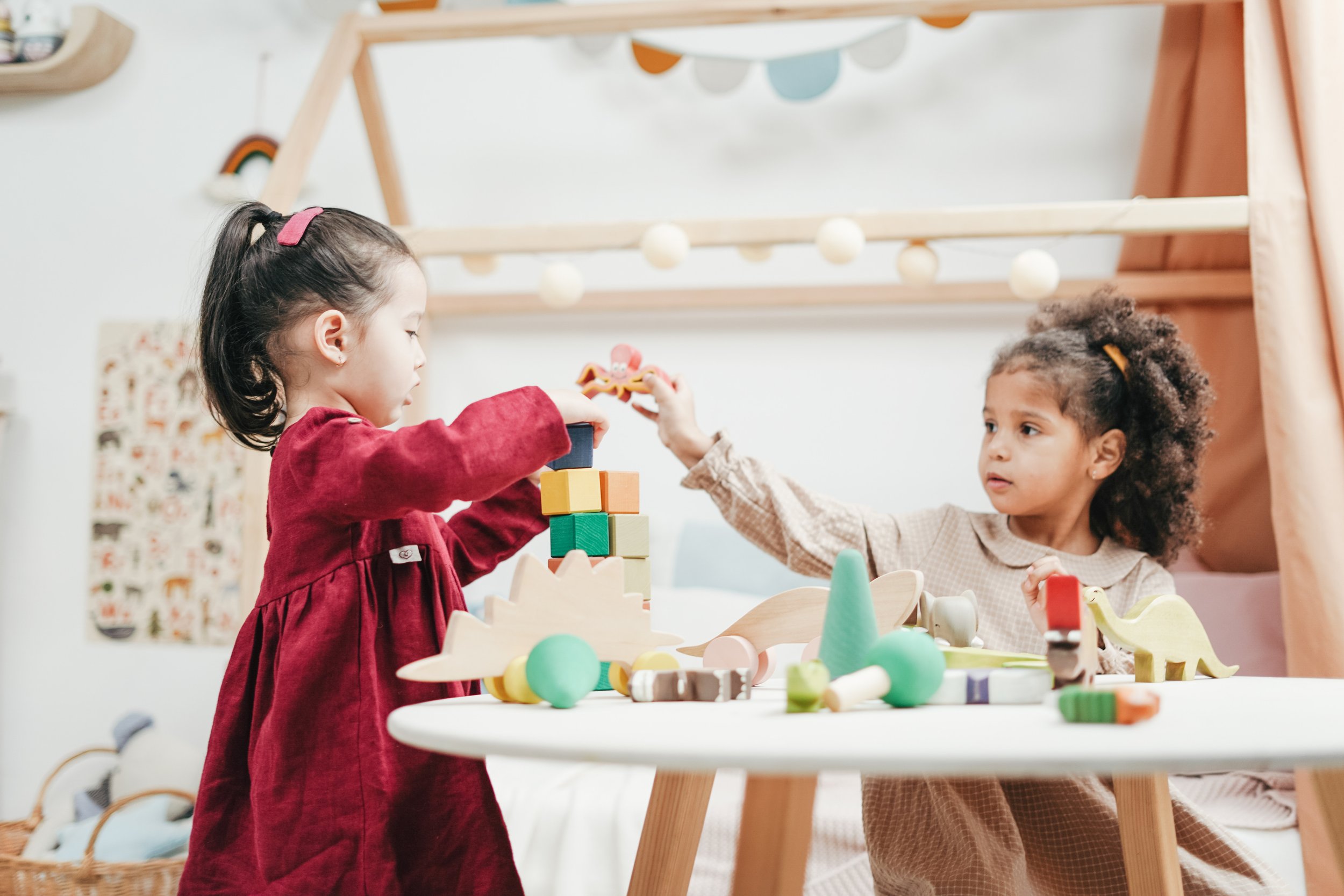
Children learn many valuable skills during the preschool years. They’re learning how to communicate with and listen to others and how to follow directions. They’re developing fine and gross motor skills, and engaging with other children in cooperative play.
The point of preschool is to teach children important skills that will lay the groundwork for their future success. Skills like reading, writing, school readiness, and social skills like how to cooperate with others are all explored in preschool.(1)
4 Types of Play in Early Childhood
Play is absolutely essential to your child’s learning and development!(18)
Preschoolers learn through fun and games! When children play, they are developing their cognitive, linguistic, physical, social and emotional skills.(18)
There Are Several Different Types of Play, but They Often Overlap(6)
1. Dramatic Play involves dressing up in costumes, playing pretend, and acting out stories. It helps children explore self-empowerment, make choices and express their feelings.(10)
2. Manipulative Play involves building something (e.g. with Legos), putting a puzzle together, or stringing beads to create a necklace.(6) It teaches children about sequencing, patterns, order, colors and textures, and how to make comparisons.(7) It also helps children to practice their decision-making skills, analyze and solve problems, and learn about cause and effect.(7)
3. Physical Play involves being physically active and developing gross motor skills. Preschoolers should get at least 3 hours of physical activity per day.(9)
4. Creative Play involves using art supplies to create while developing fine motor skills. Holding writing utensils takes strength and coordination! Through creative play, your child will practice holding writing utensils and writing their letters and their name.(1)
Play is so vital to early childhood development that sustained, moderate to severe play deprivation in childhood (between the ages of 0 and 10) has been shown to have serious negative consequences. (19) Depression, fragile and shallower relationships, reduced self-control, a propensity for addiction and difficulty adapting to change later in life are linked to play deprivation in the early years.(19)
2 Stages of Play: Cooperative Play vs. Associative Play
You may remember from this blog post that there are 6 stages of play. Preschoolers move from associative play into cooperative play between the ages of 4 and 6.(20)
Associative play, which is stage 5 of 6, is when children play with each other but aren’t working together to reach a common goal.(14) Cooperative play, the last and final stage, is when your child is interested not just in playing, but in cooperating with other children to accomplish a goal. There will likely be a division of labor, rules, assigned roles and organization as they work together toward that goal.(14)
So what does this look like in practice? It’s the difference between playing side by side in a sandbox, talking with other children while working on their own sandcastles (associative play), and working together to build one magnificent sandcastle (cooperative play).
Cooperative play is a learned skill requiring self-regulation and the ability to balance individual needs and wants with the needs and wants of the group.(14) Preschool is a great place for your child to practice and build his or her cooperative play skills.
Learning Happens Inside and Outside the Classroom
Literacy and Language Skills for Preschoolers
Have you ever noticed how your preschooler’s classroom is filled with simple images with the object name displayed? You might notice a bus icon, a cat, the sun, a ball — this is to help your child make connections between the object and the letters and words.(1) Every day your preschooler is becoming aware of letters, numbers, shapes and symbols. Whether they’re sitting on the alphabet rug for circle time, singing songs or reciting rhymes, your child’s literacy skills are growing.(1)
Math Skills for Preschoolers
Your preschooler is also practicing their basic math skills by learning to count, identify patterns, and group similar objects together. Older preschoolers will be able to answer questions like, “How many toy cars are on the floor?” and group objects that go together, like books or blocks. (13) To nurture counting skills, ask your preschooler questions like, “How many apple slices are on your plate?” or “How many steps is it from here to the car?” To grow their sorting skills, have your preschooler help you sort laundry, putting all the red clothes in a pile or matching each family member’s socks.(13)
Science Skills for Preschoolers
Science skills are also introduced at this age, and your preschooler is probably already a natural scientist, curious about the world and eager to explore. Encourage your child to interact with and learn about nature, ask questions and conduct experiments, and even talk with them about scientific concepts.
Cooking is a great example of how to incorporate scientific exploration into play. If you invite your child to help you bake something, let them practice skills like measuring and mixing ingredients.
Tricky Preschooler Behaviors
Preschool isn’t all fun and games. And preschoolers can present some challenging behaviors. This is to be expected! All preschoolers act out sometimes.
Tantrums
In a perfect world, the tantrums will have stopped by the time your child is 4-years-old. Typically, tantrums do decline with age. If your preschooler is having frequent tantrums, they have not quite learned how to cope with frustration and regulate their feelings.(17) Talk to your pediatrician if you suspect underlying causes of tantrums in your older child, such as a sensory processing issue, a speech delay or an underlying mental health disorder.(17)
Fighting
If you notice your child is about to start fighting with a sibling over a toy, try diverting their attention before the fighting starts, or offer choices so your children can proactively be involved in the decision-making of what happens next. (4)
Lying
If you catch your preschooler lying, you may be worried you’re raising a devious child. But the truth is — pun intended — that between the ages of 4 and 5, what’s real versus fantasy is still a bit blurry.(15) Preschoolers’ memories are short. Your child may have forgotten she’s done something wrong. Or she’s convinced herself she didn’t do the “bad” thing (like accidentally break mommy’s vase).(15)
Interested in Learning More?
Check out this podcast episode for more information on preschooler play, learning and behavior! We also talk about what to do if your child is potty trained but too shy to use the toilet at school and how to handle lying, bossiness, and playground aggression.
Equip yourself with knowledge and tools to help your child thrive. And be sure to subscribe to the Genius Little Minds podcast so you never miss an episode!
References
https://www.scholastic.com/parents/school-success/school-success-guides/guide-to-preschool.html
https://raisingchildren.net.au/preschoolers/behaviour/understanding-behaviour/preschooler-behaviour
https://www.first5california.com/en-us/articles/developmentally-appropriate-behavior-preschooler/
https://www.scholastic.com/parents/family-life/parent-child/preschool-struggles.html
https://childmind.org/article/can-help-kids-self-regulation/
https://www.wgu.edu/blog/dramatic-play-what-is-why-important2111.html#close
https://raisingchildren.net.au/preschoolers/play-learning/getting-play-started/preschoolers-at-play
https://rainforestlearningcentre.ca/teaching-useful-calendar-concepts-in-preschool-and-daycare/
https://www.kidcentraltn.com/development/4-5-years/brain-development--preschool-3-5-years.html
https://www.parentingforbrain.com/extreme-tantrums-in-4-year-olds/
https://www.psychologytoday.com/us/blog/optimized/202104/the-impact-play-deprivation

Early Childhood Development: Your Inquisitive and Active 4 Year Old
You may be excited to spend time with your four-year-old because they’re just so darn fun! Whether you’re doing art projects together, playing age-appropriate games, or enjoying outdoor pastimes like catch, you’ve noticed how active, chatty, and interested in the world your four-year-old is.

You may be excited to spend time with your four-year-old because they’re just so darn fun! Whether you’re doing art projects together, playing age-appropriate games, or enjoying outdoor pastimes like catch, you’ve noticed how active, chatty, and interested in the world your four-year-old is.
Early Childhood Development: Your 4 Year Old Preschooler and What to Expect
Vocabulary Development
You may have noticed that your child loves to talk! Some children are naturally chatty and enjoy having back-and-forth conversations or telling stories.(1) You might find your conversations are getting more interesting (and funny!) as well, as on average, a four-year-old will know roughly 1,500 words!(6) Your exchanges may include longer, more complicated and varied phrases, which is fun for both of you!
Motor Skills Development
As your child is growing, their motor skills are improving, so they can be more active than ever. Running, jumping and climbing might be favorite things to do at the playground or park! You may notice they’re using their hands when they talk, gesturing, or making noises to express themselves.(5) Skills like walking down steps, kicking a ball, playing catch, balancing on one foot, running and jumping have become easier.(5) Their fine motor skills, like cutting (with child-safe scissors) and writing their name, are also improving.(5)
Growing Curiosity About the Body
Your child is also likely asking endless questions, some which may make you uncomfortable. It’s normal and common for preschoolers to ask questions like, “Where do babies come from?” or ask about and touch their genital area.(1) Playing doctor with other children their age where they look at each other’s genitals might seem alarming to parents, but it’s developmentally normal.(1) (This should not happen with older children.) Facilitate your child’s learning in an age-appropriate way, like with a book on the body that’s written for pre-schoolers.(1)
As for tough questions about the body or topics you might deem inappropriate (like how babies are made), it’s important you answer their questions calmly and matter-of-factly.(1)
Early Childhood Development: 4-Year-Old Milestones
Social/Emotional Checklist(3)
Offers comfort when someone is sad or hurt
Enjoys being a “helper”
Wants to please and be like his or her friends(4)
Knows how to modify their behavior based on the situation (uses their “inside voice” in a place of worship or library, for example)
May be eagerly cooperative at times and demanding at other times(4)
Avoids danger
Asks to play with other children
Plays pretend
Has developed a sense of their gender identity(1)
Language/Communication Checklist(3)
Can answer simple questions such as “What is a lunch box for?”
Will share at least one thing that happened during the day such as, “I played with Jeremy”
Can string together a sentence of four or more words
Has back-and-forth conversations(2)
When they talk, a stranger can understand what they’re saying (most of the time)
Can sing along to a few words of a song, or memorize and recite a few words of a story or rhyme (2)
Knows between 1000 to 2000 words(2)
Movement and Physical Development Checklist(3)
Is able to hold a pencil or crayon between finger and thumb as opposed to a fist
Prints some letters(4)
Can copy geometric patterns, such as a triangle(4)
Can serve himself some food or water with adult supervision
Is able to unbutton some buttons on clothing and catch a large ball the majority of the time
Swings, climbs, hops, somersaults, and can stand on one foot for 10 seconds or longer(4)
Cognitive Checklist(3)
Follows multi-step directions (for example, when instructed, is able to pick up their toys, put them away in their toy bin, and pick out a book to read together)(2)
Can draw a person with three or more body parts
Is able to identify colors, shapes, numbers, and letters (2)
Can count to ten(4)
Can recall big parts of a simple story they’re told or read(2)
Knows what comes next in a story they know well
Can make predictions about what comes next in an unfamiliar story(2)
Is beginning to understand the concept of time(2)
Has a vivid imagination(2)
What You Can Do to Encourage Healthy Development in Your 4-Year-Old
Make Time for Play
Preschoolers learn so much through fun and games. Check out this blog post on the different types of play in early childhood and how they encourage your preschooler’s development! Play deprivation in early childhood has been linked to depression, reduced self-control, shallower and more fragile relationships, a propensity for addiction, and difficulty adapting to change later in life.(7) I can’t stress enough how vital play is to your child’s well being! Making time for arts and crafts, dress-up, dancing, imaginary play or outdoor play has tremendous benefits for your child.
Be Active Together
Preschoolers should spend at least 3 hours a day doing some kind of physical activity.(8) Yes, three hours! It may sound like a lot, but your four-year-old needs to burn all their pent up energy and grow their muscle strength! Playing on the playground, running in the backyard or at the park, or playing children’s games like “Duck, Duck, Goose” are great ways to bond with your child and help them (and you!) be active.
Know When to React Neutrally
Is your preschooler talking about having a “boyfriend” or a “girlfriend” at school? This might seem alarming to parents, but it’s developmentally normal.(1) Preschoolers don’t attach the same meaning to “boyfriend” or “girlfriend” that adults do, so it’s best to react to these types of declarations in a neutral way (not encouraging it but not showing concern, either).
Remember Their Development Stage
There are many wonderful things about preschoolers. But they can also be demanding, selfish, moody, and try your patience (regularly!). Remember that you’re not alone if your child exerts independence in ways that are frustrating, fights with siblings, has difficult habits (like food refusal) or behaves aggressively toward family members when they’re being moody.(9)
Every Stage Comes With Joys and Challenges
Each step of the way, you have the opportunity to help your child learn and grow. Subscribe to my newsletter for more helpful parenting tips, and don’t miss the other blogs in the infant and early childhood development series!
References