
Is My Child Learning in Preschool? Yes, Your Child is Learning When They Play
Children learn many valuable skills during the preschool years. They’re learning how to communicate with and listen to others and how to follow directions. They’re developing fine and gross motor skills, and engaging with other children in cooperative play.
The point of preschool is to teach children important skills that will lay the groundwork for their future success. Skills like reading, writing, school readiness, and social skills like how to cooperate with others are all explored in preschool.(1)
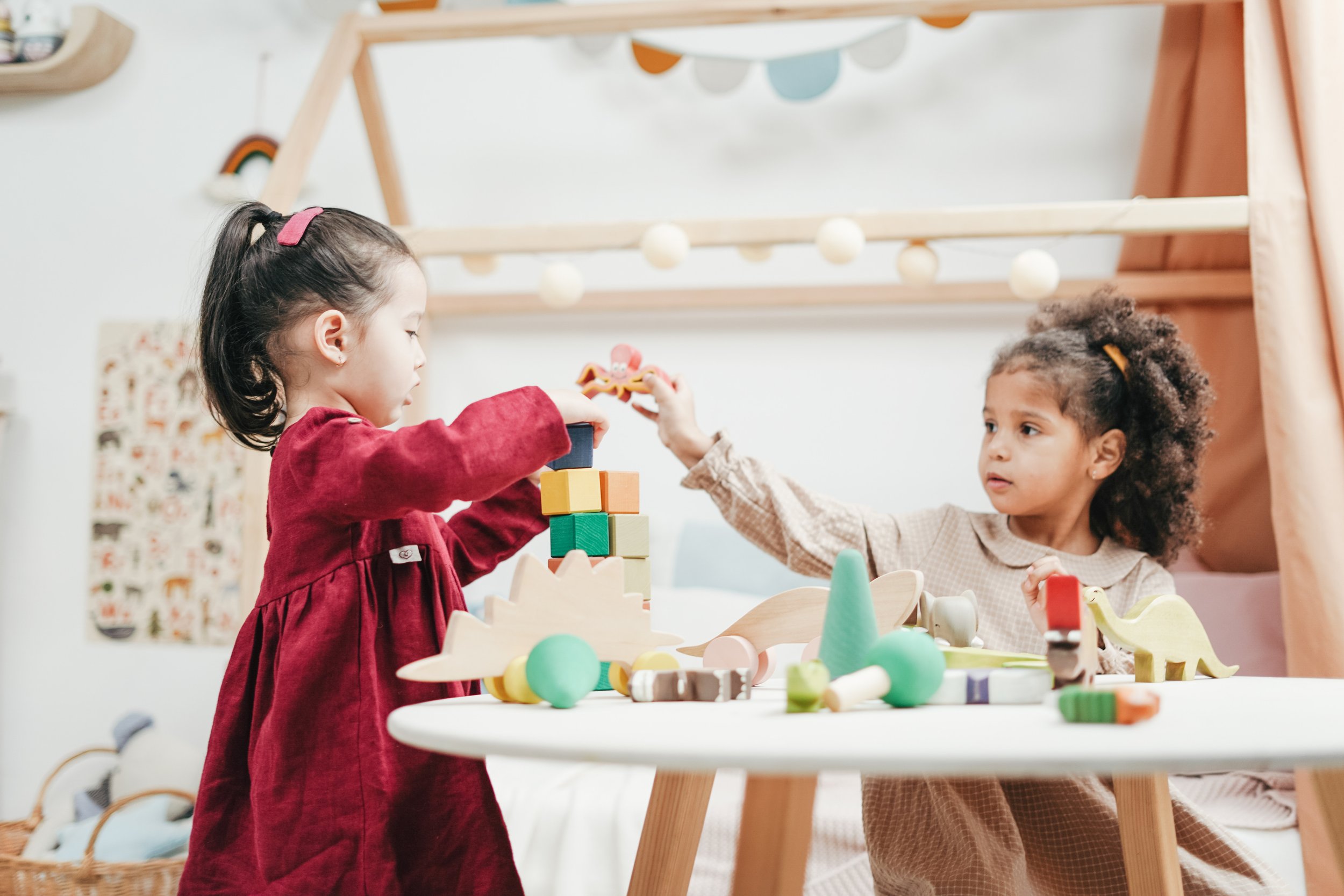
Children learn many valuable skills during the preschool years. They’re learning how to communicate with and listen to others and how to follow directions. They’re developing fine and gross motor skills, and engaging with other children in cooperative play.
The point of preschool is to teach children important skills that will lay the groundwork for their future success. Skills like reading, writing, school readiness, and social skills like how to cooperate with others are all explored in preschool.(1)
4 Types of Play in Early Childhood
Play is absolutely essential to your child’s learning and development!(18)
Preschoolers learn through fun and games! When children play, they are developing their cognitive, linguistic, physical, social and emotional skills.(18)
There Are Several Different Types of Play, but They Often Overlap(6)
1. Dramatic Play involves dressing up in costumes, playing pretend, and acting out stories. It helps children explore self-empowerment, make choices and express their feelings.(10)
2. Manipulative Play involves building something (e.g. with Legos), putting a puzzle together, or stringing beads to create a necklace.(6) It teaches children about sequencing, patterns, order, colors and textures, and how to make comparisons.(7) It also helps children to practice their decision-making skills, analyze and solve problems, and learn about cause and effect.(7)
3. Physical Play involves being physically active and developing gross motor skills. Preschoolers should get at least 3 hours of physical activity per day.(9)
4. Creative Play involves using art supplies to create while developing fine motor skills. Holding writing utensils takes strength and coordination! Through creative play, your child will practice holding writing utensils and writing their letters and their name.(1)
Play is so vital to early childhood development that sustained, moderate to severe play deprivation in childhood (between the ages of 0 and 10) has been shown to have serious negative consequences. (19) Depression, fragile and shallower relationships, reduced self-control, a propensity for addiction and difficulty adapting to change later in life are linked to play deprivation in the early years.(19)
2 Stages of Play: Cooperative Play vs. Associative Play
You may remember from this blog post that there are 6 stages of play. Preschoolers move from associative play into cooperative play between the ages of 4 and 6.(20)
Associative play, which is stage 5 of 6, is when children play with each other but aren’t working together to reach a common goal.(14) Cooperative play, the last and final stage, is when your child is interested not just in playing, but in cooperating with other children to accomplish a goal. There will likely be a division of labor, rules, assigned roles and organization as they work together toward that goal.(14)
So what does this look like in practice? It’s the difference between playing side by side in a sandbox, talking with other children while working on their own sandcastles (associative play), and working together to build one magnificent sandcastle (cooperative play).
Cooperative play is a learned skill requiring self-regulation and the ability to balance individual needs and wants with the needs and wants of the group.(14) Preschool is a great place for your child to practice and build his or her cooperative play skills.
Learning Happens Inside and Outside the Classroom
Literacy and Language Skills for Preschoolers
Have you ever noticed how your preschooler’s classroom is filled with simple images with the object name displayed? You might notice a bus icon, a cat, the sun, a ball — this is to help your child make connections between the object and the letters and words.(1) Every day your preschooler is becoming aware of letters, numbers, shapes and symbols. Whether they’re sitting on the alphabet rug for circle time, singing songs or reciting rhymes, your child’s literacy skills are growing.(1)
Math Skills for Preschoolers
Your preschooler is also practicing their basic math skills by learning to count, identify patterns, and group similar objects together. Older preschoolers will be able to answer questions like, “How many toy cars are on the floor?” and group objects that go together, like books or blocks. (13) To nurture counting skills, ask your preschooler questions like, “How many apple slices are on your plate?” or “How many steps is it from here to the car?” To grow their sorting skills, have your preschooler help you sort laundry, putting all the red clothes in a pile or matching each family member’s socks.(13)
Science Skills for Preschoolers
Science skills are also introduced at this age, and your preschooler is probably already a natural scientist, curious about the world and eager to explore. Encourage your child to interact with and learn about nature, ask questions and conduct experiments, and even talk with them about scientific concepts.
Cooking is a great example of how to incorporate scientific exploration into play. If you invite your child to help you bake something, let them practice skills like measuring and mixing ingredients.
Tricky Preschooler Behaviors
Preschool isn’t all fun and games. And preschoolers can present some challenging behaviors. This is to be expected! All preschoolers act out sometimes.
Tantrums
In a perfect world, the tantrums will have stopped by the time your child is 4-years-old. Typically, tantrums do decline with age. If your preschooler is having frequent tantrums, they have not quite learned how to cope with frustration and regulate their feelings.(17) Talk to your pediatrician if you suspect underlying causes of tantrums in your older child, such as a sensory processing issue, a speech delay or an underlying mental health disorder.(17)
Fighting
If you notice your child is about to start fighting with a sibling over a toy, try diverting their attention before the fighting starts, or offer choices so your children can proactively be involved in the decision-making of what happens next. (4)
Lying
If you catch your preschooler lying, you may be worried you’re raising a devious child. But the truth is — pun intended — that between the ages of 4 and 5, what’s real versus fantasy is still a bit blurry.(15) Preschoolers’ memories are short. Your child may have forgotten she’s done something wrong. Or she’s convinced herself she didn’t do the “bad” thing (like accidentally break mommy’s vase).(15)
Interested in Learning More?
Check out this podcast episode for more information on preschooler play, learning and behavior! We also talk about what to do if your child is potty trained but too shy to use the toilet at school and how to handle lying, bossiness, and playground aggression.
Equip yourself with knowledge and tools to help your child thrive. And be sure to subscribe to the Genius Little Minds podcast so you never miss an episode!
References
https://www.scholastic.com/parents/school-success/school-success-guides/guide-to-preschool.html
https://raisingchildren.net.au/preschoolers/behaviour/understanding-behaviour/preschooler-behaviour
https://www.first5california.com/en-us/articles/developmentally-appropriate-behavior-preschooler/
https://www.scholastic.com/parents/family-life/parent-child/preschool-struggles.html
https://childmind.org/article/can-help-kids-self-regulation/
https://www.wgu.edu/blog/dramatic-play-what-is-why-important2111.html#close
https://raisingchildren.net.au/preschoolers/play-learning/getting-play-started/preschoolers-at-play
https://rainforestlearningcentre.ca/teaching-useful-calendar-concepts-in-preschool-and-daycare/
https://www.kidcentraltn.com/development/4-5-years/brain-development--preschool-3-5-years.html
https://www.parentingforbrain.com/extreme-tantrums-in-4-year-olds/
https://www.psychologytoday.com/us/blog/optimized/202104/the-impact-play-deprivation

Stages of Play: Funny Things Toddlers Do That Are Actually Play Schemas
Have you ever wondered about the funny things toddlers do?
Maybe you’ve chuckled because your toddler carries rocks around in her purse or insists on playing with a potato instead of other children.
What looks like plain old silliness to you is actually the exploration of play schemas!
Play is how your child learns.(1) And it’s so important for healthy brain development that it’s actually been recognized as a basic human right all children should have access to by the United Nations Office of the High Commissioner for Human Rights.(2)

Have you ever wondered about the funny things toddlers do?
Maybe you’ve chuckled because your toddler carries rocks around in her purse or insists on playing with a potato instead of other children.
What looks like plain old silliness to you is actually the exploration of play schemas!
Play is how your child learns.(1) And it’s so important for healthy brain development that it’s actually been recognized as a basic human right all children should have access to by the United Nations Office of the High Commissioner for Human Rights (2)
That’s right – play has been deemed a right that all children should have access to in addition to rest, leisure, and love.(2)
Parten’s 6 Stages of Play
Children actually progress through 6 stages of play development during early childhood.(3)
These 6 stages are defined as follows:
1. Unoccupied Play (0-3 months)
This is when your baby learns how their body moves and explores the things around them.(3)
2. Solitary Play (0 – 2 years)
In solitary play, your child entertains himself by playing alone. He’s not interested in playing with others just yet.
3. Onlooker or Spectator Play (2 years)
If your toddler is content to just watch other children play at the park, she’s engaging in onlooker play.
4. Parallel Play (2+ years)
This is when children play beside each other but aren’t yet playing with each other.
5. Associative Play (3-4 years)
Your child is (finally!) showing an interest in playing with peers, indicating a significant shift in their development.
6. Cooperative Play (4+ years)
Cooperative play involves playing with others and working toward a common objective or purpose, like building a snowman or finishing a puzzle together.(5)
Each play stage has different benefits. Listen to this podcast episode for more information!
Toddlers and Sharing
Sharing is a big concern parents have. No one wants to raise the most selfish kid on the playground! But sharing is a skill that must be learned. Most children don’t develop this skill until they are 3 and a half or four years old.(6) So please don’t expect your young toddler to know how to share!
You can teach your older toddler to share by modeling it. Play cooperative games together and do things together that require taking turns.(7) Walk your toddler through the steps by saying things like, “It’s your turn to place a block on the tower, then it’s my turn to place a block. Then it’s your turn again! When we share the blocks, we both get to have fun.”
Practice, practice, practice, and don’t forget to be patient – with both yourself and your kiddo.
Types of Schemas in Play
Your toddler probably engages in some pretty funny, frustrating, and undesirable behaviors. When they do things that drive you mad – like repeatedly throwing food off of their high chair, for example -- you may think they’re just misbehaving or being “bad” when really, they’re exploring a play schema.
Trajectory
When you’re trying to serve your family dinner, it can be hard to share your toddler’s enthusiasm for throwing food all over the floor. Understandably so! But your toddler is curious about how things fall, wondering if their pasta will bounce, smash, or splatter when it drops. So what seems like a misbehavior on the surface is actually them engaging in what’s called the trajectory schema. They’re learning all about how objects fall and move.
Try This: Toss colorful scarves up in the air
Connecting
Does your toddler love Lincoln Logs or laying train tracks? In the connecting schema, your child is learning all about how things tie together or connect.
Try This: Make paper chains
Transporting
If your toddler is constantly carrying odd things around the house… a bag of rice, dirty socks, a potato… (I’ve heard it all!) they’re exploring the transportation schema.
Try This: Have them help by carrying (light and unbreakable!) groceries into the house
Positioning
In the positioning schema, your child is learning how to line things up and put them in groups. If your child is arranging his toy cars by color and size, he’s exploring this schema.
Try This: Line up leaves you find at the park
Enveloping
Children explore the enveloping schema by wrapping things – or themselves – up! So if your child enjoys wrapping toys up in blankets or covering himself in cream, you know what schema he’s exploring through play.
Try This: Wrap up a doll or teddy bear in bandages while playing doctor
Enclosing
This schema is all about creating boundaries and containing things within a defined space. If your child enjoys playing inside boxes or filling cups with water during bath time, they’re likely exploring this schema.
Try This: Color inside a shoebox or cardboard box
Rotation
If your child is obsessed with rolling around on the floor or being swung around, then they’ve discovered the rotation schema.
Try This: Turn keys in locks
Orientation
The world is so fascinating from different angles! Your toddler may want to sit on your shoulders, stand on a chair, or look at the world upside down when exploring this schema.
Try This: Toddler gymnastics
Transforming
If your toddler is fascinated by smashing Play Doh or watching ice melt, then the transforming schema has captured your toddler’s attention! They’re exploring how materials change, like going from a solid to a liquid and back to a solid again. Enjoy their curiosity while it lasts!
Try This: Add food coloring to water
Messy Play for Toddlers
It’s important for toddlers to explore with their senses! Research shows that motor and visual skills in early childhood are related to math and language skills as a child grows up.(7) So simple activities that build fine and gross motor skills are important.
Create a defined messy play area for your toddler so they know what’s okay and what isn’t. For example, you set out a tarp with supplies to signal the beginning of messy play. When it’s time for the tarp and supplies to be put away, messy play ends.(7) An organized environment makes messy play safer and sets up appropriate expectations for your toddler.
You may be thinking, “My child hates getting dirty! Messy play sounds like an absolute nightmare!” Some children are more sensitive to sensory input than others and don’t enjoy messy play.(7) And that’s OK! Every toddler is different and has different tolerance levels. Support your children in their exploration. Don’t force sensory play with textures they don’t enjoy.
Your toddler may prefer messy play that doesn’t make their hands wet, for example, so playing with loose papers or other textured materials that aren’t sticky will be more enjoyable for them.(7) Even walking barefoot in the grass or playing in a sandbox can be a wonderful sensory experience! It doesn’t have to be complicated to be impactful.
Try This: Make a dry sensory box with felt, feathers, grass, pom poms, or any other safe materials that interest your child.
Don’t Forget to Have Fun!
Remember, your little one won’t be little forever. Cherish these memories. Slow down your day. Marvel with your toddler at all the amazing, beautiful things life has to offer.
Interested in Learning More?
Check out this podcast episode for more information on toddler play! Learn more in-depth information about the stages of play and the seemingly odd ways your toddler may be exploring play schemas. Get even more ideas for sensory play that doesn’t involve food (to reduce food waste), and what to do if your toddler refuses to play outside — or with other kids.
Equip yourself with knowledge and tools to help your child thrive. And be sure to subscribe to the Genius Little Minds podcast so you never miss an episode!
References
https://educate.bankstreet.edu/cgi/viewcontent.cgi?article=1006&context=faculty-staff
https://www.ohchr.org/en/instruments-mechanisms/instruments/convention-rights-child
https://pathways.org/kids-learn-play-6-stages-play-development/
https://www.healthline.com/health/childrens-health/cooperative-play
https://www.zerotothree.org/resources/1964-helping-young-children-with-sharing
https://eclkc.ohs.acf.hhs.gov/publication/designing-messy-play-infants-toddlers