

Is My Child Learning in Preschool? Yes, Your Child is Learning When They Play
Children learn many valuable skills during the preschool years. They’re learning how to communicate with and listen to others and how to follow directions. They’re developing fine and gross motor skills, and engaging with other children in cooperative play.
The point of preschool is to teach children important skills that will lay the groundwork for their future success. Skills like reading, writing, school readiness, and social skills like how to cooperate with others are all explored in preschool.(1)
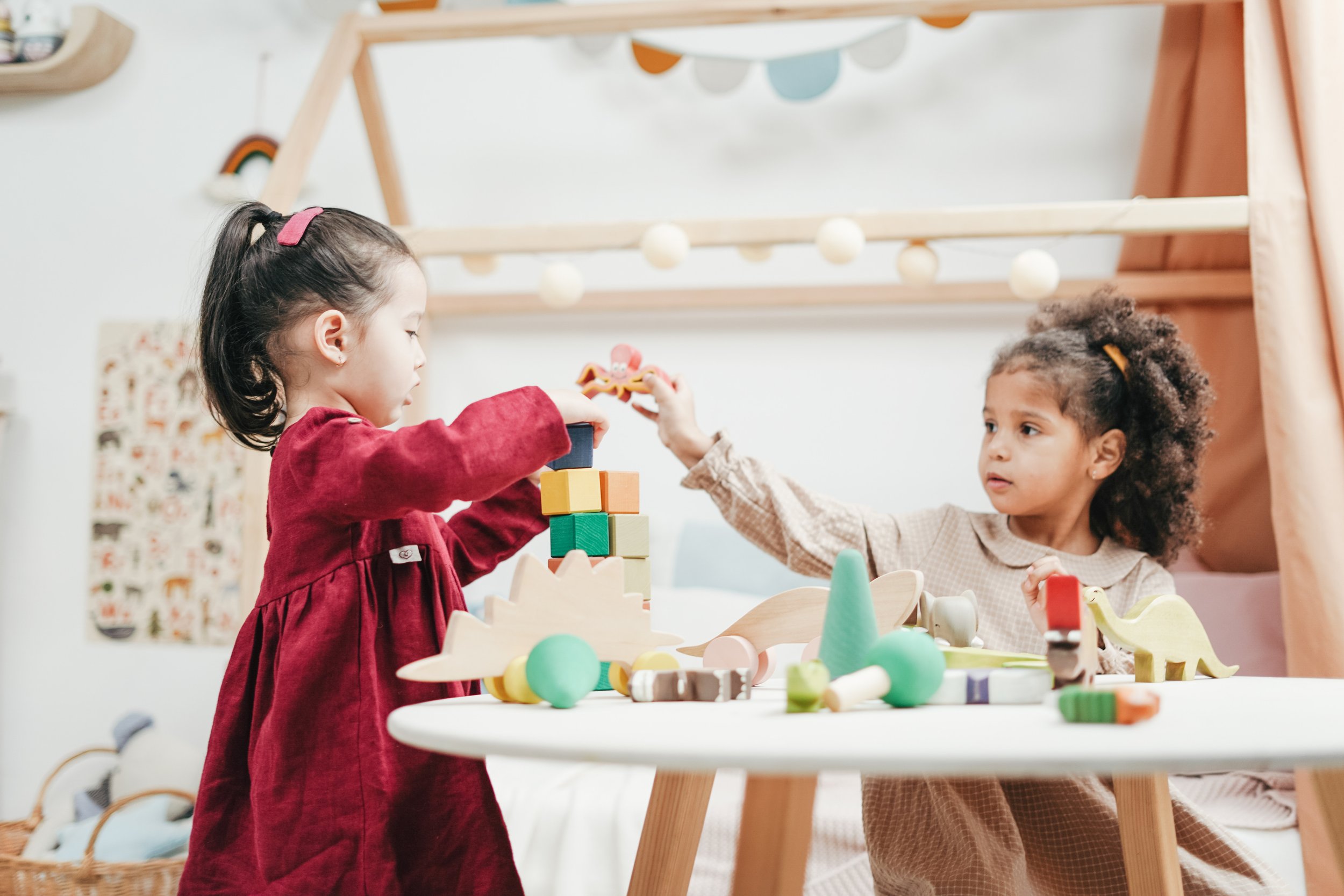
Children learn many valuable skills during the preschool years. They’re learning how to communicate with and listen to others and how to follow directions. They’re developing fine and gross motor skills, and engaging with other children in cooperative play.
The point of preschool is to teach children important skills that will lay the groundwork for their future success. Skills like reading, writing, school readiness, and social skills like how to cooperate with others are all explored in preschool.(1)
4 Types of Play in Early Childhood
Play is absolutely essential to your child’s learning and development!(18)
Preschoolers learn through fun and games! When children play, they are developing their cognitive, linguistic, physical, social and emotional skills.(18)
There Are Several Different Types of Play, but They Often Overlap(6)
1. Dramatic Play involves dressing up in costumes, playing pretend, and acting out stories. It helps children explore self-empowerment, make choices and express their feelings.(10)
2. Manipulative Play involves building something (e.g. with Legos), putting a puzzle together, or stringing beads to create a necklace.(6) It teaches children about sequencing, patterns, order, colors and textures, and how to make comparisons.(7) It also helps children to practice their decision-making skills, analyze and solve problems, and learn about cause and effect.(7)
3. Physical Play involves being physically active and developing gross motor skills. Preschoolers should get at least 3 hours of physical activity per day.(9)
4. Creative Play involves using art supplies to create while developing fine motor skills. Holding writing utensils takes strength and coordination! Through creative play, your child will practice holding writing utensils and writing their letters and their name.(1)
Play is so vital to early childhood development that sustained, moderate to severe play deprivation in childhood (between the ages of 0 and 10) has been shown to have serious negative consequences. (19) Depression, fragile and shallower relationships, reduced self-control, a propensity for addiction and difficulty adapting to change later in life are linked to play deprivation in the early years.(19)
2 Stages of Play: Cooperative Play vs. Associative Play
You may remember from this blog post that there are 6 stages of play. Preschoolers move from associative play into cooperative play between the ages of 4 and 6.(20)
Associative play, which is stage 5 of 6, is when children play with each other but aren’t working together to reach a common goal.(14) Cooperative play, the last and final stage, is when your child is interested not just in playing, but in cooperating with other children to accomplish a goal. There will likely be a division of labor, rules, assigned roles and organization as they work together toward that goal.(14)
So what does this look like in practice? It’s the difference between playing side by side in a sandbox, talking with other children while working on their own sandcastles (associative play), and working together to build one magnificent sandcastle (cooperative play).
Cooperative play is a learned skill requiring self-regulation and the ability to balance individual needs and wants with the needs and wants of the group.(14) Preschool is a great place for your child to practice and build his or her cooperative play skills.
Learning Happens Inside and Outside the Classroom
Literacy and Language Skills for Preschoolers
Have you ever noticed how your preschooler’s classroom is filled with simple images with the object name displayed? You might notice a bus icon, a cat, the sun, a ball — this is to help your child make connections between the object and the letters and words.(1) Every day your preschooler is becoming aware of letters, numbers, shapes and symbols. Whether they’re sitting on the alphabet rug for circle time, singing songs or reciting rhymes, your child’s literacy skills are growing.(1)
Math Skills for Preschoolers
Your preschooler is also practicing their basic math skills by learning to count, identify patterns, and group similar objects together. Older preschoolers will be able to answer questions like, “How many toy cars are on the floor?” and group objects that go together, like books or blocks. (13) To nurture counting skills, ask your preschooler questions like, “How many apple slices are on your plate?” or “How many steps is it from here to the car?” To grow their sorting skills, have your preschooler help you sort laundry, putting all the red clothes in a pile or matching each family member’s socks.(13)
Science Skills for Preschoolers
Science skills are also introduced at this age, and your preschooler is probably already a natural scientist, curious about the world and eager to explore. Encourage your child to interact with and learn about nature, ask questions and conduct experiments, and even talk with them about scientific concepts.
Cooking is a great example of how to incorporate scientific exploration into play. If you invite your child to help you bake something, let them practice skills like measuring and mixing ingredients.
Tricky Preschooler Behaviors
Preschool isn’t all fun and games. And preschoolers can present some challenging behaviors. This is to be expected! All preschoolers act out sometimes.
Tantrums
In a perfect world, the tantrums will have stopped by the time your child is 4-years-old. Typically, tantrums do decline with age. If your preschooler is having frequent tantrums, they have not quite learned how to cope with frustration and regulate their feelings.(17) Talk to your pediatrician if you suspect underlying causes of tantrums in your older child, such as a sensory processing issue, a speech delay or an underlying mental health disorder.(17)
Fighting
If you notice your child is about to start fighting with a sibling over a toy, try diverting their attention before the fighting starts, or offer choices so your children can proactively be involved in the decision-making of what happens next. (4)
Lying
If you catch your preschooler lying, you may be worried you’re raising a devious child. But the truth is — pun intended — that between the ages of 4 and 5, what’s real versus fantasy is still a bit blurry.(15) Preschoolers’ memories are short. Your child may have forgotten she’s done something wrong. Or she’s convinced herself she didn’t do the “bad” thing (like accidentally break mommy’s vase).(15)
Interested in Learning More?
Check out this podcast episode for more information on preschooler play, learning and behavior! We also talk about what to do if your child is potty trained but too shy to use the toilet at school and how to handle lying, bossiness, and playground aggression.
Equip yourself with knowledge and tools to help your child thrive. And be sure to subscribe to the Genius Little Minds podcast so you never miss an episode!
References
https://www.scholastic.com/parents/school-success/school-success-guides/guide-to-preschool.html
https://raisingchildren.net.au/preschoolers/behaviour/understanding-behaviour/preschooler-behaviour
https://www.first5california.com/en-us/articles/developmentally-appropriate-behavior-preschooler/
https://www.scholastic.com/parents/family-life/parent-child/preschool-struggles.html
https://childmind.org/article/can-help-kids-self-regulation/
https://www.wgu.edu/blog/dramatic-play-what-is-why-important2111.html#close
https://raisingchildren.net.au/preschoolers/play-learning/getting-play-started/preschoolers-at-play
https://rainforestlearningcentre.ca/teaching-useful-calendar-concepts-in-preschool-and-daycare/
https://www.kidcentraltn.com/development/4-5-years/brain-development--preschool-3-5-years.html
https://www.parentingforbrain.com/extreme-tantrums-in-4-year-olds/
https://www.psychologytoday.com/us/blog/optimized/202104/the-impact-play-deprivation

How to Maintain Structure and Stimulation Throughout Summer Break: 3 Practical Ideas
School is out for the summer, and you are ready to have some fun!
However, all of the extra hours spent at home with your kids can quickly lead to boredom and unwanted behaviors. Your child’s environment and schedule have changed overnight, and this can be triggering for many children.
So how do you start off the summer on the right foot and manage to keep everyone happy all summer long? I’ve got three practical tips for you!

School is out for the summer, and you are ready to have some fun!
However, all of the extra hours spent at home with your kids can quickly lead to boredom and unwanted behaviors. Your child’s environment and schedule have changed overnight, and this can be triggering for many children.
So how do you start off the summer on the right foot and manage to keep everyone happy all summer long? I’ve got three practical tips for you!
Create a Schedule as a Family
Before summer starts, sit down as a family and set expectations for the summer. Ask your children what they are interested in doing and what events they have scheduled throughout the summer. Let them know what you have planned for the family to do. Communication is key to success here.
Then, outline what a typical day will look like. When will everyone wake up? When will meals be served? What activities will fill all the time in between?
Try to include time for:
Reading - Encourage your children to read fun and educational books. Challenge them to read about a new interest or in a new genre.
Creative Expression - Not all children enjoy arts and crafts to the same extent, but creativity is a valuable skill that needs to be practiced.(1) If you do structured craft activities, try to incorporate your child’s interests into the project to get them more excited about it.
Educational activities - This does not necessarily have to be worksheets! Younger children could practice writing letters with a stick in the dirt outside. Older children could practice counting the change you spend at the restaurant. Opportunities for learning are everywhere!
Chores - Make them age-appropriate and consistent to involve your child in the upkeep of their room and home throughout the summer.
Physical exercise(2) - Hopefully, some of this physical exercise can happen outdoors. If the weather where you live does not allow for this, look for gross motor activities they can do at home or search your local area for indoor playgrounds or gyms.
Rest or a nap - Depending on the age of your child, make sure that they are getting enough sleep. Even if they are too old for a nap, try to encourage them to have quiet time each day. This gives them a chance to rest and recharge.
If possible, make it visual. Children do better with transitions and expectations if they can visually see what is expected of them.(3)
Some ideas for a visual include repurposing an old clock to show what activities correspond with each hour of the day. Or you can make a chart that has a box for each activity with the time that it starts and ends.
Try involving your child in the making of this visual aid. If they are younger, they could simply color in the boxes or draw a few doodles in one corner. If they’re a bit older, they could help write the labels or figure out how long will be needed for each activity.
The more involved and included your children feel in making the schedule, the more likely they are to be more willing participants in it.
Stick to Regular Times for Meals and Bed
It’s easy to let all the fun activities and adventures of summer throw off the timing of meals and bed.
While this is fine to do sometimes, it’s best to not make it a regular occurrence. A hungry or tired child can be cranky and irritable; exactly the opposite of what you want on your summer adventures.
When your family is at home, have a set time that everyone wakes up and a set time for bed. Even if your child is awake before that time, let them know that they need to stay in their room and do something quiet. This allows everyone in your home the opportunity to get the sleep they need.(4)
Having set times each day for meals serves two purposes. It helps your child not get overly hungry, but it also prevents excessive snacking. We still want our kids to eat nutritious, well-balanced meals, even when they have access to the kitchen all day long.
Children are used to having a set time to eat at school. Their little bodies will benefit from continued regularity in their eating schedule.
Remember that your schedule does not have to hold your family back from having fun experiences and visiting exciting places even if these adventures can’t logistically fit exactly into your schedule. That’s okay!
If your child’s schedule is going to be thrown off, prepare for it ahead of time. If dinner is going to be served late, bring some snacks along. If bedtime is going to be pushed back an hour, plan for extra rest time the next day.
Get Out and About!
Getting out of the house and exploring can be fun no matter the age of your children! It also gives them the chance to continue to learn through the summer.
Great places to visit could be the zoo or aquarium to learn about animals. You could also visit your local parks so your children can work on their gross motor skills and get some much-needed physical exercise. Wilderness camps or clubs can also be a fun outlet for exercise and to give your child a place for social interaction.
Visit your local library often to keep your kids reading throughout the summer months. Consider encouraging your children to complete a reading challenge like reading 20 books over the summer or reading one book from each major genre. Ask your local librarian if there are story times or reading clubs that your children can participate in.
These are just a few ideas that you and your children might find fun to do together. Check your local newspaper or online to see what other events may be uniquely offered in your community.
Summer should be a time for fun and bonding with our children. With the right structure and expectations in place, this summer will be one your family will never forget!
For more tips on parenting and childhood mental health, subscribe to my newsletter or check out my podcast.
References
https://nido.edu.au/news/why-creative-expression-is-so-important-for-children/
Chaddock-Heyman, L., Hillman, C.H., Cohen, N.J. and Kramer, A.F. (2014), III. THE IMPORTANCE OF PHYSICAL ACTIVITY AND AEROBIC FITNESS FOR COGNITIVE CONTROL AND MEMORY IN CHILDREN. Monographs Society Res Child, 79: 25-50. https://doi.org/10.1111/mono.12129
https://classroom.synonym.com/benefits-visual-aids-5040418.html

Toddler Development: The Amazing Things Your 13 to 15 Month Old Can Do!
Toddler Development: Your Toddler From 13 to 15 Months
You made it through your baby’s first year! Way to go. Give yourself a pat on the back and kick up your feet.
Don’t take a rest for too long, though — you have a toddler now, and they’ll surely keep you on your toes!
You’re probably eagerly awaiting the day when your child takes their first unsupported steps — so grab the camera because between 13 and 15 months, that milestone will likely be reached, as well as many others.

Toddler Development: Your Toddler From 13 to 15 Months
You made it through your baby’s first year! Way to go. Give yourself a pat on the back and kick up your feet.
Don’t take a rest for too long, though — you have a toddler now, and they’ll surely keep you on your toes!
You’re probably eagerly awaiting the day when your child takes their first unsupported steps — so grab the camera because between 13 and 15 months, that milestone will likely be reached, as well as many others.
Walking
All children develop at their own pace, but with toddlerhood comes the exciting milestone of learning to walk! Many children take their first independent steps around 14 months.(1) Before a baby can walk, they need the coordination and muscle strength to pull themselves up to a standing position and then stay standing, either by holding onto furniture or a caregiver.(2) Babies will pull themselves up to stand about 2 to 4 months before they take their first unsupported steps.(2)
When learning to walk, your toddler might fall down a lot! And that’s okay. Perfecting their strut doesn’t happen all at once, so prepare for your baby to fall down or start and stop frequently as they’re learning.(3)
Talking
By this age, your toddler may be able to say two to four words.(6) And you may start hearing them over and over again! (Though it might be “ba” for ball, not the full word yet!) Your toddler will also make lots of babbling sounds and respond to their name. As she learns more and more words, your toddler will learn what it means when you say things like, “Where is your truck?” And then she’ll go look for it. Songs and rhymes will also continue to delight your toddler. And even though she may not know the word for something, if she wants it, she’ll point to it to ask for it.(6)
Personality Grows as Your Toddler Discovers Her Independence
With toddlerhood comes an emerging personality! So your toddler will likely be pretty vocal about their likes and dislikes — and you can expect some tantrums to emerge at this age. Toddlers experience frustration because they aren’t able to adequately communicate how they feel or what they want from adults.(8) You can imagine how frustrating that must be! So try to exercise patience and be compassionate toward your toddler.
Some more fun parts of your toddler’s personality will start to emerge as well, like a sense of humor. Your child may start to find lots of things really funny! So enjoy the ups and downs of the journey and find the humor where you can, too.
As your little angel grows, so will her independence and sense of self.(9) You may even find your toddler tries to help you dress her by holding out an arm or leg as you do so.(9)
Toddler Development: Milestones From 13 to 15 Months
While every child develops differently, there are a few milestones to look out for at this age.
Here are some things your child will likely do when they’re between 13 to 15 months old:
Social/Emotional Checklist(7):
Shows affection to parent or caregiver (hugs, kisses, cuddles)
Hugs stuffed animals or dolls
Claps hands together when excited
Shows you something they like, such as a toy or object
Copies other children during play
Language/Communication Checklist(7):
Attempts to say words besides “mama” or “dada”
Points to things as a way to ask for them or receive help
Follows directions when they are given with a gesture and words
Looks at/for a familiar object when you say its name
Reaches for you when they want to be picked up(8)
Movement and Physical Development Checklist(7):
Attempts to use things properly (like a phone)
Stacks small objects, like blocks, two or more at a time
Cognitive Checklist(7):
Feeds herself food by using her fingers
Walks (at least a few steps) independently
What You Can Do to Encourage Healthy Development in Your 13 to 15 Month Old
Narrate Your Day
Even though your young toddler isn’t capable of having full blown conversations just yet, the more you talk to them, the more words they’ll be exposed to and encouraged to pick up. By talking to your toddler, you’re helping develop their language skills.(4) Generally toddlers understand more than what they can communicate on their own.(4)
Choose Toys Wisely
By this age, your toddler can pick things up with his finger and thumb.(6) So choose toys that help him develop his hand-eye coordination and motor skills.(3) (Puzzles with large pieces and vibrant colors are great for hand-eye coordination!) Avoid toys with small pieces as your toddler may try to put them in his mouth. Toys that encourage repetition and walking around (like push toys) can help with their development and show off those brand-new walking skills!
Have Playdates
By setting up playdates for your child, you’re giving him a change of scenery and a chance to practice his budding social skills.(10) Don’t be alarmed if your toddler is less than enthused about his new pal, however. He may grab a toy from his playdate or shove the other child out of the way to get something he wants.(10) This is because he hasn’t mastered the concept of empathy, yet!(10) But the chance to interact with and observe peers can still be useful (and you may enjoy getting some adult conversation in, too!).
Make Reading Part of Your Routine
Even babies get pleasure from books! By this age, your child can select the book they want you to read to them.(5) They’ll even be able to point to pictures they like.(5) So encourage your 13- to 15-month-old to participate in the bedtime reading routine. If there are animals in the book, make the sound the animal makes so your toddler can imitate you. When your child points to an image, name what they’re pointing to. They’ll be able to pay attention for at least a few minutes while you enjoy looking at a book together, so help them turn the pages and get reading!(5)
Every Stage is Full of Surprises
Support your child through all stages of development! To read more blogs like this with helpful parenting tips, subscribe to my newsletter!
You can also check out the other blogs in the infant and early childhood development series for more information on your child’s development and how to help them grow and learn! For more info on newborns to 6 month olds, click here. For 7 to 9 month olds, click here. And to learn about 10 to 12 month olds, click here.
References
(2020, August). Geddes, J. When do babies start walking? What to Expect. https://www.whattoexpect.com/first-year/first-steps/
(2022, March). Dewar, G. When do babies start walking, and how does it develop? Parenting Science. https://parentingscience.com/when-do-babies-start-walking/
(2020, November). 13-month-old: toddlerhood has begun! Pampers. https://www.pampers.com/en-us/toddler/development/article/13-month-old?web_traffic_source=direct
(2019, October). St. Clair, M., Lloyd-Esenkaya, V. When should my child start speaking? The Conversation. https://theconversation.com/when-should-my-child-start-speaking-122579
(2013, March). How to share books with your 12- to 14-month-old. Healthy Children. https://www.healthychildren.org/English/ages-stages/toddler/Pages/How-to-Share-Books-with-Your-12-to-14-Month-Old.aspx?_gl=1*1drff11*_ga*MTA4NjE2NzAyOS4xNjUyMzA3OTY2*_ga_FD9D3XZVQQ*MTY1MjMwNzk2Ni4xLjEuMTY1MjMwODA5Ny4w&_ga=2.230413080.505984204.1652307967-1086167029.1652307966
Infant & Toddler Development. 13-15 Months. The Parent Line. http://www.theparentline.org/infant-toddler-development/13-15-months/
(2022, March). Important milestones: your baby by fifteen months. Center for Disease Control and Prevention. https://www.cdc.gov/ncbddd/actearly/milestones/milestones-15mo.html
Toddler Month by Month: 13 Months. The Bump. https://www.thebump.com/toddler-month-by-month/13-month-old
Logan-Banks, P. Developmental milestones: self-care Baby Centre. https://www.babycentre.co.uk/a6503/developmental-milestones-self-care
(2022, March). Masters, M. 15-month-old child. What to Expect. https://www.whattoexpect.com/toddler/15-month-old.aspx