
Is My Child Learning in Preschool? Yes, Your Child is Learning When They Play
Children learn many valuable skills during the preschool years. They’re learning how to communicate with and listen to others and how to follow directions. They’re developing fine and gross motor skills, and engaging with other children in cooperative play.
The point of preschool is to teach children important skills that will lay the groundwork for their future success. Skills like reading, writing, school readiness, and social skills like how to cooperate with others are all explored in preschool.(1)
Children learn many valuable skills during the preschool years. They’re learning how to communicate with and listen to others and how to follow directions. They’re developing fine and gross motor skills, and engaging with other children in cooperative play.
The point of preschool is to teach children important skills that will lay the groundwork for their future success. Skills like reading, writing, school readiness, and social skills like how to cooperate with others are all explored in preschool.(1)
4 Types of Play in Early Childhood
Play is absolutely essential to your child’s learning and development!(18)
Preschoolers learn through fun and games! When children play, they are developing their cognitive, linguistic, physical, social and emotional skills.(18)
There Are Several Different Types of Play, but They Often Overlap(6)
1. Dramatic Play involves dressing up in costumes, playing pretend, and acting out stories. It helps children explore self-empowerment, make choices and express their feelings.(10)
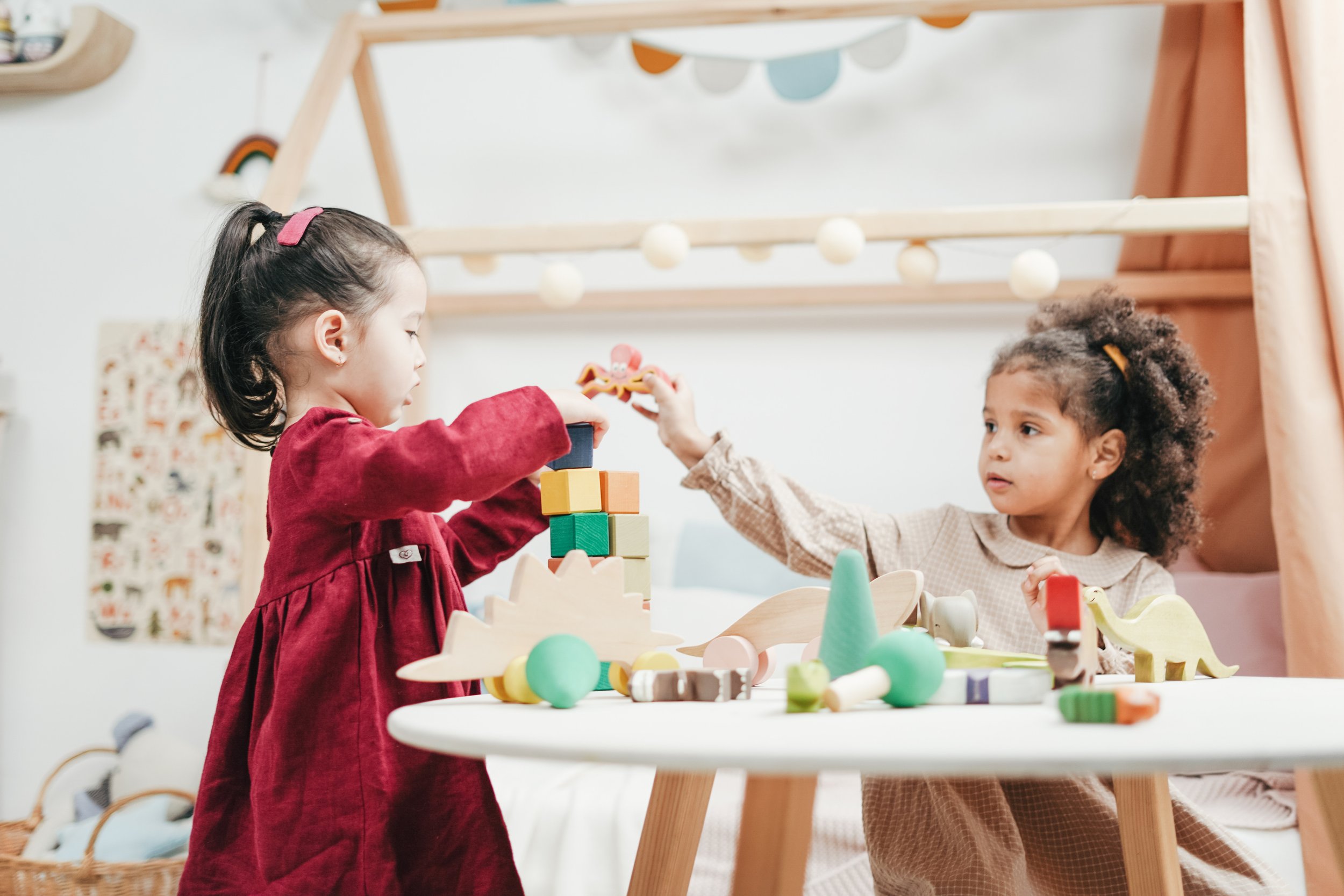
2. Manipulative Play involves building something (e.g. with Legos), putting a puzzle together, or stringing beads to create a necklace.(6) It teaches children about sequencing, patterns, order, colors and textures, and how to make comparisons.(7) It also helps children to practice their decision-making skills, analyze and solve problems, and learn about cause and effect.(7)
3. Physical Play involves being physically active and developing gross motor skills. Preschoolers should get at least 3 hours of physical activity per day.(9)
4. Creative Play involves using art supplies to create while developing fine motor skills. Holding writing utensils takes strength and coordination! Through creative play, your child will practice holding writing utensils and writing their letters and their name.(1)
Play is so vital to early childhood development that sustained, moderate to severe play deprivation in childhood (between the ages of 0 and 10) has been shown to have serious negative consequences. (19) Depression, fragile and shallower relationships, reduced self-control, a propensity for addiction and difficulty adapting to change later in life are linked to play deprivation in the early years.(19)
2 Stages of Play: Cooperative Play vs. Associative Play
You may remember from this blog post that there are 6 stages of play. Preschoolers move from associative play into cooperative play between the ages of 4 and 6.(20)
Associative play, which is stage 5 of 6, is when children play with each other but aren’t working together to reach a common goal.(14) Cooperative play, the last and final stage, is when your child is interested not just in playing, but in cooperating with other children to accomplish a goal. There will likely be a division of labor, rules, assigned roles and organization as they work together toward that goal.(14)
So what does this look like in practice? It’s the difference between playing side by side in a sandbox, talking with other children while working on their own sandcastles (associative play), and working together to build one magnificent sandcastle (cooperative play).
Cooperative play is a learned skill requiring self-regulation and the ability to balance individual needs and wants with the needs and wants of the group.(14) Preschool is a great place for your child to practice and build his or her cooperative play skills.
Learning Happens Inside and Outside the Classroom
Literacy and Language Skills for Preschoolers
Have you ever noticed how your preschooler’s classroom is filled with simple images with the object name displayed? You might notice a bus icon, a cat, the sun, a ball — this is to help your child make connections between the object and the letters and words.(1) Every day your preschooler is becoming aware of letters, numbers, shapes and symbols. Whether they’re sitting on the alphabet rug for circle time, singing songs or reciting rhymes, your child’s literacy skills are growing.(1)
Math Skills for Preschoolers
Your preschooler is also practicing their basic math skills by learning to count, identify patterns, and group similar objects together. Older preschoolers will be able to answer questions like, “How many toy cars are on the floor?” and group objects that go together, like books or blocks. (13) To nurture counting skills, ask your preschooler questions like, “How many apple slices are on your plate?” or “How many steps is it from here to the car?” To grow their sorting skills, have your preschooler help you sort laundry, putting all the red clothes in a pile or matching each family member’s socks.(13)
Science Skills for Preschoolers
Science skills are also introduced at this age, and your preschooler is probably already a natural scientist, curious about the world and eager to explore. Encourage your child to interact with and learn about nature, ask questions and conduct experiments, and even talk with them about scientific concepts.
Cooking is a great example of how to incorporate scientific exploration into play. If you invite your child to help you bake something, let them practice skills like measuring and mixing ingredients.
Tricky Preschooler Behaviors
Preschool isn’t all fun and games. And preschoolers can present some challenging behaviors. This is to be expected! All preschoolers act out sometimes.
Tantrums
In a perfect world, the tantrums will have stopped by the time your child is 4-years-old. Typically, tantrums do decline with age. If your preschooler is having frequent tantrums, they have not quite learned how to cope with frustration and regulate their feelings.(17) Talk to your pediatrician if you suspect underlying causes of tantrums in your older child, such as a sensory processing issue, a speech delay or an underlying mental health disorder.(17)
Fighting
If you notice your child is about to start fighting with a sibling over a toy, try diverting their attention before the fighting starts, or offer choices so your children can proactively be involved in the decision-making of what happens next. (4)
Lying
If you catch your preschooler lying, you may be worried you’re raising a devious child. But the truth is — pun intended — that between the ages of 4 and 5, what’s real versus fantasy is still a bit blurry.(15) Preschoolers’ memories are short. Your child may have forgotten she’s done something wrong. Or she’s convinced herself she didn’t do the “bad” thing (like accidentally break mommy’s vase).(15)
Interested in Learning More?
Check out this podcast episode for more information on preschooler play, learning and behavior! We also talk about what to do if your child is potty trained but too shy to use the toilet at school and how to handle lying, bossiness, and playground aggression.
Equip yourself with knowledge and tools to help your child thrive. And be sure to subscribe to the Genius Little Minds podcast so you never miss an episode!
References
https://www.scholastic.com/parents/school-success/school-success-guides/guide-to-preschool.html
https://raisingchildren.net.au/preschoolers/behaviour/understanding-behaviour/preschooler-behaviour
https://www.first5california.com/en-us/articles/developmentally-appropriate-behavior-preschooler/
https://www.scholastic.com/parents/family-life/parent-child/preschool-struggles.html
https://childmind.org/article/can-help-kids-self-regulation/
https://www.wgu.edu/blog/dramatic-play-what-is-why-important2111.html#close
https://raisingchildren.net.au/preschoolers/play-learning/getting-play-started/preschoolers-at-play
https://rainforestlearningcentre.ca/teaching-useful-calendar-concepts-in-preschool-and-daycare/
https://www.kidcentraltn.com/development/4-5-years/brain-development--preschool-3-5-years.html
https://www.parentingforbrain.com/extreme-tantrums-in-4-year-olds/
https://www.psychologytoday.com/us/blog/optimized/202104/the-impact-play-deprivation

Toddler Development: Your Chatty and Curious 31 to 36 Month-Old
How fast children grow! Your child is already almost three years old. You may be wondering where the time goes.
At this stage, you probably can’t get your toddler to stop asking questions and asserting his independence! And with good reason. There are many things your toddler can do by himself at this age and the wide world fascinates him.
Watch in amazement as your toddler tackles so many tasks all on his own! He can ride a tricycle, put on his shoes, brush his teeth and say his name.
You’ve done such a great job helping him grow. And the learning will only continue. The world delights and surprises him at every turn.

How fast children grow! Your child is already almost three years old. You may be wondering where the time goes.
At this stage, you probably can’t get your toddler to stop asking questions and asserting his independence! And with good reason. There are many things your toddler can do by himself at this age and the wide world fascinates him.
Watch in amazement as your toddler tackles so many tasks all on his own! He can ride a tricycle, put on his shoes, brush his teeth and say his name.
You’ve done such a great job helping him grow. And the learning will only continue. The world delights and surprises him at every turn.
Let’s see what else you can expect from your 31- to 36-month-old and how you can encourage his healthy development.
Toddler Development: Your Toddler from 31 to 36 Months
Vocabulary Development
Your 36-month-old can already say 900 to 1000 words!(1) This probably doesn’t come as too much of a shock—I bet you can’t get your three-year-old to stop talking! You’ve done such a great job facilitating your toddler’s vocabulary development by reading, singing, and talking to them. Give yourself a pat on the back and keep engaging with them as they grow.
At this age, your toddler wants to know how everything works. You’ve probably noticed your toddler asks a ton of questions. Some of them you may not know how to answer! Don’t be afraid to encourage their exploration further. Head to the library to pick up a children’s book on the topic of their choice. Read it together and talk about what you learned.
Potty Training
If your child wasn’t previously ready to use the potty, don’t worry. 18 to 36 months is a big age range to start toilet training. Many children don’t start potty training until they’re on the older end of the spectrum.(2) The “right time” varies widely from child to child. Using the toilet is a skill your child has to learn, just like having to learn to walk, talk, and use a spoon or a cup!(2)
You can tell your child is ready for potty training if they:(2)
Begin to show an interest (e.g. they want to be dry and clean, they want to wear “big kid” underwear, they wonder what happens when you go to the bathroom)
Stay dry for two hours or longer when they’re awake
Wake up with a dry diaper
Are aware when they need to go (e.g. they pee/poop in private or point to their diaper as they’re going)
Show independence by saying they can do it themselves (e.g. feeding, dressing)
Can follow directions and communicate well with you
Are able to sit still
Can run and walk well
Can undress themselves
It can be challenging to know when your toddler is ready to start potty training. But if you keep an eye out for the signs outlined above, you’ll be well on your way. Going to the bathroom independently on the toilet is an exciting skill to develop! Waiting until your child is emotionally and physically ready will put them on a successful path for potty training.
Toddler Development: Milestones from 31 to 36 Months
Social/Emotional Checklist(3)
After you leave your child (e.g. for a childcare drop off) they calm down within 10 minutes of your departure
Notices other children and plays with them
Language/Communication Checklist
Has conversations with you (you take turns speaking in at least two back-and-forth interactions)
Asks questions like, “why?” and “what?” and “where?”
Speaks well enough that others understand what they’re saying most of the time
Names what’s happening in a picture book when prompted (e.g. “Running!”)
When asked, says their name
Movement and Physical Development Checklist
Can use a fork
Dresses him or herself some of the time
Can string items together (e.g. beads)
Cognitive Checklist
Able to draw a circle when shown how
Doesn’t touch hot or dangerous objects when warned (e.g. a hot stove)
What You Can Do to Encourage Healthy Development in Your 31- to 36-Month-Old
Encourage Free Play
Having the freedom to express creativity through play is very important for your child’s development. Allow your child to follow his or her interests on a regular basis when they’re playing.(3) Research shows that free play, whether with friends or alone, improves children’s social skills, teaches them to be more resilient, and reduces anxiety.(7) When engaging in free play, your child should be allowed to choose where they play (within reason), what they play with (as long as it’s safe), and what kinds of subjects they explore.(4) Because every child is unique, self-expression will come out in free play in varied ways.(4) Some children will choose to color. Others will play with Legos. The sky’s the limit with free play! Free play also encourages problem-solving skills in addition to boosting creativity.(4)
Teach Empathy
Give your child a chance to practice recognizing how other people feel. Show them pictures of children expressing a variety of emotions.(7) This will help them learn to identify fear, anger, sadness, frustration, joy, etc. in others. Teach your child about these emotions and give them the language to label them. Walk your child through what they can do if they see another child expressing those emotions. For example, if another child looks sad, you might ask, “Why do you think he feels sad? What could you do to help her feel better?” Teaching empathy takes time and lots of practice. But it is so worth it.
Name Their Feelings
Often children throw tantrums because they don’t feel heard, seen, understood, or listened to. If your child starts to cry because they can’t get their sweater on, resist the urge to say, “Stop crying.” Instead, name what they’re likely feeling. “You’re feeling frustrated because your arm won’t go into your sweater! Getting dressed can be hard sometimes. Would you like help?” By validating your child’s feelings, they’ll feel understood. You’re also giving them a valuable lesson in recognizing how they feel. Over time, they’ll be able to identify how they’re feeling and where those feelings arise in their body.
Continue to Set Clear Boundaries
Communicate limits to your child consistently so your expectations are clear. But do this in your normal voice! Being firm and clear does not mean having to yell. When possible, give clear and firm warnings, such as, “In five minutes it will be time to leave the park and go home for dinner.” If your toddler tests that limit, explain what the consequence will be and stick to it. “If you don’t get off the slide right now, you won’t be allowed to play with your musical book later.”
Every Stage Comes With Joys and Challenges
Each step of the way, you have the opportunity to help your child learn and grow. Subscribe to my newsletter for more helpful parenting tips, and don’t miss the other blogs in the infant and early childhood development series!
References
https://edn.ne.gov/cms/developmental-milestones-31-through-36-months
https://www.verywellfamily.com/signs-your-toddler-is-ready-to-potty-train-290259
https://www.cdc.gov/ncbddd/actearly/milestones/milestones-3yr.html
https://www.unicef.org/parenting/child-care/what-is-free-play
https://www.theparentline.org/infant-toddler-development/31-36-months/
http://thedanishway.com/do-you-know-why-free-play-is-important-for-your-children/
Alexander, J. J., & Sandahl, I. (2016, August 9). The Danish Way of Parenting: What the Happiest People in the World Know About Raising Confident, Capable Kids (1st ed.). TarcherPerigee.