

5 Tricky Toddler Behaviors for Parents and Caregivers to Understand
If you’re the parent of a toddler, chances are you’ve seen your fair share of temper tantrums, dealt with hitting or biting, or gotten into power struggles with your child.
While the toddler years are a wonderful time of exploration and development, they also can be trying on parents or caregivers.
One minute your child is being oh-so-sweet and angelic and the next they’re throwing a fit in the middle of the frozen food aisle.
Let’s tackle 5 tricky (but common) toddler behaviors and gain insight into why they occur.

If you’re the parent of a toddler, chances are you’ve seen your fair share of temper tantrums, dealt with hitting or biting, or gotten into power struggles with your child.
While the toddler years are a wonderful time of exploration and development, they also can be trying on parents or caregivers.
One minute your child is being oh-so-sweet and angelic and the next they’re throwing a fit in the middle of the frozen food aisle.
Let’s tackle 5 tricky (but common) toddler behaviors and gain insight into why they occur.
Why Does My Toddler Throw Temper Tantrums?
Temper tantrums are a normal part of childhood development. They’re your two- or three-year-old’s way of expressing big emotions they’re unable to regulate. Young children are not able to express frustration, anxiety, or anger the way older children or adults can because their brains are still immature.
It’s normal for toddlers to throw tantrums because they haven’t yet learned the ins and outs of:(2)
Impulse control
Communicating their needs or wants
Self-soothing
Delaying gratification
Problem solving
Navigating situations with appropriate responses
The good news is, by age three and a half, most children have few or no tantrums.(1)
There’sno such thing as a “tantrum disorder.”(2) But frequent or persistent tantrums may be an indication of a larger issue that needs to be addressed. Children with ADHD are particularly prone to outbursts or meltdowns because they struggle with poor impulse control and being bored.(2) A recent study showed that over 75% of children who had severe temper outbursts also fit the criteria for ADHD.(2) Children with autism or anxiety may struggle with unexpected changes or unfamiliar situations and have a tantrum as a result.(2) And children with sensory processing issues may have a tantrum if they are experiencing sensory overload.(2) Depression or undiagnosed learning disorders could also be contributing factors to children throwing tantrums.(2)
Emotion-regulation is a skill children need to be taught, just like problem-solving or communicating their needs.
And when a child can’t emotionally regulate, a tantrum, or two other common toddler behaviors, may ensue.
Why Does My Toddler Bite and Hit?
It may surprise you to learn that biting is a common behavior among toddlers. It typically happens when a child is trying to communicate a need or cope with a difficult emotion. For example, your toddler may become frustrated or mad when a sibling takes his toy. He needs to self-regulate and cope with the anger and frustration but doesn’t know how, so biting ensues.
A Few Reasons Toddlers May Bite or Hit:
They are still developing their impulse control skills
They don’t yet know how to delay gratification
They’re overwhelmed and don’t know how to regulate themselves
They lack the skills to communicate their strong feelings with words
They don’t understand what constitutes an appropriate response to dealing with a challenge
On episode 13 of Genius Little Minds, I give some tips for things you can do and say when your child has bitten another child. Check out the podcast episode here.
Why Does My Toddler Refuse to Share?
Sharing is tough! Even for adults, it’s sometimes difficult.
It’s not very realistic to expect your 2-year-old to be a competent sharer. They’re just too young to grasp the concept. They’re also lacking language skills to express themselves fully, so they often can’t explain why they just don’t want toshare.
So if your young toddler hasn’t yet mastered the art of sharing, don’t sweat it. This skill doesn’t develop until a child is about 3 and a half or 4 years old.(5)
Sharing is a learned skill, so talking about it (without imposing unrealistic expectation that it will happen overnight) can be helpful. Try pointing out moments in your daily life when sharing occurs, like when you share your food with your spouse or take turns using an electronic device.
Why Is My Toddler Not Seeking Independence?
You’ve probably heard that two-year-olds have a lot of opinions. After all, everyone says they love the word “no”, want to dress themselves and try new things. But what if your child doesn’t fit that description?
Of course as a parent, you play a huge role in your child’s life. Your behaviors and parenting style have a huge impact on how your child acts and interacts with the world.
Now I’m not here to shame anyone’s parenting... I know everyone is doing the best that they can with the resources available to them. But there are two parenting styles that can either encourage the development of autonomy or hinder it.
Autonomy Supporting Parenting
Also know as Autonomy Granting Parenting, Autonomy Supporting Parenting encourages independence in ways that are gentle and appropriate.(4)
Children with Autonomy Supporting parents are allowed to explore new, non-threatening situations without interference. (4) This teaches them independence and the idea that it’s OK to be themselves.
Protective Parenting
Protective Parenting is “the broad restriction of a child’s autonomy.”(4) And it “can increase the risk of child anxiety development.”(4)
To some degree, every parent is protective of their children. But Protective Parenting can interfere with a child’s discovery or the magical world of autonomy. It can hinder independent exploration and reduce their confidence.(4)
Interested in Learning More?
Check out this podcast episode for more information on these tricky — but common — toddler behaviors. Learn what to do when your toddler starts to hit the dog… or their sibling. Gain insight into how to handle a toddler who won’t get dressed, and what to do when your child simply won’t. stop. screaming. I also provide a few scripts for what to say to your toddler in these tough situations.
Equip yourself with knowledge and tools to help your child thrive. And be sure to subscribe to the Genius Little Minds podcast so you never miss an episode!
References
https://www.mayoclinic.org/healthy-lifestyle/infant-and-toddler-health/in-depth/tantrum/art-20047845
https://childmind.org/article/why-do-kids-have-tantrums-and-meltdowns/
https://link.springer.com/content/pdf/10.1007/s10802-019-00522-9.pdf
https://www.zerotothree.org/resources/1964-helping-young-children-with-sharing
https://www.todaysparent.com/toddler/toddler-behaviour/how-to-discipline-a-toddler/
https://www.brighthorizons.com/family-resources/articles/e-news/autonomy-supported-parenting
https://www.sciencedirect.com/science/article/pii/S0022096513002440
https://www.babycentre.co.uk/a1021960/how-to-teach-your-child-to-share
https://www.greatkidsinc.org/sharing-is-caringand-a-developmental-milestone/

Transitioning Back to School: How to Handle Your Child’s Anxiety
A new backpack, a different classroom, and an excited little learner–the new school year brings many changes and excitement for most children.
For other children, however, it can be a source of anxiety. Maybe they enjoyed the previous year but feel scared of the unknown of the new year. Or maybe your family has moved and they know they will have to make new friends.
Whatever the reason for the anxiety is, there are ways that you can help your child. Even if the anxiety is just normal, first day jitters, a little preparation can go a long way.

A new backpack, a different classroom, and an excited little learner–the new school year brings many changes and excitement for most children.
For other children, however, it can be a source of anxiety. Maybe they enjoyed the previous year but feel scared of the unknown of the new year. Or maybe your family has moved and they know they will have to make new friends.
Whatever the reason for the anxiety is, there are ways that you can help your child. Even if the anxiety is just normal, first day jitters, a little preparation can go a long way.
Walk Them Through What to Expect
Taking out the element of the unknown can make a big difference in calming nerves. Set aside time in the week or month before school starts to talk about the new schedule. Discuss who their new teacher will be, where their classes will be, and what to expect throughout the day.
If possible, try to set up a time to meet their new teacher. Many schools will have an open house to allow students to see the building, their classroom, and the teacher. Take full advantage if this is the case for you. Let your child practice opening their locker and help them find their desk.
If you can’t get into the school before the first day, you can still drive by and talk about the drop-off and pickup. Or if your child walks to school or rides the bus, the two of you can role play what they will need to do each morning and afternoon. Not only will this help calm their nerves, but it will also keep them safe and in the right place on the first day.
Establish Connection Throughout the Day
For some children, the hardest part of the first day of school is simply that they don’t like being separated from their parents or siblings. In this case, creating a way for them to continue to feel connected to their loved ones even when they’re separated is essential. Here are some ideas of ways to do just that.
Leave a Note in their Bag or Lunchbox
A little one-line note can let them know that you are thinking about them and cheering them on from afar. A lunchtime note can help break up the school day and may reach them at just the right time to give them a boost to finish the day.
If you know that your child often struggles at a different point in the day, try putting a note in the backpack and letting them know what time they should go looking for it. It could be at a specific time or after a certain class.
Read Books
Children’s story books can be a great tool to help children recognize their feelings and know how to handle them. Feeling anxiety when separating from a caregiver is a very common experience, so there are many resources to help families tackle these feelings.
Some of my favorite books to help children conquer non-clinical separation anxiety include:
The Kissing Hand by Audrey Penn
Llama Llama Misses Mama by Anna Dewdney
Love You All Day Long by Francesca Rusackas
The Invisible String by Patrice Karst
If you think that your child might be suffering from a more intense form of separation anxiety, my book Charlie Cub Is Afraid To Leave His Mothercan be a useful resource. This book follows the journey of Charlie Cub as he wants to go to a sleepover but is terrified to leave his mother behind. It uses a Cognitive Behavioral Therapy approach to help him face and conquer his fear. Your child may be able to see themselves in Charlie Cub and use his approach to overcome their anxiety too.
Charlie Cub Is Afraid To Leave His Mother can be pre-ordered by clicking here.
Get Matching Bracelets, Necklaces, or Backpack Tags
There are many products that you can buy that establish a physical point of connection between you and your child. Matching bracelets or necklaces can give your child something to touch throughout the day and know that you are doing the same.
However, you don’t have to purchase something to get this experience. You can make matching bracelets out of string and beads. Or the two of you can make matching pictures to put in their locker and your work bag. The possibilities are endless!
Adjust Their Sleep Schedule
A tired child is a more emotional child. That’s the last thing that you want during an already emotional time.
If your child has been sleeping in a bit later in the morning this summer and staying up late each night, don’t wait until the first day of school to adjust their schedule. Start a week or two before the first day pushing their wake time and bedtime up by 10 minutes. This slow transition will go much smoother and will help your child be rested and ready to learn on their first day.
Focus on the Positive
When we’re anxious or nervous, it’s easy to focus on the negative in the situation. You may need to help your child see the good things in the new school year instead of just the scary things.
Talk with them about what fun activities they’ll do in the classroom and the exciting games they’ll play with their friends. Encourage them to list the things about their new school or classroom that they’re excited to try out like new playground equipment.
Have a Debrief
Give your child time to recoup and relax when they get home from school. Schedule a chunk of time with nothing to do so that they can breathe and do whatever activity calms them.
Once they’ve had some downtime, make sure to ask them about their day. Let them know that you want to know what was great and what could have gone better. Having this talk every day will help you know what’s going on with them at school and help you be able to address problems before they get too big.
To hear more about after-school restraint collapse, check out my podcast episode Ep. 7: Why Is My Child Acting Out? Oppositional Defiant Disorder Explained.
Remember to Take Care of Yourself
The start of the school year means a lot of changes for you, too. You may be getting up earlier to get your children ready. You’re likely running them to more events and trying to coordinate new schedules.
Make sure to take time to rest and relax. You cannot take care of everyone else’s needs if your needs aren’t met first.
Reach Out for Help if Necessary
If the transition into school this fall seems even more difficult than usual, remember that it’s just a phase. Change is hard, but we are capable of adapting. If after a few weeks, your child is still really struggling, don’t be afraid to reach out for help from their teacher, the school counselor, or a mental health professional. We’re all in this together!
Would you like more tips on how to proactively nurture your child’s mental health? Be sure to subscribe to my newsletter!
My podcast covers a variety of mental health topics, as well. You can check out all the episodes here.
References

Toddler Development: Your Stubborn and Capable 25 to 30 Month Old
Toddlers have a reputation for being stubborn, independent, defiant and frustrating—in addition to being to being painfully cute, of course. And for good reason! At this age, your child is going through tremendous cognitive growth. They’re realizing they’re an individual who can make an impact on their environment—and all that curiosity can lead to magical discoveries. (As well as a little mischief!)
Your 25-month-old will start to play pretend, stand on their tiptoes, blow you a kiss, and find new ways to surprise you each and every day!

Toddlers have a reputation for being stubborn, independent, defiant and frustrating—in addition to being to being painfully cute, of course. And for good reason! At this age, your child is going through tremendous cognitive growth. They’re realizing they’re an individual who can make an impact on their environment—and all that curiosity can lead to magical discoveries. (As well as a little mischief!)
Your 25-month-old will start to play pretend, stand on their tiptoes, blow you a kiss, and find new ways to surprise you each and every day!
Toddler Development: Your Toddler From 25 to 30 months
Vocabulary Development
Your 25-month-old can probably say simple phrases and two- to four-word sentences, and they may know as many as 100 words already!(1) Pay close attention to what you’re saying because at this age, your toddler is bound to repeat everything they hear.(1)
Your toddler can probably name up to five different objects like a ball or a car and name familiar pictures, (2) making reading time together even more fun. They can also follow short directions(2) like, “Give me the cup.”(3)
Continue to read to your toddler and have conversations with them throughout the day to encourage their vocabulary development.
Potty Training
Some children are ready to begin potty training around this age.(1) But you don’t want to rush it—potty training is a major milestone. Certain physical, developmental and behavioral milestones need to be reached before it’s possible for your toddler, and some children don’t learn until they’re closer to three.(6) If you try to potty train your child too early, it may end up taking even longer!(6)
Teething and Brushing
Your toddler’s two-year molars may be coming in sometime between 20 and 33 months.(1) They’re big ones—so this can be painful. Luckily, they’re the last teeth to come in until your child is around six years old.(1)
It can be hard to get a toddler to brush their teeth—but that doesn’t mean you should stop trying! It’s so important to establish good oral hygiene habits when your child is young.
Try some of these tips to make teeth brushing more fun for your toddler!(7)
Let your child pretend brush her favorite doll, stuffed animal, or action figure’s teeth while you brush her teeth.
Brush your toddler’s teeth and then let her take a turn brushing her own teeth (or vice versa).
Play a favorite song and let your child know when the song is over, it’s time to rinse.
Let your toddler pick out her own toothbrush
Toddler Development: Milestones From 25 to 30 Months
Social/Emotional Checklist(4)
Follows simple routines when instructed
Says “look!” to show you something he can do
Engages in parallel play
Language/Communication Checklist
Can say about 50 words(4)
Can say words like, “me,” “we,” and “I”(4)
Uses action words in short, two-word phrases like “Kitty jump”(4)
Can name known objects in a book when you point and ask what it is(4)
Begins to speak clearly(5)
Movement and Physical Development Checklist(4)
Can twist or turn things with their hands
Jumps up off the ground with two feet
Removes some clothing by himself
Turns book pages
Can throw a ball(5)
Can build a six-block tower(5)
Cognitive Checklist(4)
Plays pretend like “feeding” a doll a block as though it was food
Follows simple instructions
Shows simple problem-solving abilities
Knows at least one color and can point to it when you ask
What You Can Do to Encourage Healthy Development in Your 25- to 30-Month-Old
Allow Them to Make Small Choices
Support your toddler’s assertion of their independence by allowing them to make small choices throughout the day.(1) Let your toddler select their own outfits, for example—even if it takes them twice as long to get dressed. Letting your toddler work through the awkward stages of developing a skill is so important. Instead of stepping in to speed up the process, let them fumble—it’s good practice and helps them learn.(8)
Continue to Set Limits
While it’s important to support your toddler’s exploration of independence, it’s still important to set limits so they know you’re the boss. Your toddler may insist on jumping on the couch or doing other unsafe activities in their desire to explore. Continue to set consistent limits that keep them safe.(1)
Take a Time-In
It’s pretty normal for toddlers to bite or hit when they’re frustrated. (I talk about this at length on my upcoming episode this month on toddler behavior of Genius Little Minds if you want to learn more.) Try taking a “time-in” when your child is overwhelmed and having a meltdown. It’s an opportunity for you to co-regulate (as opposed to a time-out where a child sits alone.)(9) To take a time-in, sit with your child somewhere quiet if possible, and offer comfort and reassurance that you understand their big emotions. Give language to their feelings. Take some deep breaths together.
Example: “You’re frustrated because you aren’t allowed to have cake today. I get frustrated sometimes, too. Instead of screaming when we are frustrated, let’s try taking a deep breath and counting to 5.”(9)
Once they’ve calmed down, talk about what could have been done differently.
Example: “Did you scream at mommy because you wanted cake? What could you have done instead?”(10)
Transition Slowly
Transitions can be tough. Even for adults! So transitioning from playing at the park to going home can be especially hard for your toddler. Give plenty of verbal warnings like, “In twenty minutes it will be time to leave the park and go home to make dinner.” Repeat yourself a few times—giving these types of warnings in 10 minutes and again in 5 minutes.
Every Stage Comes with Joys and Challenges
Each step of the way, you have the opportunity to help your child learn and grow. Subscribe to my newsletter for more helpful parenting tips, and don’t miss the other blogs in the infant and early childhood development series!
References
https://www.canr.msu.edu/news/play_through_the_ages_ages_24_to_30_months
https://childdevelopment.com.au/areas-of-concern/understanding-language/following-instructions/
https://www.cdc.gov/ncbddd/actearly/milestones/milestones-30mo.html
https://www.babycentre.co.uk/a6471/milestone-chart-25-to-30-months
https://hurstpediatricdentistry.com/2020/09/10/tips-for-brushing-baby-toddler-teeth/
https://reachformontessori.com/time-in-vs-time-out-what-is-a-time-in/

How to Help a Child Who Is Struggling to Make Friends: 8 Tips and Tricks
Most of us reflect fondly on some of the friends that we had in our childhood. Whether it was a friend that lived just down the block that we biked to see every day or a friend we made at summer camp and have kept in touch with ever since. Friendships can be one of the sweetest parts of childhood.
Today, however, we are seeing more and more children struggle to establish and maintain healthy friendships. The pandemic and lockdowns drastically changed children’s social lives. For months on end, most children only interacted with their siblings or even no children at all.

Most of us reflect fondly on some of the friends that we had in our childhood. Whether it was a friend that lived just down the block that we biked to see every day or a friend we made at summer camp and have kept in touch with ever since. Friendships can be one of the sweetest parts of childhood.
Today, however, we are seeing more and more children struggle to establish and maintain healthy friendships. The pandemic and lockdowns drastically changed children’s social lives. For months on end, most children only interacted with their siblings or even no children at all.
Now, as many children have transitioned back to in-person learning and full daycare and preschool, they may have social skills to catch up on.
So, how do we help bridge this gap? Let’s dig into it.
Friendships Are Essential to Healthy Development
You know that a good friendship is good for the soul. You likely have people in your life who you don't know how you would live without.
It can be easy to forget that our children are really just little adults with all those same social and emotional needs. They long for connection and relationships with others just like we do.
Additionally, friendship has so many other benefits. Here are just a few:
Lower stress levels(1)
Providing a sense of belonging
Higher self-esteem
Encouraging good behavior
Good friendships can also help children develop social and emotional skills. Through conversations and interactions with their peers, they learn the rules of conversation.(2) They are also exposed to others’ viewpoints, learning how to put themselves in someone else’s shoes. Being around their peers also shows them what type of behavior is appropriate for their age and situation.
Studies have shown that children with high-quality friendships are more likely to perform well at school. This likely relates to friends helping a child feel comfortable, valued, and welcome in their classroom. Reliable friendships can also make big transitions, like from one grade to the next, easier.
The need for friendship and the benefits experienced by it are equal for boys and girls. We need to remember that boys need quality relationships and connections just as much as girls do.
On the flip side, there are significant challenges that come with not having good friends. More than 50% of children who have been referred for emotional-behavioral problems report having no friends.(4)
Trouble making friendships and keeping healthy relationships often carries into adulthood.(3) These social skills are ones that we need to be teaching our children early on so that they are set up for success.
Why Friendship in Childhood Can Be Difficult
Children lack the practice that adults have in interpersonal skills. They don’t always know how to read social cues and how to act in certain situations.(5)
Some children are a bit more shy and anxious and struggle to start friendships because of this. Other children haven’t yet learned good empathy skills and find it difficult to think about others and their feelings.
If your child is struggling to make friends, it could be for a variety of reasons. Sitting down and having a conversation with them is a great place to start. You can try to understand what they are feeling and experiencing. Then together, form a strategy to build and maintain friendships.
Maybe you need a few pointers to get you started. Here are some of my best tips for helping your child make friends.
8 Tips for Helping Your Child Make Friends
Model what good friendship looks like. Let them watch you make conversation with other adults and children. Tell them when you are reaching out to check on your friend or sending them a gift to brighten their day. Involve them in activities that you do with your friends.
Encourage friendships that are good for your child. You may be thinking, ‘I don’t even know who my child could be friends with.’ If so, this is the first place to start. Talk with your child to identify who they might like to be friends with. You could enlist the help of their teacher or another adult in their life to identify good friends. Then, put in the effort to schedule play dates and fun activities with that child. If you can’t find any particular friends that your child may enjoy, consider enrolling them in group activities, like ballet or football.
Recognize their personality and adjust to it. Every child is unique, just like every adult is unique. Some are introverted while others are extroverted. Some enjoy being in crowds and attending big events while others don’t. Recognize that your child (and their friends) may have a different idea of quality time together than you do. Adjust your activities and plans accordingly.
Role play with your child. Practice what they should say and do in certain situations. Let them practice introducing themselves and asking if the other child would like to play with them. Make conversation with them and guide it in a direction that it would typically go between two children, such as talking about their favorite toy or kind of ice cream.
Reinforce and praise them when they interact well with their peers. Especially in the first few years, you will likely be around for every one of your child’s social interactions. When you see them being kind, sharing, taking turns, and making conversation, praise them. Let them know that they are doing a great job.
Discuss and identify your child’s emotions. Help your child figure out what they are feeling and name it. Many childhood friendships suffer because of a lack of emotional awareness and emotional regulation. Giving your child the tools to manage their emotions will help them avoid this.
Help your child put themselves in someone else’s shoes. Empathy and compassion are essential to making relationships work. Children aren’t born with the ability to see things from another person’s perspective. We need to guide them and help them identify what other children are feeling and how to handle those feelings.
Demonstrate how to say sorry and make amends. Nobody is perfect. Sometimes your child is going to hurt someone else and sometimes your child is going to be the one that’s hurt. We need to demonstrate to our children not only how to apologize and ask forgiveness, but also how to forgive and set healthy boundaries.
Friendships can feel difficult and time-consuming to maintain at times. However, every human needs connection with other humans; it’s how we’re wired.
Before your children are fully independent in their social skills, they may need your help with this. That is totally normal and okay. Give them the tools and information they need and get ready to watch them succeed.
Would you like more child development tips in your email inbox? Be sure to sign up for my newsletter!
References

Why the Toddler Years Matter So Much for Brain Development
If you have a toddler, you’ve witnessed firsthand how incredibly active they are and how fast they learn! So many amazing milestones are reached during the toddler years — from walking to talking to using their fingers to eat.
Toddlers can be larger than life. With their big feelings, bigger tantrums, and daily skill acquisition — you may be marveling at all the new things they’re learning and doing.
Every day is different with a toddler. And it’s in part because their brains are so incredibly malleable and developing at a wildly rapid pace.
So what’s going on inside that genius little mind of theirs?

If you have a toddler, you’ve witnessed firsthand how incredibly active they are and how fast they learn! So many amazing milestones are reached during the toddler years — from walking to talking to using their fingers to eat.
Toddlers can be larger than life. With their big feelings, bigger tantrums, and daily skill acquisition — you may be marveling at all the new things they’re learning and doing.
Every day is different with a toddler. And it’s in part because their brains are so incredibly malleable and developing at a wildly rapid pace.
So what’s going on inside that genius little mind of theirs?
How Does Your Toddler’s Brain Work?
You’ve probably heard that children’s brains have more neuroplasticity than adult brains. What’s neuroplasticity? The brain’s ability to change or rewire itself after experiences.(1)
Two-year-olds have twice as many synapses or connections between neurons than adults do. (2) Synapses are where neurons (or brain cells) communicate. The neural pathways that are used regularly become well-established, while the ones that aren’t are lost.
We either ‘use it or we lose it’.
What does this mean in practical terms?
Brain development is all about forming connections.(2) Your toddler’s brain is shaped by his or her experiences. So singing familiar songs, letting your toddler play, practice their skills, and engage with you and others is a vital part of their development.
This is why you’re encouraged to read to your toddler every single day. Even if you’re reading the same short books over and over again, you’re encouraging those neural pathways to strengthen.
A Critical Period in Brain Development
Children’s brains develop in what are called “critical periods”(2) and “sensitive periods” which are essentially windows of time in which their brain plasticity is maximized.(3) Critical periods happen between age 2 and 7 and again in adolescence.(2) During critical periods, synapses can form or strengthen more easily.
This is why it’s easier for children to learn things when they’re young, like learning to speak a foreign language.
The sensitive period for learning to speak a foreign language like a native speaker is from age 0 to 12.(4) Of course you can still learn to speak a new language after age 12. But it will be harder and require more effort because the critical and sensitive periods will have already closed.(4)
Over time, pruning occurs. The connections that don’t get used get discarded. As we age, our brain wiring becomes harder to change.(5) Just like the old adage says, “You can’t teach an old dog new tricks.” It’s not impossible, but we tend to get stuck in our ways — quite literally.
Help Your Child Cultivate Emotional Intelligence and a Growth Mindset… Eventually
Your toddler is learning something new every single day — be it from you, another caregiver in her life, or just from the wide world she’s interacting with. Her brain is like a sponge, taking in new words, faces, and places. She’s learning to sing songs, identify pictures, and how her toys work. It can be quite surprising when your toddler shows off a new skill or says a new word she overheard!
And as a parent or caregiver, you are a tremendous resource, teacher, and model for desirable behavior.
Here are 3 ways you can help your toddler’s brain develop:
1. Name Feelings Together
Children learn emotional intelligence from the adults who model it for them. And naming feelings is hugely important in helping your child understand his or her emotional landscape and internal world.
Let’s say your child is struggling with jealousy over the birth of her baby sister. You could say, ‘Your new baby sister is getting a lot of attention from your dad and I. I bet that makes you feel a little jealous and maybe even sad.’ Naming and acknowledging your toddler’s feelings — even the more “negative” or “less-desirable” ones — can help her feel understood. It can also help her feel more receptive to being comforted when she’s upset.(5) Rather than brushing her feelings off as insignificant, you’re teaching her what it is she’s feeling. You’re letting her know it has a name.
It may also be helpful to share a time when you were a child and experienced similar emotions. This helps your toddler learn that these big feelings are okay to have and won’t last forever.
2. Praise Their Process
Did you know there’s a difference between praising outcome and praising effort?
Research shows that when you praise the process and effort a toddler is putting into a task rather than just the outcome of the task itself — your toddler is more likely to have a growth mindset five years down the line.(5)
Let’s say your toddler is playing with nesting cups. You could praise intelligence — ‘You did it! You’re so smart!’
You could swoop in when things get tough — not allowing them to work things out for themselves, even if they’re age appropriate — undermining your child’s independence and sense of competence.
Or you could praise the process — ‘You stuck with this even though it was tricky at times. I like how you kept trying.’
Praising process teaches your child that it’s okay to fail. And it’s okay to make mistakes. And it’s okay to try again. Maybe your toddler loves the responsibility of feeding the family cat. But sometimes, more of the cat’s kibble gets on the floor than in the bowl. You could offer praise by saying, ‘Scooping the cat food without spilling is tough! But I love how you’re trying.’
This type of praise not only has an impact on their developing brain but will help cultivate a growth mindset when they’re older.(5)
3. Study Piaget’s Theory of Cognitive Development
Toddlers are fascinating little beings. And Piaget’s Theory of Cognitive Development provides a great framework for understanding just that — how their brain is developing.
If you’re not familiar with it, Piaget’s Theory of Cognitive Development can be a very helpful tool. You’ll gain insight into how your child learns, processes, and engages with the world. When you understand things from their point of view, you can embrace the parenting journey with even wider arms.
According to Piaget’s Theory, toddlers are in the preoperational stage of development. There are 8 important features within this stage that I go over in detail on this podcast episode. I cover things like why the animated film Toy Story is such a hit with kids, whether imaginary friends are “normal” or cause for concern, and why your toddler will play next to her little friend, but struggles to actually engage with her.
Interested in Learning More?
Check out the podcast episode on toddler brain development! You’ll get a deeper look at the topics covered in this blog and much more. Tune in to gain insight into why your 3-year-old might be afraid of the bathtub drain or think her shoe is “mad at her.”
Equip yourself with knowledge and tools to help your child thrive. And be sure to subscribe to the Genius Little Minds podcast so you never miss an episode!
References
https://www.verywellmind.com/what-is-brain-plasticity-2794886
https://www.edutopia.org/article/why-ages-2-7-matter-so-much-brain-development
https://vachildcare.com/the-critical-vs-sensitive-periods-of-brain-development/
https://therapyworks.com/blog/language-development/home-tips/growth-mindset/
Raising an Emotionally Intelligent Child: The Heart of Parenting, John Gottman, Simon & Schuster.

What Is Panic Disorder with Agoraphobia? Recognizing the Causes, Symptoms, and Treatments
Most of us really enjoy being at home. It's a place with all our favorite things. It contains familiar faces and special memories. It houses our family members and pets that we love. It’s a safe and comfortable place to be.
This love of familiarity is often felt by our children as well. They like having their own space, a reprieve from an often demanding outside world.

Most of us really enjoy being at home. It's a place with all our favorite things. It contains familiar faces and special memories. It houses our family members and pets that we love. It’s a safe and comfortable place to be.
This love of familiarity is often felt by our children as well. They like having their own space, a reprieve from an often demanding outside world.
Sometimes, however, it's more than that. What if your child never wants to leave? What if leaving their home or safe space causes them to spiral out of control, having panic attacks or uncontrollable irrational fears? It may seem like something more than average anxiety. It may be panic disorder with agoraphobia.(1)
Panic Disorder
Panic disorder is part of the family of anxiety disorders. It is characterized by sudden, unexpected episodes of intense fear. These episodes are often called panic attacks, and they cause extreme physical and emotional discomfort. Panic attacks can feel so intense that the person may mistake them for a heart attack or other physical issue.(2)
The symptoms and duration of panic attacks vary from person to person. Some people only experience one panic attack that lasts a few minutes, while other people may experience multiple panic attacks in a row with the whole episode lasting hours.
Sometimes it’s easy to pinpoint what triggers the panic attack, but other times they can pop up with little warning or explanation. With therapy and self-reflection, a person experiencing panic attacks may be able to anticipate the attacks and take steps to prevent them or decrease their severity.
Agoraphobia
Agoraphobia is an anxiety disorder that involves an intense fear of being trapped.(1) What exactly ‘trapped’ means can vary from person to person. Some people with agoraphobia feel trapped by small or crowded spaces. This could include places like elevators, the movies, or large events.
Conversely, others feel trapped by wide-open spaces, such as a bridge or park. Being in these situations can cause panic attacks. In some cases, the person does not even have to be in the situation for a panic attack to be triggered. They may simply be thinking about the anxiety-inducing place or be on their way to such places. Because of this, those with agoraphobia tend to avoid these situations if at all possible.
Symptoms
When a child experiences panic attacks along with their fear of being trapped, they may be diagnosed with panic disorder with agoraphobia.
Physical symptoms of panic disorder with agoraphobia include:(2)
Panic attacks
Rapid heartbeat
Difficulty breathing
Pressure or pain in the chest
Headaches
Stomachaches
Shakiness and/or tingling in hands and limbs
Feelings of weakness
Excessive sweating
Fatigue
Insomnia
Children may also experience emotional symptoms such as:
Feeling trapped with no escape
Sensing that something bad is about to happen to them
Fear of open spaces or enclosed spaces
Fear of long lines or crowds
Feeling like they are losing control or dying
Difficulty concentrating
Intense fear of separating from parents
Refusal to go to school or leave home
Feeling anxiety in anticipation of a feared situation
Expecting the worst possible consequences if in open or enclosed spaces
Avoidance of situations that may lead to the feeling of being trapped
These symptoms will often begin to interfere with a child’s day-to-day life. School may become more difficult. They may not get enough sleep at night. Concentrating on academic and fun tasks alike may be harder. This is the point at which a mental health professional is needed.
Causes
Panic disorder with agoraphobia is caused by three main factors: predisposition, genetics, and environment.(3)
Children’s personality or tolerance for stress can make them predisposed to developing anxiety disorders. Children with a family history of mental health illness are more likely to develop a mental illness themselves.
Certain experiences or events that invoke intense fear in a child can also bring on panic disorder with agoraphobia. A child may have a traumatic experience in a crowded or enclosed space. Or they may experience a traumatic event in some other part of their life, like a car accident, abuse, or parental divorce, and that event manifests into panic disorder as agoraphobia.
Treatment
Like with many other anxiety-related disorders, cognitive-behavioral therapy is the most widely-recognized and evidence-based treatment for panic disorder with agoraphobia.(4)
Cognitive-Behavioral Therapy
Cognitive-behavioral therapy (CBT) is a type of talk therapy that helps children recognize what their thought patterns are and how they may be affecting their emotions and behaviors.
CBT will walk a child through how the outcome that they are imagining is not realistic. It is easier to recognize that these outcomes are not realistic when a child is not in the midst of a panic attack, but they also need to be able to recognize this when they are in the moment. So, CBT gives tools, such as self-talk or relaxation techniques, to use when the fear and panic are starting to build.
A mental health professional will likely also use Graded Exposure. In this CBT technique, a child will slowly face their fear, employing the techniques CBT has given them to keep them calm. They will start with a situation that only makes them slightly uncomfortable and then work closer and closer to the feared situation.
An example of this would be starting off by being in a small space with one person, then with two or three people. Then, perhaps the child would be in a space with four or more people that is also noisy. Slowly they would go to places with more and more people until they can manage their anxiety effectively.
Implementing CBT Techniques
Children learn by seeing. They learn by watching someone walk through a situation and then mimicking what they saw.
If your child is suffering from panic disorder with agoraphobia, you may be struggling with how to help them, particularly if you don’t struggle with the disorder yourself. You don’t fully understand what they are experiencing or what their anxiety feels like.
Books like, Pablo Parrot Is Afraid of Being Trapped!, provide a great solution to both of these issues. Part of Dr. Madeleine Vieira’s anxiety disorder series, I’M AFRAID, this book specifically focuses on panic disorder with agoraphobia. Pablo Parrot experiences all the feelings and emotions that your child is about being trapped in certain situations. Your child will see themself in Pablo.
Pablo Parrot can help your child practice the CBT techniques, like Graded Exposure, that they are learning with their mental health professional. You will also get to play a vital role in your child’s treatment as you work through the exercises with your child. You will have actionable steps to help your child work through their anxiety and fear.
On the days when facing their fears feels extra tough, books like Pablo Parrot Is Afraid of Being Trapped!, can provide a reprieve. Your child will know they are not alone and they are strong enough to face their fear.
To learn more about the I’M AFRAID series, click here.
Medication
If the symptoms of panic disorder with agoraphobia persist even with therapy, medication such as SSRI may be recommended.(1) Medication should only be used under the direct guidance of a mental health professional and a doctor.
Panic disorder with agoraphobia can feel like a beast that needs to be tamed. It can rearrange your whole schedule if your child struggles intensely with leaving the house.
However, with the proper treatment, and enough time, returning to normal life is possible.
Would you like more information on childhood mental health? Check out my podcast, Genius Little Minds, for new episodes every two weeks.
Don’t forget to subscribe to my newsletter to hear about new blogs and podcast episodes!
References

Toddler Development: Independence, Exploration, and Tantrums, Oh My! Your Energetic 19 to 24 Month Old
Your baby is more than a year and a half old now, and boy does she have a lot to say! As your toddler’s vocabulary continues to grow, so does her confidence. You may find her testing limits, exerting her independence, and strutting her stuff everywhere she goes!
Between 19 and 24 months, you’ll notice your child is going through so many amazing changes. The chubby baby you know and love is growing up so fast! She’s gaining muscle, a more defined jawline, and getting both taller and leaner.

Your baby is more than a year and a half old now, and boy does she have a lot to say! As your toddler’s vocabulary continues to grow, so does her confidence. You may find her testing limits, exerting her independence, and strutting her stuff everywhere she goes!
Between 19 and 24 months, you’ll notice your child is going through so many amazing changes. The chubby baby you know and love is growing up so fast! She’s gaining muscle, a more defined jawline, and getting both taller and leaner.
As she’s mastering skills like walking, running and climbing stairs, her personality is also developing. Soon it will become more obvious if you have a daredevil or more careful child on your hands. One thing’s for sure–your toddler will keep you on your toes as she engages in pretend play, feels big emotions, and continues exploring the wide world.
Toddler Development: Your Toddler From 19 to 24 months
Exciting New Movements
Toddlers have so much energy–and by now you’re probably used to chasing after them! As your toddler gets more confident walking, he’ll use his hands less and less for balance and even break into a run at times!(1) When running, it can be hard for your toddler to stop or make turns, so he might take a tumble to the ground once in a while.(3) He may also discover he can stand on tiptoe to look for things out of reach.(4) Overtime, he’ll learn to kick a ball and throw one underarm.(11) Every tactile discovery feels exciting and new as he grows into his body each day!
Expanding Vocabulary
By 21 months, your toddler will be able to use around 50 words!(4) And by 24 months, they’ll be able to use two word phrases and simple pronouns like “me, my, you.”(4) They’ll start to pick up new words all the time, often echoing the words you say.(3) You may be singing “Head, Shoulders, Knees and Toes” to teach your toddler anatomy. By 21 months they’ll be able to identify 3-5 body parts when asked.(4) Reading with your toddler may also become more fun as they more readily identify objects in their picture books.(4) But you also may find they want you to read the same story to them… over and over and over!(5) They know what they like and want to have it… all the time!
Tantrums are Normal
Your toddler is learning to regulate their emotions and communicate their needs and desires.(6) But it takes time to master these skills. When a young child is frustrated with herself and her limitations or is angry she can’t get her way, a tantrum is likely to ensue.(7) While they can be embarrassing for parents, tantrums are a normal part of toddler development.
Toddler Development: Milestones From 19 to 24 months
While every child develops at their own pace, here are some things your child will likely do by the time they’re 24 months old:
Social/Emotional Checklist (2)
Can tell when someone is upset or hurt. For example, pauses or looks sad when they see someone crying
Turns to you to see how to respond in an unfamiliar situation
Says “no”(3)
Has trouble waiting for things and wants them right now(3)
Engages mainly in parallel play, but begins showing an interest in including other children and playing together(8)
Language/Communication Checklist(2)
Strings at least two words together to form a short sentence, like, “more please”
Able to point to known objects or things when asked
Uses gestures beyond just pointing or waving
Can identify at least two body parts when asked
Follows simple directions(8)
Movement and Physical Development Checklist(2)
Can kick a ball
Walks upstairs with or without help
Runs (but stopping or turning can be difficult)(3)
Can take a few steps backward(3)
Uses a spoon to eat
Opens cabinets, boxes, and drawers(3)
Can stack 2 to 4 blocks(3)
Cognitive Checklist(2)
Able to play with multiple toys at a time, like serving tea to a teddy bear
Uses switches, buttons, and knobs on toys
Can hold something in one hand while using the other (like when holding a cup and removing the lid)
Says “please” and “thank you” when prompted(3)
What You Can Do to Encourage Healthy Development in Your 19 to 24 Month Old
Encourage Pretend Play
Pretend play will emerge at this age, and it’s so fun to witness! Your toddler may pretend to cook a meal or sail the high seas in a cardboard ship. Make space for your child to play both near you—they gain the confidence to explore and try new things, knowing you’re close by—and with other children.(9) Sharing and taking turns will still be hard at this age—so don’t think you’re raising a selfish child!(9) Toddlers just tend to think everything is theirs and are reluctant to share.
Have Conversations and Respond in Full Sentences
Now that your toddler knows a handful of words, you can encourage conversation by listening and replying when they speak to you.(9) If your child says, “Mama, ball” you could reply by saying, “Would you like to play with your red ball?” By doing this, you’re exposing your child to more words, helping expand her vocabulary and giving context to her requests.
Encourage Problem Solving
Give your toddler space to learn and problem solve. Model curiosity and questioning when something doesn’t work out. For example, if your toddler is trying to put shapes in their corresponding holes and it’s not working out, you can ask, “Does the triangle have round edges?”(1)
Make Time for Skill Building
It can feel hard to let your toddler do things on their own when you know it would be faster if you did it for them. But stepping in can rob your child of the opportunity to learn and grow! Try to build time into your day to allow for your toddler to build everyday skills and develop their independence. Let them take off their own shoes or use a spoon to feed themselves. It may take longer, but you’re giving them the opportunity to engage their brain (as well as their large and small muscle groups).(9)
Model Emotional Regulation
Sometimes, your toddler will try to do something and they’ll fail. And tears will likely ensue. They’ll want to drive their toy truck under the bridge (coffee table) but the bridge is too low. And they’ll have a meltdown over it. Empathize with your toddler and their big feelings. Validate their frustration, be patient, and explain what they’re experiencing. You could say, “You’re feeling frustrated because the truck doesn’t fit under the table.” And give them an opportunity to choose again. “Would you like to drive the small car under the table instead?”
Every Stage Comes with Joys and Challenges
Each step of the way, you have the opportunity to help your child learn and grow. Subscribe to my newsletter for more helpful parenting tips, and don’t miss the other blogs in the infant and early childhood development series!
References
https://www.pampers.com/en-us/toddler/development/article/20-month-old
https://www.cdc.gov/ncbddd/actearly/milestones/milestones-2yr.html
https://edn.ne.gov/cms/developmental-milestones-19-through-24-months
https://pathways.org/growth-development/19-24-months/milestones/
http://www.theparentline.org/infant-toddler-development/19-21-months/
https://www.mayoclinic.org/healthy-lifestyle/infant-and-toddler-health/in-depth/tantrum/art-20047845
https://raisingchildren.net.au/toddlers/development/development-tracker-1-3-years/18-24-months
https://www.parentingforbrain.com/self-regulation-toddler-temper-tantrums/
https://www.babycentre.co.uk/a6472/milestone-chart-19-to-24-months

How Should I Feed My Infant? And Other Common Questions New Parents Have
Feeding your baby can seem incredibly complicated. There are so many breastfeeding and formula feeding charts out there. For something so basic to sustain life — it can seem impossible to keep track of it all!
Know that the first few weeks at home with your baby will likely be a tired haze. But over time, you’ll learn how to tell when your infant needs to eat, sleep, be changed or cuddled. You’ll learn your baby’s cues and settle into a routine together.

Feeding your baby can seem incredibly complicated. There are so many breastfeeding and formula feeding charts out there. For something so basic to sustain life — it can seem impossible to keep track of it all!
Know that the first few weeks at home with your baby will likely be a tired haze. But over time, you’ll learn how to tell when your infant needs to eat, sleep, be changed or cuddled. You’ll learn your baby’s cues and settle into a routine together.
How Do I Know When my Baby Is Hungry?
Contrary to what you may think, crying is actually a late sign of hunger.(1) Other signs, such as licking their lips, sticking their tongue out, rooting, opening their mouth, sucking, putting their hand to their mouth repeatedly, or being fussy will show up first.(2)
So those cute movements your infant is making? Pay close attention to them! They may actually be your baby trying to say — feed me!
Breastfeeding vs. Formula Feeding
You don’t need to have given birth or have ovaries or a uterus to breastfeed.(4) If you want to induce lactation, speak to your healthcare provider or a lactation consultation for information on how to do so. You can look into insurance-covered lactation consultations through The Lactation Network if you’re in the United States.(4)
There are 3 main ways you can feed your child:
Exclusive breastfeeding
Supplemented breastfeeding
Exclusive formula-feeding
Exclusive breastfeeding is not right for everyone. At the end of the day, what matters most is that you’re providing the nourishment your baby needs, however you choose to do so. For more information on safe feeding, visit Fed is Best.
Breastfeeding Benefits
Breastfeeding is generally recommended by pediatricians. Breast milk boosts your baby’s immune system, is easy to digest, and provides the nutrients your child needs to grow.(5) Breast milk helps fight infections because it contains antibodies, proteins, fats, sugars and white blood cells.(5) These all work together to fight infection and nourish your child.(5)
Breastfed babies are less likely to get respiratory infections, gastrointestinal infections up to 12 months, and are slightly less likely to develop SIDS or childhood leukemia.(6)
Exclusive Breastfeeding Isn’t Right for Everyone
Sometimes breastfeeding is not possible or there can be breastfeeding complications.
You may have medical, emotional, or logistical reasons for why breastfeeding isn’t the best choice for you. And you don’t need to explain your choice to anyone.
What’s most important is that your child gets all the nourishment he needs. So supplemental feeding or exclusive formula-feeding may be right for you and your family. And there is no shame in exploring those options!
You have other feeding options:
1. Exclusive formula feeding
This is a great option for parents who can’t or don’t want to breastfeed. Formula is nutritionally complete(27) and nourishing for your child.
2. Supplemented feeding
This entails giving formula in addition to breast milk. Many families choose to do this. Whether because they have low breast milk supply, find breastfeeding distressing, or for convenience when they return to work, etc.(3) There’s no reason to avoid formula supplementation. But there are true consequences of insufficient feeding. Supplementation can be life saving.(6)
3. Pump and feed your breast milk in a bottle
You may not love breastfeeding, and that’s okay. Some women really do, others really… don’t. There’s nothing shameful about feeding your child in a way that keeps you both happy and keeps your child well-fed. This allows you to provide your child with breast milk without having to put them to your breast.
4. Donor breast milk
Many mothers donate their breast milk if they overproduce. To find an accredited milk bank, turn to The Human Milk Banking Association of North America or the United Kingdom Association of Milk Banking.
Casual breast milk donation and sharing can be unsafe, carry infection, or be contaminated with bacteria due to improper handling and storage.(6) So seeking out a screened, accredited milk bank is safest.
Uh oh, my Baby Is Refusing a Bottle
Bottle refusal can be extremely frustrating for both you and your infant.
Believe it or not, taking a bottle is actually a skill your baby needs to learn.(7) So you may want to try introducing a bottle when your baby isn’t super hungry but is more relaxed and calm.(7)
Introduce a bottle slowly over time to ease the transition, and know that feeding-related problems are fairly common. About 25% of parents report having some sort of struggle with this at some point during their child’s development.(8)
If your baby is refusing a bottle, there are a few things you can do.
1. Rub the bottle nipple gently along the baby’s gums and inner cheek
Let them get used to the texture and feeling without the bottle attached. If they don’t like it, try again later. Once your baby seems comfortable with the nipple in her mouth, rub it gently along her tongue to encourage sucking.(7)
2. Use a slow flow nipple
Breastfed babies are used to working — so to speak — to get their food! You don’t want too much milk coming out of the bottle at once. That can make it difficult for them to keep up!
3. Encourage latching
Tickle your baby’s upper lip with the bottle to encourage latching, rather than just putting the bottle in her mouth.(7) Latching should occur at the nipple’s wide base and not just the tip, just like with breastfeeding.
4. Try feeding in different positions
Support their head and have them semi-upright so they can swallow and breathe comfortably.(8)
5. Have someone other than the breastfeeding caregiver bottle-feed them
The baby can tell if the breastfeeding parent is nearby, and will wonder why the breast isn’t being offered!(7)
Interested in Learning More?
Hopefully this blog post gave you some peace of mind about the different ways you can approach infant feeding. But feeding is such a huge topic, there is so much more to cover! Be sure to check out the Genius Little Minds podcast episode on infant feeding for even more bite-sized information to help you on your parenthood journey. Tune in to learn more about how much your baby should eat, when to start introducing solid foods, cluster feeding, and more!
Equip yourself with knowledge and tools to help your child thrive. Genius Little Minds is a podcast dedicated to demystifying infant and childhood mental health.
In each episode, clinical child psychologist and mother of three children, Dr. Madeleine Vieira, unpacks children’s mental health, equipping listeners with actionable strategies to promote mental health and wellness within the family system.
Subscribe here to the Genius Little Minds podcast so you never miss an episode!
References
https://americanpregnancy.org/healthy-pregnancy/breastfeeding/breastfeeding-overview/
https://www.verywellfamily.com/combining-breastfeeding-and-formula-feeding-431930
https://lactationnetwork.com/blog/breastfeeding-faq-for-trans-and-non-binary-parents/
https://lacted.org/iable-breastfeeding-education-handouts/bottle-refusal/
https://www.nhs.uk/conditions/baby/breastfeeding-and-bottle-feeding/bottle-feeding/advice/

4 Reasons Why You Should Maintain Bedtime Throughout Summer Break
Days full of adventures may be the best part of summer. Whether you’re basking in the sun or hiding from the weather indoors, there is so much fun to be had. Some of us get to spend extra time with our children, maybe even take them on outings to the zoo or park.
In all the hustle and bustle, it’s easy to push bedtime back by just one hour today and maybe 45 minutes tomorrow.

Days full of adventures may be the best part of summer. Whether you’re basking in the sun or hiding from the weather indoors, there is so much fun to be had. Some of us get to spend extra time with our children, maybe even take them on outings to the zoo or park.
In all the hustle and bustle, it’s easy to push bedtime back by just one hour today and maybe 45 minutes tomorrow.
While all the time spent exploring, learning, and enjoying each other’s’ company is a wonderful part of summer, sticking to a sleep schedule is also important. Our children’s bodies and brains thrive on adequate sleep. High-quality sleep habits are as essential a need as food or water.
Let’s dive into the benefits of children getting consistent, quality sleep.
1. Better Brain Function
Many of us know that getting enough sleep is essential for children to be able to learn in the classroom. Research has shown that children not getting enough high-quality sleep translates into trouble concentrating and negatively impacts their ability to learn.(1) These negative effects are especially stark in younger children because their prefrontal cortex is still developing.
Summer is not a time that our children stop learning. They can learn about butterflies and other types of insects as they play out in the garden. They can practice letter writing in a sandbox. Rainbows teach about colors and lights, while baseball teaches about physics.
Learning can happen in so many moments during school breaks. Maintaining an age-appropriate bedtime and, if necessary, nap schedule will prepare your child’s brain to absorb every new thing.
2. Increased Emotional Regulation and More Positive Behavior
We’ve likely all seen a toddler having a meltdown mid-afternoon and thought, “Poor baby, they probably need a nap.”
Poor sleep triggering intense, negative emotions happens in the early years of life and throughout childhood. Even as adults, many of us experience a lack of control of our emotions after a certain number of hours awake. Maybe you’ve found yourself in tears because your favorite food isn’t in the fridge after you’ve spent the last few nights awake with the baby.
Children experience the same thing, just much sooner. Getting enough hours of sleep at night helps a child be in control of their emotions and behavior.(2) Good sleep helps them to stop and think before making decisions, so their behaviors may not be as impulsive.
Inattentive behaviors are also much more common when a child isn’t taking good naps during the day or isn’t getting enough sleep at night.(3) You may notice that your child doesn’t listen to instructions well or jumps from task to task after they’ve slept poorly or didn’t get to bed on time.
3. Greater Motor Skills
Your child focuses hard to get those tiny Lego blocks to click together. Or their brows furrow in concentration as they work on their typing skills at the computer. Their little fingers work so hard to move in just the right way to execute a task.
Research has shown greater fine motor skills in children that got adequate day and night sleep over those who didn’t.(4) Children as young as six years old were able to reap these benefits from sufficient sleep.
You may also see increases in their gross motor skills with adequate sleep. They may be able to go across the monkey bars faster or climb higher on the jungle gym. Their balance will also be better as they tetter across the balance beam or tiptoe from one garden rock to the next.
Play is a child’s work, and they need their motor skills to play and learn. Keeping those skills sharp with adequate sleep is essential.
4. Enhanced Memory
Not only are children able to learn better if they've gotten adequate sleep, but they are also able to remember those lessons better.
Memory consolidation happens while we sleep. Young children have smaller stores for short-term memories than adults do. Think of it like them having a child’s size glass and you having an adult-sized one that you both fill from the same faucet. The child will need to empty theirs much sooner.
Daytime sleep allows them to empty their cup, or short-term memory, into long-term memory. Having shorter intervals between bouts of sleep allows them to retain more information in the long term. One study showed this as preschoolers who consistently took a midday nap were better able to retain information that they learned in the morning.(5)
The results emphasized the importance of daytime sleep in this group. Even an adequate number of hours of nighttime sleep did not reap the same memory benefits as a daytime nap. If your child doesn’t want to take a nap, try having them rest or have quiet time in the middle of the day. You may see some of the same benefits.
Inadequate Sleep Aggravates Mental Illness
All of these benefits of sleep are great. However, it’s good to recognize the flip side as well: not getting enough sleep leads to negative outcomes.
Pre-existing mental illness can be aggravated by a lack of quality sleep.(6) Emotional disorders and behavioral disorders are especially affected. Poor quality, and insufficient sleep can also be a risk factor for developing new mental illnesses.
Protecting bedtime and naptime is essential to caring for our children. They are equipped to thrive with adequate sleep.
So, stick to the nightly routine even when they protest and know that they will be rested and prepared to go again the next day. If the schedule gets off one night, get right back on it the next day. Don’t let a late bedtime become a summer habit. This way your child will be happy, healthy, and ready to enjoy every day.
Enjoy the summer break!
Want to learn more specifically about infant sleep? Check out my recent Genius Little Minds podcast episode that answers all your infant sleep questions!
Be sure to subscribe to my newsletter to stay up to date on all my new blogs and podcast episodes!
References
Dewald, J. F., Meijer, A. M., Oort, F. J., Kerkhof, G. A., & Bögels, S. M. (2010). The influence of sleep quality, sleep duration and sleepiness on school performance in children and adolescents: A meta-analytic review. Sleep medicine reviews, 14(3), 179-189.
Beebe, D. W. (2011). Cognitive, behavioral, and functional consequences of inadequate sleep in children and adolescents. Pediatric Clinics, 58(3), 649-665.
Fallone, G., Acebo, C., Arnedt, J. T., Seifer, R., & Carskadon, M. A. (2001). Effects of Acute Sleep Restriction on Behavior, Sustained Attention, and Response Inhibition in Children. Perceptual and Motor Skills, 93(1), 213–229. https://doi.org/10.2466/pms.2001.93.1.213
Yan, J. H. (2017). Children benefit differently from night-and day-time sleep in motor learning. Human movement science, 54, 297-307.
Kurdziel, L., Duclos, K., & Spencer, R. M. (2013). Sleep spindles in midday naps enhance learning in preschool children. Proceedings of the National Academy of Sciences, 110(43), 17267-17272.
Dahl, R. E., & Harvey, A. G. (2007). Sleep in children and adolescents with behavioral and emotional disorders. Sleep medicine clinics, 2(3), 501-511.

Infant Sleep: How to Help Them Fall (and Stay) Asleep
If you’re a first-time parent, you may not know a lot about infants’ sleep needs. In fact, the only thing you may know about sleep is you won’t be getting a lot of it.
If you have questions like…
Can newborns sleep too much?
Should I keep my newborn awake during the day?
Is swaddling safe?
When do I stop swaddling?
How do I sleep train my baby?
Then this article is for you!

If you’re a first-time parent, you may not know a lot about infants’ sleep needs. In fact, the only thing you may know about sleep is you won’t be getting a lot of it.
If you have questions like…
Can newborns sleep too much?
Should I keep my newborn awake during the day?
Is swaddling safe?
When do I stop swaddling?
How do I sleep train my baby?
Then this article is for you!
How Much Should My Infant Sleep?
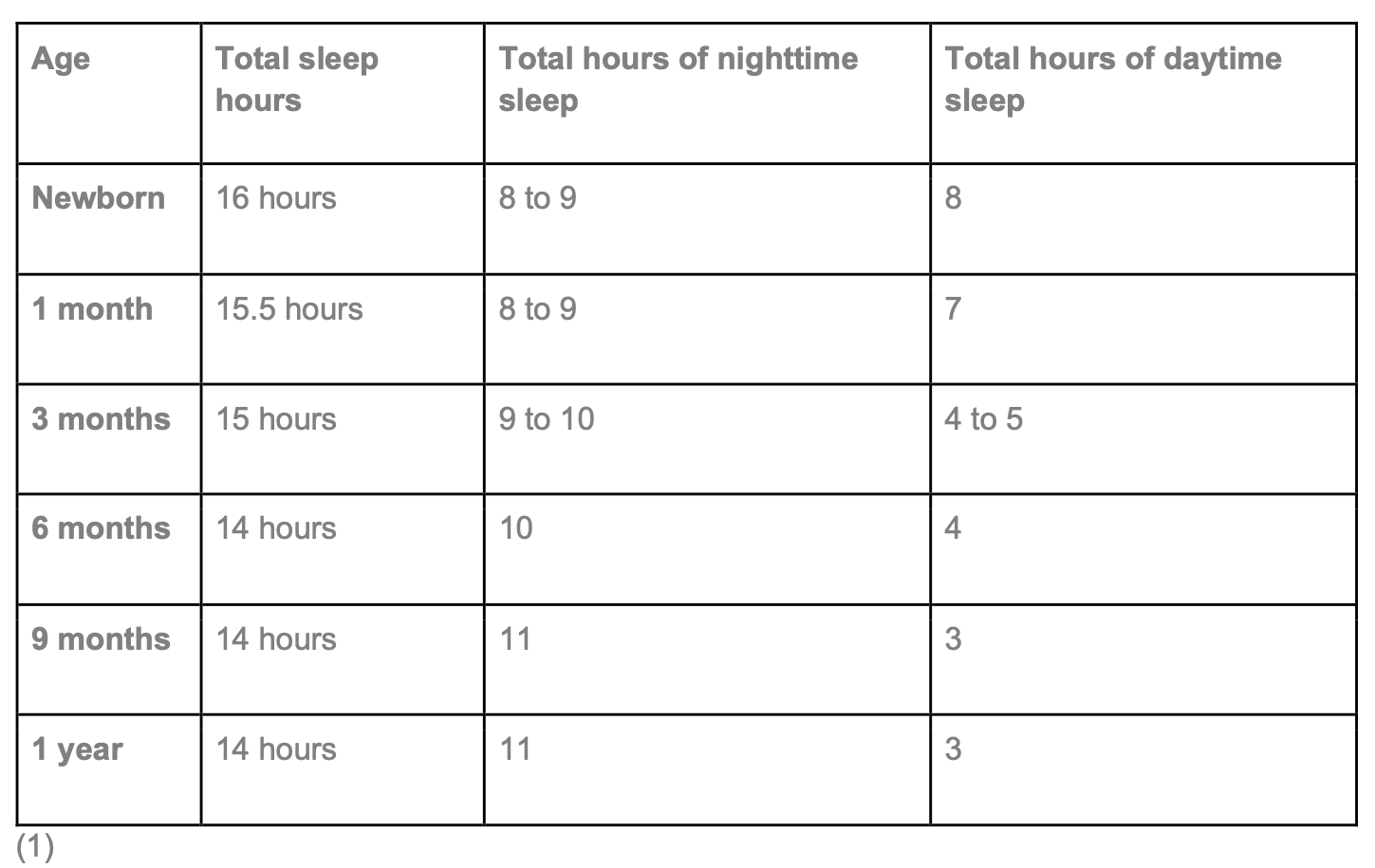
If you have a newborn, you’ve probably noticed—they sleep a lot—but not always when you want them to! Generally, newborns sleep about 16 hours—8 to 9 hours during the day and around 8 hours at night—with repeated wakings for feedings.(1)
Unfortunately, newborns won’t sleep for more than 1 to 2 hours at a time, which is exhausting for parents—waking up several times a night to feed your baby will be common in the first few months after they’re born.
Here is a table that summarizes the amount of sleep infants need from the time they’re born to their first birthday:
How Should My Baby Sleep? 5 Tips for Safe Sleeping
Here are some tips to keep your baby safe and help him get to sleep:
1. On their back
Your baby should be placed on his back to sleep—not on his stomach or side—to reduce the likelihood of SIDS or sudden infant death syndrome.(2) Once your baby learns to safely roll from his stomach to his back it’s okay for him to sleep on his stomach, but don’t put him to sleep this way.(8) It’s safest to always put your baby down to sleep on his back.
2. On a firm surface
A soft, fluffy surface can block an infant’s airway, so make sure the sheets over your infant’s mattress fit snugly and your baby’s crib, bassinet, or other sleeping arrangement meet safety standards.(2)
3. In an empty crib or bassinet
Your baby’s sleeping area should be free of plush toys, pillows, blankets, sheepskins, quilts, or bumper pads.(2) An exception is putting your baby to sleep with a dummy (known as a pacifier in the US) which can help them go to sleep. And if it falls out while your infant is sleeping, don’t sweat it.(2)
4. Swaddled
You’re likely familiar with swaddling, which has been used for thousands of years across many cultures. Swaddling is when you wrap your newborn snugly in a light blanket to recreate the sensation of being in the womb.(3) Many parents find swaddling helps soothe their baby and helps them sleep for longer stretches.(3)
Swaddling is only appropriate for newborns. Once your infant learns to roll over or is showing signs of being able to roll over, stop swaddling your infant for safety reasons.(3)
5. Appropriately dressed so they don’t overheat
Regardless of their age, don’t over bundle your baby when you put them down for bed! Dress them appropriately for sleep in the climate you live in so they don’t overheat during the night.(2)
How You Can Help Your Baby Fall Asleep
Babies aren’t born with fully developed circadian rhythms. You can help them establish one by making sure they get plenty of stimulation during the day and enough exposure to daylight.(4) However, you don’t want to keep your infant awake during the day in the hopes she’ll sleep more at night. Babies who are overtired actually have more trouble falling asleep than those who’ve had enough naps during the day!(5)
Setting up a routine for your baby to associate with sleeping. Taking a bath, getting sung to, getting changed into pyjamas in a quiet environment, and dimming the lights, can all be helpful.(4) Try to teach your baby to associate the crib with being soothed and calm.(6)
Your baby may not feel safe falling asleep on their own at first. Putting your baby to bed while they’re still awake can help them practice falling asleep without you.(4) Sleep training is another great resource for parents who want to get more than one hour of shut eye a night.
What Is Sleep Training? 5 Sleep Training Methods (4 to Try, 1 to Avoid)
There are a number of different sleep training methods out there and we’ll go over five of them so you can make an informed choice for your family.
Sleep training teaches your baby to self-soothe and go to sleep—or fall back asleep—independently. It’s usually appropriate to start when your baby is between four and six months old, as this is typically the age at which infants can learn to soothe themselves.
Here’s a brief overview of 5 sleep training methods so you can make an informed decision for yourself and your infant:
1. The Cry-It-Out Method
This method is controversial, though it was quite popular in the late 19th and early 20th century(7) it’s now seen as rather out of date and perhaps even harmful. Essentially you leave your infant to cry—alone—until he falls asleep. Parents and caregivers don’t respond to baby’s cries throughout the night or soothe them when they’re fussy.(7)
2. The Ferber Method
A less extreme method, the Ferber Method involves checking in on your baby at predetermined times and briefly comforting them. The amount of time between these intervals increases gradually, and you continue with them until your baby falls asleep on their own.(7) Comforting should only last a minute or two and involves gentle touch or speaking to your infant in a calming voice — it does not involve feeding, picking them up, or turning on the light.(8)
3. The Chair Method
The chair method involves sitting in a chair close to your baby’s crib and comforting them as needed until they fall asleep.(9) You move the chair further and further from the crib until you’re able to remove it entirely.(9) If your baby wakes up during the night, you soothe them with gentle reassurance as needed (from wherever the chair is in the process) until they fall back asleep.(9)
4. The Pick Up Put Down Method
The Pick Up Put Down Method is exactly what it sounds like! You put your baby down in their crib and if they cry or fuss, you pick them up and hold them for a bit until they calm down.(10) Once calm, you return your baby to their crib. This is repeated until your baby falls asleep.(10)
5. The Bedtime Fading Method
This method involves not putting your infant to bed at the time you deem correct, but rather tuning into your infant’s sleep cues and putting them down when they show signs of tiredness.(11) Cues such as yawning, fussing, rubbing their eyes, fluttering their eyelids, pulling their ears, etc. can all indicate your infant is sleepy.(11) When they show their sleep cues, put them to bed, and offer comfort as needed throughout the night. Then shift their bedtime by 15 minutes every few nights until it’s at your desired time.(11)
If you’re still having a hard time getting your baby to sleep through the night, it may be a good idea to consult a sleep trainer.
Interested in Learning More?
Check out the Genius Little Minds podcast episode on infant sleep! You’ll learn all about infant sleep cycles and how they differ from adults’, fascinating cultural differences in approaches to sleep and nap time, and hear parent questions on co-sleeping vs. room-sharing, the cry-it-out method, and whether pacifiers are appropriate sleep aids.
Equip yourself with knowledge and tools to help your child thrive. Subscribe here to the Genius Little Minds podcast so you never miss an episode!
References
https://www.stanfordchildrens.org/en/topic/default?id=infant-sleep-90-P02237
https://www.parents.com/baby/sleep/issues/why-the-cry-it-out-method-is-so-controversial/
https://www.parents.com/baby/sleep/basics/the-ferber-method-explained/
https://www.whattoexpect.com/first-year/sleep/chair-method-sleep-training/
https://www.whattoexpect.com/first-year/sleep/pick-up-put-down-method-sleep-training/
https://www.whattoexpect.com/first-year/sleep/fading-sleep-training-method/

PTSD Awareness: How to Help a Child Through Trauma
We often think of Post-Traumatic Stress Disorder (PTSD) as a mental illness that only soldiers suffer from. In fact, it has been referred to in the past as Shell Shock or Combat Fatigue.(1)
While PTSD is common in those individuals who have seen and experienced war, unfortunately, any person who has experienced trauma can develop PTSD.
This even includes children.
So what should you be looking for if you suspect that your child or another child in your life has PTSD? And how can you help them? Let’s talk about it.

We often think of Post-Traumatic Stress Disorder (PTSD) as a mental illness that only soldiers suffer from. In fact, it has been referred to in the past as Shell Shock or Combat Fatigue.(1)
While PTSD is common in those individuals who have seen and experienced war, unfortunately, any person who has experienced trauma can develop PTSD.
This even includes children.
So what should you be looking for if you suspect that your child or another child in your life has PTSD? And how can you help them? Let’s talk about it.
Symptoms
Common symptoms of PTSD specifically relating to the trauma include:
Flashbacks to the traumatic event
Intense distress when memories of the traumatic event are triggered
Avoidance of people or places associated with the event
Denial that the trauma happened
Reenacting the event
Those struggling with PTSD also tend to experience other symptoms such as:
Nightmares and sleep disturbances
Ongoing sadness, fear, and anxiety
Increased aggression or violent outbursts
Lack of positive emotions
Inability to show affection
Being hypersensitive to possible threats
Feelings of helplessness or hopelessness
Loss of interest in hobbies and activities previously enjoyed
Symptoms must continue for at least one month before a diagnosis of PTSD will be given. PTSD symptoms often appear around 3 months after the traumatic event but can appear months or even years after the event.
It’s essential to understand PTSD across the lifespan and how it can look different in children than it does in adults. Many professionals have worked tirelessly to develop diagnostic criteria for PTSD in children that are developmentally appropriate.(2)(3)
Children with PTSD may have unique symptoms such as having problems at school or regressing to behaviors like thumb-sucking or bedwetting. They also may be overly worried about dying at a young age.(5)
Causes
A variety of traumatic events can cause PTSD. These include:
Sexual, emotional, or physical abuse or neglect
Being a witness to or a victim of a crime
Watching serious illness or death in a loved one
Natural disasters, such as a hurricane or tornado
Serious car accidents
Invasive medical procedures
This list is not exhaustive. Any event that is traumatic can trigger symptoms of PTSD in a person.
It’s important to remember that not every person experiences and processes events in the same way. Two people can experience the exact same event and only one person may emerge with PTSD. This is totally normal and does not mean that there is anything wrong with that person. They simply need more support to work through their trauma.
Risk Factors
Some children are more likely to experience PTSD than others. Genetics play a role, along with a child’s temperament. A more anxious or nervous child may be more likely to develop symptoms of PTSD.
A history of personal mental illness or having many family members with mental illness can also make a child predisposed to developing PTSD
Treatments
Psychotherapy
Many types of psychotherapy may be beneficial to treat PTSD. Using the variety of psychotherapy methods available, a therapist or psychologist will encourage a child to speak, draw, play, or write about the traumatic event.(8) As the mental health professional and patient converse, they examine the patient’s thoughts and feelings to determine the best way to change them for the better.
Many people are hesitant to try psychotherapy but having a non-judgmental, objective person listen to the sufferer can be incredibly healing. Plus, they will also help a person navigate the best way to cope with their symptoms.
Cognitive-Behavioral Therapy
Cognitive-Behavioral Therapy (CBT) is most often the first line of treatment after a diagnosis of PTSD. This type of therapy helps children recognize their thought processes and feelings around the traumatic event. CBT helps a person identify distortions, or inaccuracies, in their thinking that are causing them harm.
Then, a mental health professional will help the child learn how to reframe their thoughts and change their behavior. They learn problem-solving skills and coping techniques to better handle their symptoms when they strike.
If there are other mental health illnesses at play, CBT is a great option.(7) CBT has been proven effective in treating many mental health disorders including anxiety disorders, depression, eating disorders, and more.
Dialectical Behavior Therapy is another technique used in CBT that gives sufferers more tools to manage their stress.(9) This method may be useful for children with PTSD to understand what emotions they’re feeling, how their reactions affect their relationships with others, and what behavioral skills can help change those emotions and reactions.
Acceptance and Commitment Therapy
Acceptance and commitment therapy is another type of psychotherapy that may be useful in treating PTSD. (9) This technique helps a child become more aware of their thoughts and feelings and works towards acceptance of them. Then, the mental health professional will encourage the child to commit to specific changes that will increase their ability to cope with their feelings and adjust better in stressful situations.
Supportive Psychotherapy
Supportive psychotherapy focuses on improving both a sufferer’s symptoms and their self-esteem.(10) The mental health professional is a source of comfort, support, and empathy to the child as they examine their emotional responses and behaviors. Praise, reassurance, and encouragement are used to help the child feel more comfortable with their emotions.
Medication
If a child is not experiencing improvements in their symptoms with therapy, medications may be prescribed as the next option. The use of medications in children should be used sparingly and under the careful supervision of mental health and medical professionals.
PTSD Awareness Month in the US
June marks PTSD Awareness Month in the United States. The goals of this event include raising awareness, understanding PTSD, and getting support. There’s an activity you can complete every day in June or you can join the Virtual Walk, walking 30 minutes every day to raise awareness for PTSD.
To check out more of the resources and events available, visit: https://www.ptsd.va.gov/understand/awareness/index.asp
PTSD affects about 4% of people worldwide.(6) It is dark and scary, but it does not have to be tackled alone.
Children experiencing PTSD need us to come alongside them and support them through this difficult illness. With the right treatment, full recovery is possible.
Check out my podcast, Genius Little Minds, for more information on topics such as Oppositional Defiant Disorder and Autism Spectrum Disorder. You can even submit questions you have about your own children at the bottom of this page!
Don’t forget to subscribe to my newsletter to stay up to date on all my latest articles and podcast episodes.
References
https://www.talkspace.com/mental-health/conditions/articles/history-of-ptsd/
De Young, A.C., Landolt, M.A. PTSD in Children Below the Age of 6 Years. Curr Psychiatry Rep 20, 97 (2018). https://doi.org/10.1007/s11920-018-0966-z
Pate, Kailey Marie, "A Comprehensive Review of Post-Traumatic Stress Disorder (PTSD) in Children" (2020). USF St. Petersburg campus Honors Program Theses (Undergraduate) https://digitalcommons.usf.edu/honorstheses/263
https://www.apa.org/ptsd-guideline/patients-and-families/cognitive-behavioral

Toddler Development: They're Getting into Everything! Your Curious 16 to 18 Month Old
Toddler Development: Your Toddler From 16 to 18 Months
Your little one sure is keeping you on your toes with all the walking, talking, climbing and playing at this age. And you may feel like you have a shadow everywhere you turn because your toddler can’t get enough of you and the exciting world around them!
Now that they’re mobile and on the go, their personality will start to shine. You may notice you have a chatty child or a quiet observer. Whatever you do or say, you’ll likely have a mini who wants to copy everything you do!

Toddler Development: Your Toddler From 16 to 18 Months
Your little one sure is keeping you on your toes with all the walking, talking, climbing and playing at this age. And you may feel like you have a shadow everywhere you turn because your toddler can’t get enough of you and the exciting world around them!
Now that they’re mobile and on the go, their personality will start to shine. You may notice you have a chatty child or a quiet observer. Whatever you do or say, you’ll likely have a mini who wants to copy everything you do!
Developing Language Skills
By this time, most toddlers are saying at least three words, and some may even know up to fifteen.(1) Their language skills may still sound like gibberish—but you’ll learn to identify what they’re trying to say over time. And you’ll notice they’ll start to string two words together based on associations to form short sentences. If you go to a park, for example, you might hear your toddler say, “Play ball!” to express what they want to do.(1)
Constantly in Motion
You’ve probably noticed your toddler is always in motion! Now that he can walk without holding onto anyone or anything, the world is his oyster! Running, dancing, walking backwards, and climbing are ways your child may assert his independence and expend his energy.(2) If your child likes to climb on things, double-check your home’s childproofing systems to keep your active toddler safe.(2)
Discovering Independence
As your toddler develops language skills, you may find you have a bossy child on your hands! Hearing them say “no!” is common at this age as they are learning to assert their independence and preferences. (1) It may feel tiresome, and you may start to wonder if you have a tiny teenager on your hands! But small acts of defiance or rebellion are normal in toddlerhood.
Toddler Development: Milestones From 16 to 18 Months
While every child develops differently, there are a few milestones to look out for at this age.
Here are some things your child will likely do by the time they’re 18 months old:
Social/Emotional Checklist(3)
Points at something interesting to show it to you
Extends their hands for you to wash them
Asserts independence but makes sure you’re still nearby
Looks at short books with you, shows an interest in pictures(4)
LIfts up a foot or puts an arm through a sleeve to get dressed
Language/Communication Checklist(3)
Can say 3 or more words aside from “mama” or “dada”
Understands up to 50 words(4)
Points to familiar people or objects in pictures(4)
Can follow simple, one-step directions (even if they’re not accompanied by a gesture)
Repeats words they overhear in conversation(4)
Shakes head yes/no in response to simple questions(4)
Movement and Physical Development Checklist(3)
Scribbles with markers, pens, pencils, etc.
Uses fingers to feed herself
Uses a cup without a lid (spilling sometimes to be expected)
Attempts to use a spoon
Walks unassisted (and seldom falls)(4)
Climbs on things without help (like a couch or chair)
Can squat to pick up a toy(4)
Cognitive Checklist(3)
Can play with simple toys (like pushing a toy truck)
Will copy your actions (like sweeping with a toy broom as you clean)
What You Can Do to Encourage Healthy Development in Your 16 to 18 Month Old
Encourage Play with Other Children
If you’re worried you’re raising a self-centered child who can’t share, don’t fret—thinking the world revolves around him is a normal part of your toddler’s development. It’s okay that he doesn’t quite understand the concept of empathy yet or know that people have feelings or thoughts that differ from his own. Let your toddler engage in parallel play, or the type of play that happens side by side with other children. Over time, he’ll acquire the skills to play well with other children his age. Offer toy options during playdates. Consider hiding favorite toys to minimize possessiveness that may inspire hitting or biting.(5)
Model Sharing (But Understand When They Don’t Want To)
Sharing probably won’t come naturally to your 18-month-old, and that’s okay. Try to model good behavior and demonstrate what sharing looks like. The concept of sharing will become easier as your child develops, but don’t rush it. Accept that parallel play is more developmentally appropriate for this age.(8) Your child probably won’t fully understand what sharing means until they’re 3 or 4 years old.(10)
Set and Enforce Boundaries (But Avoid Saying ‘No!”)
It’s natural for your toddler to want to get into everything. At this age, they’re curious about the wide world around them! But your number one priority is keeping your child safe. So even though he may object, boundaries are necessary in accomplishing that. You can narrate boundaries as you’re enforcing them. Try saying things like, “You want to be barefoot, but you need to wear sneakers at the playground.” Or, “You want to have dessert now, but your body needs a healthy dinner first.”(6) Reserve a strong “no!” for when your child is in danger or hurting others—hitting or biting another child, for example.(7) This will make it more likely that they listen to you than if you say “no” frequently.(7)
Continue to Narrate Your Day
You’re probably already used to narrating your day as a way to develop your child’s vocabulary. Keep it up! Your toddler understands a surprising amount of what you say. And the more language you expose him to, the more new words he learns! Research shows that children who are spoken to more often process and understand words at a faster rate than children who are spoken to less.(7) If you regularly point out dogs when you’re on a walk with your toddler, for example, it will be easier for him to learn the word “leash” when you say, “Look at the dog on the leash.” This is because some of the words are already familiar to him.(7)
Sing Together
Did you know rhyming songs like “Humpty Dumpty” actually have a purpose? Singing rhymes together or reciting simple poems can help your toddler understand that certain sounds, words, or letters go together. (5) What great preparation for learning to read! And if your child mispronounces a word, repeat the word with the correct pronunciation so they can hear it—and try pronouncing it—again.(7)
Do a Safety Check
18-month-olds are frequently on the move and curious about everything. Avoid toys with small parts or magnets as those pose serious hazards to children. Keep baby gates up. Teach your child how to safely get down the stairs when accompanied. Be cognizant that your child may be learning how to open doors or baby gates. If you have a pool, make sure your toddler can’t get to it to avoid a tragedy. Consider signing up your toddler for swimming lessons, too.(9) While not a substitute for adult supervision, it’s a great way to introduce water safety skills. It also encourages parents and children to have fun in the water together.(9)
Embrace Every Stage
Support your child through all stages of development! To read more blogs like this with helpful parenting tips, subscribe to my newsletter!
You can also check out the other blogs in the infant and early childhood development series for more information on how to help your child grow and learn at different stages.
References
https://www.cdc.gov/ncbddd/actearly/milestones/milestones-18mo.html
https://pathways.org/growth-development/13-18-months/milestones/
https://www.pampers.com/en-us/toddler/development/article/16-month-old
https://centerforparentingeducation.org/library-of-articles/child-development/way-children/
https://www.nytimes.com/2020/04/18/parenting/milestones/your-18-month-old.html
http://www.theparentline.org/infant-toddler-development/16-18-months/
https://www.greatkidsinc.org/sharing-is-caringand-a-developmental-milestone/

Infant Mental Health: What It Is and Why It's Important
When you think about managing mental health, what comes to mind? Perhaps you think of a therapy couch, box of tissues, and feeling loads better after getting some things off your chest.
Or maybe you’re a big believer in a bubble bath or a long run as a form of self-care.
Whatever your mental health management routine, it probably involves taking specific action to care for and nurture yourself. After all, your life is complex. You have a job, relationships and finances to manage, family obligations, and social events to attend.
And if you’re a parent, your life is even more complex because you have the lives of other people to manage as well!

When you think about managing mental health, what comes to mind? Perhaps you think of a therapy couch, box of tissues, and feeling loads better after getting some things off your chest.
Or maybe you’re a big believer in a bubble bath or a long run as a form of self-care.
Whatever your mental health management routine, it probably involves taking specific action to care for and nurture yourself. After all, your life is complex. You have a job, relationships and finances to manage, family obligations, and social events to attend.
And if you’re a parent, your life is even more complex because you have the lives of other people to manage as well!
Luckily, your infant’s social calendar is pretty empty, so you can’t imagine they have a lot to stress about. Aside from feeding, sleeping, and pooping, there’s not much on their agenda... So they can’t possibly have mental health that needs attending to, right?
Wrong!
Believe it or not, even your infant has mental health needs! Yes, even before your little one is babbling or crawling, walking or talking, their mental health is being shaped by the world around them—and their relationship with you.
Loving parent that you are, you’re doing everything you can to provide love, affection, and protection for your child.
So where do you start with their mental health needs? And what does infant mental health even mean?
What Is Infant Mental Health?
You can think of infant mental health as infant brain health.(1) Brain health is crucial to an infant’s development, and it all starts when the baby is still in the womb.
Previously it was thought that as long as pregnant women avoided harmful substances like drugs or alcohol and ate enough nutrients, they’d give birth to healthy babies.(2) But research shows that when the pregnant mother is stressed, the fetus is negatively impacted.
Risks of Prenatal Stress
Prenatal stress is associated with altered brain structure and function.(3) A child may be at an increased risk for developing ADHD or conduct disorder, having impaired cognitive development and emotional issues if a mom is stressed, depressed, or anxious during pregnancy.(3)
People stressed during pregnancy are more likely to deliver preterm or before 37 weeks.(4) Low birth weight is also associated with maternal stress during pregnancy(4) and complications can arise later for preterm babies, like chronic lung disease, learning disorders, or developmental delays. Babies who are stressed out in utero are also more likely to develop chronic health problems as adults, like diabetes, high blood pressure, or heart disease.(2)
Because prenatal stress can have a lasting impact on an infant’s health, neurocognitive development, and immune system functioning, it’s important you take care of yourself as best you can if you’re pregnant.(3) Work with your healthcare provider and social network to develop a plan to help you cope with the stresses of pregnancy.
The Impact of a Child’s Environment on Their Brain Development
Stable, nurturing, positive relationships with parents and adults help babies develop strong, healthy brains. So does stimulation, love and caring interaction.(5)
But the opposite is also true.
If a parent or caregiver is frequently absent or unable to regulate their baby, toxic stress can occur.
What Is Toxic Stress?
Toxic stress—or the prolonged activation of the body’s stress response—overloads a child’s developing systems. And it can have lifelong consequences for children.(6) Persistent negative experiences means fewer brain connections will form. And those that do will develop at a slower rate.(5)
A child’s environment helps determine which synapses are used more or less. For example, if a baby is talked to or read to often, their language development synapses are activated more often.(8) But if a baby and his family has to face severe, prolonged, or repetitive adversity, and the parent or caregiver is unable to relieve the child’s stress response, an abnormal stress response develops.(7)
The Effects of Toxic Stress on Child Development
The prolonged activation of stress hormones in infancy and early childhood can reduce neural connections when they should actually be multiplying.(6) Children who experience toxic stress in early childhood are more likely to develop long-term negative health problems that may not show up until adulthood. Poor coping skills and stress management capabilities, mental illness, and physical disease are all more likely for children who experience toxic stress.(7)
We can avoid toxic stress if the environments children are growing and developing in are stable, nurturing, and engaging.
Signs of Infant Mental Health Concerns
Raising an infant comes with challenges—there’s no doubt about that. And every parent does the best they can with the resources they have available to them. But sometimes, infants seem to struggle more than “normal.” And since infants aren’t able to communicate their needs with words, it’s important to look for signs that they may be struggling with their mental health.
Seeking support from an expert in infant and early childhood development can be helpful when challenges become chronic.
Here are some warning signs that your infant’s mental health may need some tending to:(10,11)
They don’t want to be held
They’re not comforted when they’re upset
They avoid eye contact
They have feeding and sleeping difficulties
They cry persistently
They’re restless
They display distress, fear, anxiety, and/or tension
They aren’t gaining weight
They have intestinal disturbances
They aren’t meeting developmental milestones
Understanding Infant Behavior and Development
Sometimes a parent or caregiver is unable to provide consistent, reliable care to an infant despite their best efforts. This may be due to their own mental illness, their own history of neglect or abuse, or a lack of social support, especially for single parents. Financial stress, relationship conflict, and alcohol or drug abuse can all contribute to a parent not being able to consistently meet their infant’s needs.(9)
Raising kids is hard work. There’s just no way around that. But there’s support available if you know where to look for it.
Consider the following tips to better understand your infant’s behavior and development:
Connect with an Infant Mental Health Specialist
There are actually professionals trained in newborn behavioral observation, which can be extremely helpful! Seek out an infant mental health consultation if you’re looking for insight into how to read your infant better, understand their cues, bond with them, and interact with them in ways that will encourage your relationship to thrive.(9)
Learn About Attachment Theory
An attachment is an emotional bond that forms between two people, and children seek closeness with their attachment figures to find safety and comfort. When an adult responds to an infant’s needs in an appropriate way, secure attachment becomes possible. Learn about the four attachment styles to understand your own way of relating to others and to know if your child is securely attached to you (or not).
Seek out Your own Mental Health Resources
Often times, the way we were raised impacts the way we raise our kids. It can be helpful to seek your own therapy to understand your family of origin and process any mental health blocks you may be facing that’s impacting your ability to be there effectively for your child. There’s never any shame in asking for help!
Interested in Learning More?
Check out this podcast episode on infant brain development. You’ll get a deeper look at the topics covered in this blog and much more! Tune in to get a basic overview of your baby’s brain—how it’s growing in and out of the womb and what makes them kick—plus dive into Piaget’s stages of cognitive development and how this theory can help you understand your infant better. You’ll also learn about how many neurons your baby’s brain has when they’re born—hint: it’s as many stars as there are in the Milky Way!
Equip yourself with knowledge and tools to help your child thrive. Subscribe here to the Genius Little Minds podcast so you never miss an episode!
References
Clinton, J., Feller, A. F., & Williams, R. C. (2016). The importance of infant mental health. Paediatrics & child health, 21(5), 239–241. https://doi.org/10.1093/pch/21.5.239
Glover, V. (2019). The effects of prenatal stress on child behavioural and cognitive outcomes start at the beginning. Encyclopedia on Early Childhood Development. https://www.child-encyclopedia.com/stress-and-pregnancy-prenatal-and-perinatal/according-experts/effects-prenatal-stress-child
(2019, October). Stress and pregnancy. March of Dimes. https://www.marchofdimes.org/complications/stress-and-pregnancy.aspx
https://www.firstthingsfirst.org/early-childhood-matters/brain-development/
Toxic Stress Derails Healthy Development. (2011, September 29). [Video]. YouTube. https://www.youtube.com/watch?time_continue=26&v=rVwFkcOZHJw&feature=emb_logo
Franke H. A. (2014). Toxic Stress: Effects, Prevention and Treatment. Children (Basel, Switzerland), 1(3), 390–402. https://doi.org/10.3390/children1030390
(2021, April). Styger, K., Zadroga, J. Infants have mental health needs, too. Mayo Clinic. https://www.mayoclinichealthsystem.org/hometown-health/speaking-of-health/infants-have-mental-health-needs-too
Stapert, E. Infant mental health – what is it and why is it important? Manhattan Psychology Group. https://manhattanpsychologygroup.com/infant-mental-health-what-is-it-and-why-is-it-important/

How to Maintain Structure and Stimulation Throughout Summer Break: 3 Practical Ideas
School is out for the summer, and you are ready to have some fun!
However, all of the extra hours spent at home with your kids can quickly lead to boredom and unwanted behaviors. Your child’s environment and schedule have changed overnight, and this can be triggering for many children.
So how do you start off the summer on the right foot and manage to keep everyone happy all summer long? I’ve got three practical tips for you!

School is out for the summer, and you are ready to have some fun!
However, all of the extra hours spent at home with your kids can quickly lead to boredom and unwanted behaviors. Your child’s environment and schedule have changed overnight, and this can be triggering for many children.
So how do you start off the summer on the right foot and manage to keep everyone happy all summer long? I’ve got three practical tips for you!
Create a Schedule as a Family
Before summer starts, sit down as a family and set expectations for the summer. Ask your children what they are interested in doing and what events they have scheduled throughout the summer. Let them know what you have planned for the family to do. Communication is key to success here.
Then, outline what a typical day will look like. When will everyone wake up? When will meals be served? What activities will fill all the time in between?
Try to include time for:
Reading - Encourage your children to read fun and educational books. Challenge them to read about a new interest or in a new genre.
Creative Expression - Not all children enjoy arts and crafts to the same extent, but creativity is a valuable skill that needs to be practiced.(1) If you do structured craft activities, try to incorporate your child’s interests into the project to get them more excited about it.
Educational activities - This does not necessarily have to be worksheets! Younger children could practice writing letters with a stick in the dirt outside. Older children could practice counting the change you spend at the restaurant. Opportunities for learning are everywhere!
Chores - Make them age-appropriate and consistent to involve your child in the upkeep of their room and home throughout the summer.
Physical exercise(2) - Hopefully, some of this physical exercise can happen outdoors. If the weather where you live does not allow for this, look for gross motor activities they can do at home or search your local area for indoor playgrounds or gyms.
Rest or a nap - Depending on the age of your child, make sure that they are getting enough sleep. Even if they are too old for a nap, try to encourage them to have quiet time each day. This gives them a chance to rest and recharge.
If possible, make it visual. Children do better with transitions and expectations if they can visually see what is expected of them.(3)
Some ideas for a visual include repurposing an old clock to show what activities correspond with each hour of the day. Or you can make a chart that has a box for each activity with the time that it starts and ends.
Try involving your child in the making of this visual aid. If they are younger, they could simply color in the boxes or draw a few doodles in one corner. If they’re a bit older, they could help write the labels or figure out how long will be needed for each activity.
The more involved and included your children feel in making the schedule, the more likely they are to be more willing participants in it.
Stick to Regular Times for Meals and Bed
It’s easy to let all the fun activities and adventures of summer throw off the timing of meals and bed.
While this is fine to do sometimes, it’s best to not make it a regular occurrence. A hungry or tired child can be cranky and irritable; exactly the opposite of what you want on your summer adventures.
When your family is at home, have a set time that everyone wakes up and a set time for bed. Even if your child is awake before that time, let them know that they need to stay in their room and do something quiet. This allows everyone in your home the opportunity to get the sleep they need.(4)
Having set times each day for meals serves two purposes. It helps your child not get overly hungry, but it also prevents excessive snacking. We still want our kids to eat nutritious, well-balanced meals, even when they have access to the kitchen all day long.
Children are used to having a set time to eat at school. Their little bodies will benefit from continued regularity in their eating schedule.
Remember that your schedule does not have to hold your family back from having fun experiences and visiting exciting places even if these adventures can’t logistically fit exactly into your schedule. That’s okay!
If your child’s schedule is going to be thrown off, prepare for it ahead of time. If dinner is going to be served late, bring some snacks along. If bedtime is going to be pushed back an hour, plan for extra rest time the next day.
Get Out and About!
Getting out of the house and exploring can be fun no matter the age of your children! It also gives them the chance to continue to learn through the summer.
Great places to visit could be the zoo or aquarium to learn about animals. You could also visit your local parks so your children can work on their gross motor skills and get some much-needed physical exercise. Wilderness camps or clubs can also be a fun outlet for exercise and to give your child a place for social interaction.
Visit your local library often to keep your kids reading throughout the summer months. Consider encouraging your children to complete a reading challenge like reading 20 books over the summer or reading one book from each major genre. Ask your local librarian if there are story times or reading clubs that your children can participate in.
These are just a few ideas that you and your children might find fun to do together. Check your local newspaper or online to see what other events may be uniquely offered in your community.
Summer should be a time for fun and bonding with our children. With the right structure and expectations in place, this summer will be one your family will never forget!
For more tips on parenting and childhood mental health, subscribe to my newsletter or check out my podcast.
References
https://nido.edu.au/news/why-creative-expression-is-so-important-for-children/
Chaddock-Heyman, L., Hillman, C.H., Cohen, N.J. and Kramer, A.F. (2014), III. THE IMPORTANCE OF PHYSICAL ACTIVITY AND AEROBIC FITNESS FOR COGNITIVE CONTROL AND MEMORY IN CHILDREN. Monographs Society Res Child, 79: 25-50. https://doi.org/10.1111/mono.12129
https://classroom.synonym.com/benefits-visual-aids-5040418.html

Secure Attachment with Your Infant: What It Is and How to Develop It
Whether you’re a first-time parent or have kids already, one thing is certain — you love your children and would do anything for them. But there’s a lot of noise about how to do this parenting thing “right” — so how do you determine what to tune out and what to tune into?
Tuning in to your infant’s needs is really at the core of attachment theory.
What is Attachment Theory?
An attachment is an emotional bond that forms between people.(1) We create bonds with all types of people throughout our lifetime — friends, loved ones, and family. Evolutionarily, attachment serves a purpose. An infant who stays physically close to her primary caregiver is generally more likely to survive.(2)

Whether you’re a first-time parent or have kids already, one thing is certain — you love your children and would do anything for them. But there’s a lot of noise about how to do this parenting thing “right” — so how do you determine what to tune out and what to tune into?
Tuning in to your infant’s needs is really at the core of attachment theory.
What Is Attachment Theory?
An attachment is an emotional bond that forms between people.(1) We create bonds with all types of people throughout our lifetime — friends, loved ones, and family. Evolutionarily, attachment serves a purpose. An infant who stays physically close to her primary caregiver is generally more likely to survive.(2)
Children naturally seek closeness with their attachment figures to feel safe and be soothed. Infants especially need trustworthy adults to feel a sense of well-being and safety.(3)
Think of a time in your own life when you were particularly distressed and you reached out to someone for comfort. Knowing someone was there for you was soothing, right?
It’s the same thing for babies. It’s soothing to be seen.
We aren’t born with the ability to self-regulate — this is a behavior learned from caregivers.(4)
When an adult responds appropriately to an infant’s needs, secure attachment becomes possible. A baby is more likely to securely attach to someone who responds to their needs with sensitivity, calm and regularity. Lack of consistency and responsiveness is very distressing, especially for infants.
You can follow every trick in the book — breastfeeding, skin to skin contact, co-sleeping situations — there’s so much parenting advice out there, it can be hard to know what’s what! But at the end of the day, the most important thing is the relationship you’re forming with your baby. And tuning in to your infant’s needs is crucial to developing a secure attachment.
Biological parents aren’t the only ones a baby can securely attach to. A secure attachment can be formed with a mom, a dad, an aunt, a grandparent — however your family looks, forming secure attachment is possible.
The Four Attachment Styles
Psychologists Bowlby and Ainsworth developed a theory that there are four attachment styles: secure, anxious, avoidant, and disorganized.(5)
1. Secure Attachment
If a child is brought up in an environment where the caregiver is responsive and attuned to their emotional needs, a secure attachment is formed. The child learns that if they need something, someone will be there for them. Their needs are met and their emotions are acknowledged, so they feel supported and loved, and learn they can trust others. If the infant has a safe, predictable, attuned relationship with at least one caregiver, neural structures in the brain that contribute to infant well-being will form.(6) This doesn’t mean mistakes won’t be made! But if a parent does misinterpret an infant’s cue — trying to feed them when they want a nap, for example — it doesn’t mean a secure attachment won’t form. The parent just has to make a repair attempt and try again to understand their baby’s needs.
2. Anxious Attachment
Anxious attachment is formed when a parent or caregiver is intrusive, inconsistent, or misattuned.(7) Sometimes they’re responsive to the infant’s needs, sometimes they aren’t. The infant becomes confused and doesn’t know what to expect. Will someone be there when they cry and need soothing? Will they be fed when they’re hungry? Will they be changed when they’ve soiled their diaper and are uncomfortable? When a child becomes anxiously attached, they desire closeness, but they also have a fear of abandonment. This can cause issues later in life in their adult relationships. Researchers estimate that parents only have to understand their baby’s cues a third of the time for secure attachment to be possible.(8) So anxious attachment is more likely if there’s chronic misattunement or intrusiveness.
3. Avoidant Attachment
Avoidant attachment, on the other hand, happens when a parent is emotionally distant.(9) When the baby is crying or seeking connection, especially when they’re distressed, the parent rejects that bid for closeness. The parent might be irritable or emotionally rigid, so the infant learns not to seek comfort from others when they’re anxious. Over time, a person with avoidant attachment learns to be overly self-reliant. They become uncomfortable with closeness because they’ve learned it’s not safe to depend on others.
4. Disorganized Attachment
Disorganized attachment is formed when a child depends on someone who also scares them. It’s often found when parents physically, emotionally, or sexually abuse their children.(10) But that kind of trauma doesn’t have to be present for this type of attachment to form. Chaotic (but not necessarily abusive) dynamics can also cause disorganized attachment. With disorganized attachment, the caregiver is unpredictable and frightening, so the child learns being close to others is unsafe.(10)
How to Create Secure Attachment with Your Baby
You’re probably wondering how you can develop secure attachment with your infant. Here are five things you can do to promote secure attachment and wellbeing within your relationship.
1. Learn Their Cues
Pay attention to and learn your child’s cues. Every baby is different! What worked for your first born may not work for your second child. Think of yourself as a sensory sleuth trying to figure out what your baby is communicating with their facial expressions, movements, coos or cries. Understand when your baby needs to be held versus played with. Learn what kind of touch comforts them and what type of environment they enjoy. Do they like peace and quiet or soft music playing in the background? Do they want to be rocked when they’re fussy or is motion not comforting?(8) Have patience with yourself because learning these cues will take time! And remember, even if you get a cue wrong on the first guess, if you make an attempt to repair the disconnect and figure out what your baby needs, you can still be on track to building a secure attachment!(8)
2. Mirror Your Baby
Mirroring, playing with and laughing with your baby also help form secure attachment. Mirroring is a psychological term that means reflecting the affect, behavior or body language of another person.(11) So when you smile at your baby and she smiles back at you, you’re engaging in mirroring. Mirroring is so important for children because it gives them the experience of being seen and makes them feel validated.(12) Even though your infant won’t remember playing peek-a-boo with you, or how you giggled at her so she would giggle back, she will remember how you made her feel. Mothers who are securely attached mirror their infant twice as often as mothers who aren’t.(13)
3. Create a Mutual Relationship
Mirroring is part of creating a mutual relationship with your child. Don’t let the relationship be dominated by what you need — put what the baby needs first. Remember when I talked about intrusive behavior from the caregiver? If you’re initiating play with your infant when all she really wants and needs is to take a nap, that’s intrusive. You’re making it about your needs, not hers. And she probably won’t be much fun if she’s exhausted, anyway! Don’t be smothering. Go along with it when your baby initiates interactions or play. Creating a mutual relationship becomes more possible as you learn cues and get in tune with her. All of which comes with practice and time and the monitoring of your own needs.(14)
4. Do Your Own Internal Work
Taking care of yourself is so important when you have children. It may feel impossible to take care of your own needs when you have a newborn because you’re on constant sleep, feed, and diaper change duty. But as your children grow up, you may find yourself reflecting on how you were parented as a child and whether or not you want to parent your child the same way.(12) Doing your own internal homework can help you navigate the messages that were sent to you as a child by your parents and whether you want to send the same messages or say something different.(12) The more space you have to be present with your own experience, the more you’ll be able to be present with your child.(12) And learning about your own family of origin and attachment style can be useful when trying to figure out how to parent.
5. Be as Consistent as You Can
Respond to your baby’ distress as consistently as you can. Babies whose needs are met consistently are more likely to develop higher self-confidence and better self-image later in life. They learn they are respected, worthy, and lovable, which impacts their relationships and the way they navigate the world as they grow.(15) Research shows that children who form a secure attachment early in life score higher in agreeableness and conscientiousness and lower in neuroticism.(16) The reverse is also true. Children with insecure attachments early in life score higher in neuroticism and lower in agreeableness and conscientiousness.(16)
Interested in Learning More?
Check out this podcast episode on Attachment Theory. You’ll learn surprising facts about whether breastfeeding, natural birth, and taking space from your infant helps or hurts secure attachment. Plus so much more!
Equip yourself with knowledge and tools to help your child thrive. Subscribe here to the Genius Little Minds podcast so you never miss an episode!
References
Cherry, K. (2022, May). What is attachment theory? The importance of early emotional bonds. Very Well Mind. https://www.verywellmind.com/what-is-attachment-theory-2795337
McCleod, S. (2017, February). Attachment theory. Simply Psychology. https://www.simplypsychology.org/attachment.html
(2021, April). Infants have mental health needs to. Mayo Health Clinic. https://www.mayoclinichealthsystem.org/hometown-health/speaking-of-health/infants-have-mental-health-needs-too
(2018, October). How emotional attunement can transform your relationships. Emotional Enhancement. https://www.emotionenhancement.com/single-post/how-attunement-can-transform-your-relationships
Li, P. (2022, April). Attachment styles — how they affect your parenting. Parenting for Brain. https://www.parentingforbrain.com/attachment-styles/
Li, P. (2022, April). Dismissive avoidant attachment — what it is, causes and signs. Parenting for Brain. https://www.parentingforbrain.com/dismissive-avoidant-attachment/
(2022, February). Anxious attachment style: causes and symptoms. Attachment Project. https://www.attachmentproject.com/blog/anxious-attachment/
Robinson, L., Saisan, J., Smith, M., Segal, J. (2020, October). Help Guide. https://www.helpguide.org/articles/parenting-family/building-a-secure-attachment-bond-with-your-baby.htm
(2015, April). Building a secure attachment with your baby. CAPPA https://cappa.net/2015/04/18/building-a-secure-attachment-with-baby/
Li, P. (2022, April). Disorganized attachment: understanding how it forms and how to heal. Parenting for Brain. https://www.parentingforbrain.com/disorganized-attachment/
(2013, October). How to parent with attunement and creativity. The Attached Family. http://theattachedfamily.com/membersonly/?p=4214
Kim, S., Fonagy, P., Allen, J., Martinez, S., Iyengar, U., Strathearn, L. (2014). Mothers who are securely attached in pregnancy show more attuned infant mirroring 7 months postpartum. Infant Behavior and Development, 37(4) 491-504. https://doi.org/10.1016/j.infbeh.2014.06.002
(2016, May). Five ways to create a secure attachment with your baby, without sharing your bed. PsychCentral. https://psychcentral.com/lib/five-ways-to-create-a-secure-attachment-with-your-baby-without-sharing-your-bed#3
Cuddling does kids (and parents) good. Children’s Hospital Los Angeles. https://www.chla.org/blog/rn-remedies/cuddling-does-kids-and-parents-good
Young, E. S., Simpson, J. A., Griskevicius, V., Huelsnitz, C. O., & Fleck, C. (2019). Childhood attachment and adult personality: A life history perspective. Self and Identity, 18(1), 22–38. https://doi.org/10.1080/15298868.2017.1353540

More Than Childhood Fear: How to Identify and Address a Specific Phobia
Many children hang on their mother’s leg with apprehension on the first day of kindergarten. Other children struggle to sleep some nights because of the monsters they think are under the bed. Or maybe the trip to the dentist each year is a source of anxiety for your child.
These are all normal childhood fears. They are specific to one experience, and they can be worked through, and the child quickly moves on from them.
When a child’s fears become disproportionate to the actual situation and are long-standing, bleeding into many areas of the child’s life, there may be more going on, such as a Specific Phobia.
A Specific Phobia centers on one particular activity, object, animal, or situation. The fear that the child feels drives them to avoid that trigger at all costs. An inability to avoid the trigger causes intense distress.

Many children hang on their mother’s leg with apprehension on the first day of kindergarten. Other children struggle to sleep some nights because of the monsters they think are under the bed. Or maybe the trip to the dentist each year is a source of anxiety for your child.
These are all normal childhood fears. They are specific to one experience, and they can be worked through, and the child quickly moves on from them.
When a child’s fears become disproportionate to the actual situation and are long-standing, bleeding into many areas of the child’s life, there may be more going on, such as a Specific Phobia.(1)
A Specific Phobia centers on one particular activity, object, animal, or situation. The fear that the child feels drives them to avoid that trigger at all costs. An inability to avoid the trigger causes intense distress.
Some types of specific phobias include:(2)
Fear of water (Aquaphobia)
Fear of the dark (Nyctophobia)
Fear of thunder and lightning (Astraphobia)
Fear of insects (Entomophobia)
Fear of dogs (Cynophobia)
Fear of places or situations that might cause panic (Agoraphobia)
Fear of social situations (Social Phobia)
This isn’t an exhaustive list. There are many other things that children may develop a Specific Phobia around. Looking for the tell-tale symptoms and speaking to a mental health professional are the best ways to determine if your child is suffering from a Specific Phobia.
Symptoms
Children with Specific Phobia can experience both emotional and physiological symptoms. The emotional symptoms of intense, unrealistic fear and panic around a specific situation or thing are what most people think of when they think of a Specific Phobia.(2) However, children can also feel a compelling need to avoid the object of their anxiety. This need for avoidance shapes their behavior and influences how they make decisions.
Physical symptoms that are experienced with Specific Phobia can include headaches, stomachaches, a racing heart, trembling, difficulty breathing, sweating, and feelings of weakness.(5) Children can experience any combination of these physical symptoms in addition to the emotional symptoms they experience.
Specific Phobia can interfere with many aspects of a child’s life by disrupting their sleep patterns or ability to have fun.(4) It can also cause concentration problems that often result in behavior issues in the classroom. If the symptoms of Specific Phobia have progressed to this point, the child needs help from a mental health professional.
Causes
The three main causes of Specific Phobia are predisposition, genes, and environment. Predisposition speaks to a child’s personality. Some children are more prone to be anxious and are less capable of handling stressors in their lives.
Mental illnesses can be hereditary or related to genetics.(3) A child with more anxious people in their family history is more likely to be diagnosed with a Specific Phobia. Finally, if a child’s environment is stressful, that can also be a cause of Specific Phobia. These environments could include living in a volatile home, feeling stressed at school, having parents going through a divorce, or a loss of a family member.
Very rarely is just one of these factors at play with a diagnosis of Specific Phobia. More often two or three factors are involved to varying degrees.
Treatments
Cognitive Behavioral Therapy (CBT) is often the most effective type of therapy to treat a Specific Phobia.(7) CBT works to help a child identify their thought patterns and how those thoughts may be helping or hurting them. As they begin to recognize what their thought patterns are and the power that they hold, children can work to change those thoughts and, in turn, change their behavior.
One technique of CBT, known as Graded Exposure, helps children systemically face their fears and more effectively manage their symptoms.(6) Through repeated practice of Graded Exposure, a child can gain mastery over their fear.
The mental health professional may help your child understand how the outcome that they imagine when they are anxious is not realistic. They might teach your child how to use self-talk to combat fear. Therapy sessions may also consist of your child learning various relaxation techniques, like breathing exercises.(6) The exercises are great for you as the parent to learn as well so that you can help coach your child through them when they are anxious.
For a child suffering from a Specific Phobia and their parents, an effective technique like Graded Exposure can be an amazing tool. So let me tell you a bit more about implementing Graded Exposure with your child.
Graded Exposure
While treatment of a Specific Phobia should always be overseen by a mental health professional, there are strategies that can be practiced at home to help your child.
My anxiety disorder series, I’M AFRAID, has a book focused on Specific Phobia. Sophia Swan Is Afraid of Water! follows Sophia as she faces her intense fear of water. She uses Graded Exposure to slowly expose herself to water and address her fear step-by-step.
This book can be a wonderful tool to see the practical application of Graded Exposure. Your child may see themselves in Sophia. They can watch as a character that feels the same fear that they do is able to succeed in facing her fears.
The book also has a page outlining this stepladder approach and other coping strategies that may be useful.
Other Therapy Strategies
The mental health professional you partner with may also try other techniques to help your child address their fear.
Role-playing techniques can be a great tool to work through a worst-case scenario that a child is picturing. Through role-playing, the child can most often see how that scenario is not likely or even not possible.
A mental health professional can help a child find the combination of different strategies that work best specifically for them. They can also provide the space and encouragement to continue to practice these techniques until the child is able to use them successfully.
Remember, some childhood fears are normal. The many new and unusual things that a child experiences are bound to bring out some feelings of trepidation. However, if any anxiety is beginning to seem prolonged and unrealistic, reach out for help.(2) Even if there is no diagnosis, it never hurts to have someone come alongside you and your child and give you strategies to cope with anxiety.
Pre-order Sophia Swan Is Afraid of Water! HERE. To check out other books in the I’M AFRAID anxiety disorder series, visit: www.DrMadeleineVieira.com/books/imafraid
Would you like more information on childhood anxiety? Listen to my Genius Little Minds two-part podcast series on childhood anxiety disorders now! Click here for part 1 and Click here for part 2.
And don’t forget to subscribe to my monthly newsletter to stay up-to-date on the latest blogs and podcasts on infant and childhood mental health!
References
https://www.mayoclinic.org/diseases-conditions/specific-phobias/symptoms-causes/syc-20355156
https://adaa.org/understanding-anxiety/additional-disorders/phobias
https://adaa.org/understanding-anxiety/specific-phobias/symptoms
https://www.mayoclinic.org/diseases-conditions/specific-phobias/diagnosis-treatment/drc-20355162
https://www.nhs.uk/mental-health/conditions/phobias/treatment/

Why Is My Child Acting Out? Oppositional Defiant Disorder Explained
Some kids are just “bad kids.” You know the ones. They run down the aisle screaming at church. They have meltdowns in the supermarket. They don’t listen, they talk back, and they laugh in the face of authority. They can’t be controlled by their parents or teachers.
In short, they’re a menace with a capital M.
Except… there’s no such thing as a “bad kid,” is there? There are good kids who need help… Kids who start to believe the worst about themselves because they’ve come to expect negative reinforcement from their parents, other adults, or their peers…
Believe it or not, that kid yelling obscenities at his mother in the school parking lot probably doesn’t want to be doing that. But children with oppositional defiant disorder, or ODD for short, have difficulty controlling their impulses and making healthy, developmentally appropriate choices.

Some kids are just “bad kids.” You know the ones. They run down the aisle screaming at church. They have meltdowns in the supermarket. They don’t listen, they talk back, and they laugh in the face of authority. They can’t be controlled by their parents or teachers.
In short, they’re a menace with a capital M.
Except… there’s no such thing as a “bad kid,” is there? There are good kids who need help… Kids who start to believe the worst about themselves because they’ve come to expect negative reinforcement from their parents, other adults, or their peers…
Believe it or not, that kid yelling obscenities at his mother in the school parking lot probably doesn’t want to be doing that. But children with oppositional defiant disorder, or ODD for short, have difficulty controlling their impulses and making healthy, developmentally appropriate choices.
What is Oppositional Defiant Disorder?
Oppositional defiant disorder (ODD) is a behavior disorder that’s typically diagnosed in childhood between the ages of 6 and 8 (3). Children with ODD can be defiant, hostile, exceptionally uncooperative, and argumentative.(1)
ODD Symptoms(2)
If your child has ODD, you may notice they frequently have an angry and irritable mood and are:
Easily annoyed by other people
Resentful
Often losing their temper
If your child has ODD, you may notice defiant, argumentative behavior where they:
Argue with authority figures frequently
Defy adults and refuse to follow rules
Deliberately annoy and upset other people
Blame others for their own mistakes, misbehaviors, or wrongdoings
If your child as ODD, you may notice vindictive behavior where they:
Behave spitefully
Try to “get back at” someone they feel has wronged them
But children with ODD aren’t having your typical toddler tantrum or teenage rebellion. Just because your toddler learned the word “no” and loves saying it to everyone and everything, for example, does not mean they have oppositional defiant disorder.(2) For a parent of a child with ODD, things like screaming matches, angry or aggressive behavior, expulsions from school, or daily rule breaking are the norm.(4) And it can be really hard on families.
In children with ODD, the oppositional and defiant behavior is persistent, extreme, and significantly interferes with their ability to function in school or have relationships with others.(1) It also has to be going on for at least 6 months in order to be diagnosed as ODD.(2)
Is ODD Genetic?
Biological, genetic, and environmental factors may all play a role in a child developing oppositional defiant disorder.(5) Unbalanced neurotransmitters may play a role too, as many children with ODD also have other mental health disorders, such as ADHD or mood disorders.(5)
Risk Factors for ODD:
Lack of supervision(11)
Poverty(11)
An unstable or dysfunctional home life(11)
Exposure to violence or aggressive behavior(8)
A family history of substance abuse(8)
Abuse or neglect(8)
Inconsistent parenting and disciplining(7)
A parent or close relative with mental illness(7)
You may be thinking, “Now, wait a minute. I’ve given my child everything! Nothing you’ve described sounds like our family. There’s no violence, no drugs. The rules are clear, easy to follow, and my child still has these out-of-control outburst and anger issues.”
A chaotic, stressful home life can contribute to mental health problems, there’s just no way around that. But even in a stable home, some children will develop oppositional defiant disorder.
Genetics may also be a factor. If a child has a close relative with mental illness, they are more likely to develop ODD.(7) Oppositional defiant disorder occurs more commonly among children whose family members have a history of ADHD, mood disorders like depression or bipolar disorder, and substance use disorders.(8)
Comorbidity
Children with ODD may struggle with one or more of the following:(9)
ADHD
Conduct disorder
Mood disorders (anxiety and depression)
ODD Diagnosis
You love your child desperately… You’d do anything for them. You’d die for them! But at this rate, you’re finding it very difficult to like them.
You know the angry outbursts, temper tantrums, spiteful behavior and arguments are, well… not exactly normal. So what’s a parent to do?
A medical doctor or mental health professional like a child psychologist or psychiatrist can diagnose oppositional defiant disorder. It’s likely they’ll want to talk to you, the parent or caregiver, and your child to conduct an assessment. They may also want to speak to your child’s teachers and conduct an assessment at school, depending on where your child exhibits their ODD symptoms.
What’s the Outlook for Kids with ODD?
About two thirds of children diagnosed with ODD overcome the disorder and don’t show behavioral symptoms anymore by the time they’re 18. (7) Amazing news, right?
It’s so important that your child get help if you think they do have ODD. Left untreated, severe oppositional defiant disorder can become conduct disorder, which is a more serious, delinquency version of ODD. But when treated early, prognosis is much better. Studies have shown that ODD symptoms resolve within 3 years in about 67% of children with the diagnosis.(14)
Treatment
There are many treatment options for children with ODD, and they will likely involve the whole family!
Family Therapy
ODD can be very taxing for parents and difficult on siblings. Family therapy can help improve communication skills, suggest systemic changes that need to be made within the family unit, and provide support for the entire family.(1) Being involved in your child’s treatment plan is important. Share your concerns, goals, and hopes with your child’s care team.
Parent-Management Training
Want to learn how to manage your child’s behavior? There’s a class for that! In parent-management training, you’ll be taught positive reinforcement techniques and how to discipline effectively.(14) Ask your child’s therapist or doctor for information on where to sign up.
Cognitive Behavioral Therapy
Often, children with ODD don’t understand that their defiant and aggressive behavior is wrong or unjustified. When asked why they behave the way they do, they might say, “because my parents are always on case.” In therapy, your child will master social skills and learn that he’s capable of making different, healthier choices.
Cognitive Behavioral Therapy (CBT) helps tackle unhelpful patterns of thinking and replaces them with healthier patterns.(10) In therapy, your child may role play scenarios he might encounter with family or friends and practice more adaptive, appropriate behaviors.
Peer Group Therapy
This can be a great resource if your child struggles to interact and socialize with peers. ODD can be hard on friendships. Peer group therapy provides a safe space for children with ODD to practice getting their social interactions right so they feel safe to try things out in the real world.
Medication
Typically, medication is not recommended to treat ODD unless another underlying condition like ADHD needs to be addressed.
Interested in Learning More?
Check out this podcast episode on ODD. You’ll learn five surprising questions you should ask yourself if you think your child has oppositional defiant disorder… and you’ll learn more about the parent-child relationship and how it can impact your child’s mental health. This is an episode you won’t want to miss!
Equip yourself with knowledge and tools to help your child thrive. Subscribe here to the Genius Little Minds podcast so you never miss an episode!
References
https://www.hopkinsmedicine.org/health/conditions-and-diseases/oppositional-defiant-disorder
https://www.healthline.com/health/childrens-health/odd-in-children
https://my.clevelandclinic.org/health/diseases/9905-oppositional-defiant-disorder
https://www.additudemag.com/what-is-oppositional-defiant-disorder/
https://www.sonorabehavioral.com/behavioral/odd/symptoms-causes/
https://www.apa.org/ptsd-guideline/patients-and-families/cognitive-behavioral

Toddler Development: The Amazing Things Your 13 to 15 Month Old Can Do!
Toddler Development: Your Toddler From 13 to 15 Months
You made it through your baby’s first year! Way to go. Give yourself a pat on the back and kick up your feet.
Don’t take a rest for too long, though — you have a toddler now, and they’ll surely keep you on your toes!
You’re probably eagerly awaiting the day when your child takes their first unsupported steps — so grab the camera because between 13 and 15 months, that milestone will likely be reached, as well as many others.

Toddler Development: Your Toddler From 13 to 15 Months
You made it through your baby’s first year! Way to go. Give yourself a pat on the back and kick up your feet.
Don’t take a rest for too long, though — you have a toddler now, and they’ll surely keep you on your toes!
You’re probably eagerly awaiting the day when your child takes their first unsupported steps — so grab the camera because between 13 and 15 months, that milestone will likely be reached, as well as many others.
Walking
All children develop at their own pace, but with toddlerhood comes the exciting milestone of learning to walk! Many children take their first independent steps around 14 months.(1) Before a baby can walk, they need the coordination and muscle strength to pull themselves up to a standing position and then stay standing, either by holding onto furniture or a caregiver.(2) Babies will pull themselves up to stand about 2 to 4 months before they take their first unsupported steps.(2)
When learning to walk, your toddler might fall down a lot! And that’s okay. Perfecting their strut doesn’t happen all at once, so prepare for your baby to fall down or start and stop frequently as they’re learning.(3)
Talking
By this age, your toddler may be able to say two to four words.(6) And you may start hearing them over and over again! (Though it might be “ba” for ball, not the full word yet!) Your toddler will also make lots of babbling sounds and respond to their name. As she learns more and more words, your toddler will learn what it means when you say things like, “Where is your truck?” And then she’ll go look for it. Songs and rhymes will also continue to delight your toddler. And even though she may not know the word for something, if she wants it, she’ll point to it to ask for it.(6)
Personality Grows as Your Toddler Discovers Her Independence
With toddlerhood comes an emerging personality! So your toddler will likely be pretty vocal about their likes and dislikes — and you can expect some tantrums to emerge at this age. Toddlers experience frustration because they aren’t able to adequately communicate how they feel or what they want from adults.(8) You can imagine how frustrating that must be! So try to exercise patience and be compassionate toward your toddler.
Some more fun parts of your toddler’s personality will start to emerge as well, like a sense of humor. Your child may start to find lots of things really funny! So enjoy the ups and downs of the journey and find the humor where you can, too.
As your little angel grows, so will her independence and sense of self.(9) You may even find your toddler tries to help you dress her by holding out an arm or leg as you do so.(9)
Toddler Development: Milestones From 13 to 15 Months
While every child develops differently, there are a few milestones to look out for at this age.
Here are some things your child will likely do when they’re between 13 to 15 months old:
Social/Emotional Checklist(7):
Shows affection to parent or caregiver (hugs, kisses, cuddles)
Hugs stuffed animals or dolls
Claps hands together when excited
Shows you something they like, such as a toy or object
Copies other children during play
Language/Communication Checklist(7):
Attempts to say words besides “mama” or “dada”
Points to things as a way to ask for them or receive help
Follows directions when they are given with a gesture and words
Looks at/for a familiar object when you say its name
Reaches for you when they want to be picked up(8)
Movement and Physical Development Checklist(7):
Attempts to use things properly (like a phone)
Stacks small objects, like blocks, two or more at a time
Cognitive Checklist(7):
Feeds herself food by using her fingers
Walks (at least a few steps) independently
What You Can Do to Encourage Healthy Development in Your 13 to 15 Month Old
Narrate Your Day
Even though your young toddler isn’t capable of having full blown conversations just yet, the more you talk to them, the more words they’ll be exposed to and encouraged to pick up. By talking to your toddler, you’re helping develop their language skills.(4) Generally toddlers understand more than what they can communicate on their own.(4)
Choose Toys Wisely
By this age, your toddler can pick things up with his finger and thumb.(6) So choose toys that help him develop his hand-eye coordination and motor skills.(3) (Puzzles with large pieces and vibrant colors are great for hand-eye coordination!) Avoid toys with small pieces as your toddler may try to put them in his mouth. Toys that encourage repetition and walking around (like push toys) can help with their development and show off those brand-new walking skills!
Have Playdates
By setting up playdates for your child, you’re giving him a change of scenery and a chance to practice his budding social skills.(10) Don’t be alarmed if your toddler is less than enthused about his new pal, however. He may grab a toy from his playdate or shove the other child out of the way to get something he wants.(10) This is because he hasn’t mastered the concept of empathy, yet!(10) But the chance to interact with and observe peers can still be useful (and you may enjoy getting some adult conversation in, too!).
Make Reading Part of Your Routine
Even babies get pleasure from books! By this age, your child can select the book they want you to read to them.(5) They’ll even be able to point to pictures they like.(5) So encourage your 13- to 15-month-old to participate in the bedtime reading routine. If there are animals in the book, make the sound the animal makes so your toddler can imitate you. When your child points to an image, name what they’re pointing to. They’ll be able to pay attention for at least a few minutes while you enjoy looking at a book together, so help them turn the pages and get reading!(5)
Every Stage is Full of Surprises
Support your child through all stages of development! To read more blogs like this with helpful parenting tips, subscribe to my newsletter!
You can also check out the other blogs in the infant and early childhood development series for more information on your child’s development and how to help them grow and learn! For more info on newborns to 6 month olds, click here. For 7 to 9 month olds, click here. And to learn about 10 to 12 month olds, click here.
References
(2020, August). Geddes, J. When do babies start walking? What to Expect. https://www.whattoexpect.com/first-year/first-steps/
(2022, March). Dewar, G. When do babies start walking, and how does it develop? Parenting Science. https://parentingscience.com/when-do-babies-start-walking/
(2020, November). 13-month-old: toddlerhood has begun! Pampers. https://www.pampers.com/en-us/toddler/development/article/13-month-old?web_traffic_source=direct
(2019, October). St. Clair, M., Lloyd-Esenkaya, V. When should my child start speaking? The Conversation. https://theconversation.com/when-should-my-child-start-speaking-122579
(2013, March). How to share books with your 12- to 14-month-old. Healthy Children. https://www.healthychildren.org/English/ages-stages/toddler/Pages/How-to-Share-Books-with-Your-12-to-14-Month-Old.aspx?_gl=1*1drff11*_ga*MTA4NjE2NzAyOS4xNjUyMzA3OTY2*_ga_FD9D3XZVQQ*MTY1MjMwNzk2Ni4xLjEuMTY1MjMwODA5Ny4w&_ga=2.230413080.505984204.1652307967-1086167029.1652307966
Infant & Toddler Development. 13-15 Months. The Parent Line. http://www.theparentline.org/infant-toddler-development/13-15-months/
(2022, March). Important milestones: your baby by fifteen months. Center for Disease Control and Prevention. https://www.cdc.gov/ncbddd/actearly/milestones/milestones-15mo.html
Toddler Month by Month: 13 Months. The Bump. https://www.thebump.com/toddler-month-by-month/13-month-old
Logan-Banks, P. Developmental milestones: self-care Baby Centre. https://www.babycentre.co.uk/a6503/developmental-milestones-self-care
(2022, March). Masters, M. 15-month-old child. What to Expect. https://www.whattoexpect.com/toddler/15-month-old.aspx

Two Mental Health Events With a Common Thread: Friendship and Connection
Our children’s mental health and our own mental health can feel like topics difficult to tackle. Being equipped with the right knowledge, however, can make all the difference.
Mental health events can do exactly this. They often have speakers, online forums, and other resources to help make difficult topics easier to understand and talk about. A theme often ties the event together to focus on one area of mental health.
Both events that are happening in May very fittingly chose to focus on connection and friendship.

Our children’s mental health and our own mental health can feel like topics difficult to tackle. Being equipped with the right knowledge, however, can make all the difference.
Mental health events can do exactly this. They often have speakers, online forums, and other resources to help make difficult topics easier to understand and talk about. A theme often ties the event together to focus on one area of mental health.
Both events that are happening in May very fittingly chose to focus on connection and friendship.
US Children’s Mental Health Awareness Week
This week-long event will be celebrated in the United States from May 1st to the 5th. The Youth Mental Health Project heads this event and offers up online events to educate on children’s mental health. These events can be attended by teachers, parents, and friends alike from anywhere in the world.
To learn more about the events during Children’s Mental Health Week visit: https://ymhproject.org/cmhaweek/
Find Connections. Build Community
This theme is a very understandable one after the world has felt the isolation of being in a pandemic for over two years. Many of us found ourselves staying home 24/7, only having contact with the people we lived with (if you didn’t happen to live alone).
Most of us had never experienced that before. We had never known a time when friendships, school and work relationships, and community events were cut off so completely and with so little notice. Our world changed almost overnight.
And many people’s mental health suffered because of it. The rate of anxiety and depressive disorders in adults quadruped.(2) Many parents reported that their children’s mental health worsened or was at the lowest it had ever been as a result of the pandemic.(3)
We need a shift, a path back to wholeness and health. The best way to get through is with one another.
A Sense of Belonging
Friendship and community are two things that every person is looking for. Some people look for belonging at their favorite sports or events, some look at church, and others look at their job. Everyone wants a place where they are wanted and needed. They want a place where they can be 100% who they are and are accepted in that form.
You may think I’m speaking of adults when talking about this, but children seek this sense of belonging as well. Children want to fit in with their peers; they want to be accepted and appreciated. They want meaningful relationships with their parents or other adults in their life.
While these wants may simply seem to be what we desire, they are also a necessity for mental health. Leaning on each other when times are tough, helping one another get professional help, and providing safe spaces for one another are essential to our well-being.
Understanding One’s Struggles and Perspectives
Connections and relationships with people who emphasize with one’s struggles are invaluable. Feeling that someone truly understands what you’re going through and has maybe even experienced it themselves brings a certain comfort.
Support like this can help youth who would not otherwise reach out for help feel confident enough to do so. Since we know that up to 47% of children and teens with certain mental illnesses do not receive treatment, the importance of this cannot be overstated.(1)
Adults need to be well-educated on the signs and symptoms of mental illness to be able to spot it in children. They also need to be in a close enough relationship with that child to empathize with their struggles and offer support and help.
UK Mental Health Awareness Week
UK’s Mental Health Awareness Week is celebrated from May 9th to the 15th. The Mental Health Foundation provides a variety of resources for parents and teachers to use to be better equipped to talk to their children about mental health.
To learn more about UK Mental Health Awareness Week and the events it’s hosting visit: https://www.mentalhealth.org.uk/blog/why-loneliness-theme-mental-health-awareness-week-2022
Loneliness
UK’s Mental Health Awareness Week picked its topic with the very same experiences in mind. Everyone around the world has been in this pandemic together. Though various countries have experienced spikes and lockdowns are different points in time, everyone has experienced them at some point.
The mental health implications of the pandemic have also been felt worldwide. One study found that people were reporting intense loneliness at three times the rate experienced before the pandemic.(4)
Loneliness can be detrimental to mental health, gnawing away at a person’s sense of self-worth and satisfaction with life. It has also been shown to lead to higher rates of mortality and poorer physical health outcomes.(5)
Many children have struggled with the loss of time at daycare or school, time that was spent playing with other children and building friendships. Suddenly one day, it was gone, and their young minds couldn’t fully understand why.
We should not be surprised that children’s mental health outcomes were also at a very low point. The pandemic has thrust loneliness upon them too.
Share Your Stories, Break The Stigma
The statistics tell us that no person is alone in their feelings of loneliness. So many are experiencing the pain and heartache of not having the social connections that they really want.
Together we can tackle loneliness. It is possible. We just need each other.
We can share our stories with one another, relating to each other’s struggles and finding a connection in that. Sharing publicly, during an event like Children’s Mental Health Week, helps break the stigma that admitting to mental health struggles makes one weak. More and more children and adults alike will feel the strength to come out from the shadows, share their own stories, and receive the support and help they desperately need.
Over the next few weeks, as these events take place, have the courage to engage in those hard conversations. Talk with your children about how they’re really doing, how they’re feeling on the inside. Check on your neighbors and friends. Ask your coworkers how they are.
We’re all in this together.
For more tips on child mental health, be sure to subscribe to my newsletter or check out my podcast.
Resources

Autism Spectrum Disorder: What Parents Need to Know
Did you know that 1 in 44 children are diagnosed with autism spectrum disorder?(1)
If you have a child who is currently or has recently been diagnosed with autism, you may be feeling overwhelmed and confused.
You may be wondering what this diagnosis means for your child's future.
What treatment options are available? What can you do to help your child?
Here's what parents need to know about autism spectrum disorder in children.

Did you know that 1 in 44 children are diagnosed with autism spectrum disorder?(1)
If you have a child who is currently or has recently been diagnosed with autism, you may be feeling overwhelmed and confused.
You may be wondering what this diagnosis means for your child's future.
What treatment options are available? What can you do to help your child?
Here's what parents need to know about autism spectrum disorder in children.
What is Autism Spectrum Disorder (ASD)?
Autism spectrum disorder (ASD) is a neurological condition that affects social skills, communication, and behavior.
It's lifelong and can range from mild to severe—with widely varying symptoms.
What Causes Autism Spectrum Disorder?
Diagnoses of ASD are on the rise. What remains unclear is whether we're learning more about autism and are therefore diagnosing more children, if there truly is an increase in autism cases, or a combination of both.(2)
Autism spectrum disorder seems to be caused by a combination of genetic and environmental risk factors.
Research shows an association between genes and autism, and many of the genes seem to be involved in brain development. It's estimated that genetic factors may contribute to 40-80% of the risk of developing ASD.(3)
While autism is present across all cultures, races, and ethnicities, some groups are more likely to be diagnosed than others.
For example, boys are four times more likely to be diagnosed with ASD than girls.(4)
It also tends to run in families. If a parent or sibling has ASD, it increases the likelihood that the child will have ASD.(5)
What Are the Signs of Autism Spectrum Disorder in Children?
While the symptoms and severity of ASD can vary greatly, there are some commonalities.
The two main categories of autism characteristics include:
· Challenges with social skills and communication
· Restricted and repetitive behaviors
Social and Communication Difficulties
Persistent difficulties with communication and social interaction are hallmarks of autism.
These can manifest in several ways, such as:
· Delayed speech and language skills
· Eye contact avoidance
· Repetitive or unusual use of language
· Poor understanding of social cues
· Challenges understanding others' emotions
· Difficulties expressing their own emotions
Restricted and Repetitive Behaviors
Children with ASD may display restricted and repetitive behaviors.
This may include:
· Stereotypical body movements, like hand flapping or spinning
· Obsessive interests in certain topics
· Repetitive use of language or phrases
· Inflexible thinking or behaviors
· Need for routine
· Difficulty with new experiences
· Sensory sensitivities
Is your child's favorite food the brand-name organic white cheddar crackers that come in the purple packaging? (You learned your lesson when you tried to switch to the store brand and the meltdown ensued.)
Children with autism often have very specific interests and may become fixated on certain objects or routines.
They may also have sensory sensitivities, such as an aversion to loud noises.
The world to the child with autism can seem like a confusing and unpredictable place. Routine can provide a sense of security.
How Is Autism Spectrum Disorder Diagnosed?
There is no medical detection for autism and no single test that can diagnose it.(1)
Instead, children are typically diagnosed based on behavior and development. Early signs can be present before 12 months.(6)
It can be reliably diagnosed at age 2, though most children receive a diagnosis after 4.(1)
However, autism can also be diagnosed in the later childhood years. Sometimes, challenges don't arise until children enter school and have difficulty making friends or start showing behavior problems.
Common Co-Morbid Conditions with Autism
Parents should be aware that children with ASD often have other co-occurring conditions.
Children with autism are more likely to have:(7)
· Neurological conditions, such as epilepsy
· Sleep disorders
· Genetic disorders
· Gastrointestinal disorders
· Feeding and eating issues
· Anxiety disorders
· Mood disorders
For instance, research indicates that anxiety is present in almost 40% of children with autism spectrum disorder.(8)
These co-morbid conditions may happen along with ASD or develop later in life. It's important to be aware of them and get help from a doctor or specialist.
What Treatments Are Available for My Child With ASD?
The good news is that there are a number of different treatment options available for children with ASD. The not-so-good news is, that there is no one-size-fits-all treatment for autism.
It can be tricky to navigate all the possible treatments, supports, and interventions for your child, so here is a breakdown of some of the more common ones:
Applied behavior analysis (ABA): A behavioral intervention intended to support children with ASD in improving their skills by reinforcing positive behaviors.
Mental health support: Seeing a psychologist, or other mental health specialist can help your child, especially if they have co-morbid conditions like anxiety or depression.
School-based and special education services: School-based professionals can assess your child's needs and may provide an Individual Education Plan. Under an IEP, students with ASD receive specialized instruction and services to support their learning.
Social skills support: A type of therapy that helps children with autism develop the social skills they need to interact with peers.
Speech therapy: A Speech-Language Pathologist can help children with speech and communication skills. Many schools directly employ SLPs.
Medication: Prescribed medications may be part of a comprehensive treatment plan, though are typically a last resort when all other options have been exhausted.
How Can I Help My Child with Autism Succeed in School and Life?
If you suspect your child may have autism, the first step is to get an evaluation.
Take time to learn what you can about autism spectrum disorder and the various treatments and interventions available. The more you know, the better you will be able to advocate for your child's needs.
Partnering with your child's teacher will be key to their success in school. And when home, you can help support your child by providing consistent structure and routine.
Encouraging your child's interests and providing opportunities for them to practice social skills with other children their age can also be helpful.
What Can I Do If I'm Struggling as a Parent of a Child With ASD?
Let's face it. Parenting is the toughest job around. You have to pour your heart and soul into it 24/7 with little to no sleep, vacations, or mental breaks. And on top of all that, your kiddo is still upset because you cut their sandwich into four instead of two pieces. No wonder you're struggling!
It’s important to seek out support from other parents, professionals, or autism organizations.
Parent skills training: While sessions with a psychologist can be incredibly helpful, what do you do when the psychologist isn't there? It can be very helpful to gain skills and learn effective ways to respond to challenging behavior.
Support groups: Here you can learn from other parents going through similar challenges. And have a chance to vent, share your wins, and get advice.
Autism-specific parent organizations: These organizations can provide you with information about resources in your area.
Autism education: If your child has recently been diagnosed with autism, educate yourself on the condition. The more you know, the better you’ll understand your child and how to provide more effective support at home. Be sure to listen to my podcast, Genius Little Minds, where I dive deeper into the mind of a child with autism, plus answer questions from parents like you.
And don’t forget to subscribe to my monthly newsletter to get parenting tips and resources delivered straight to your inbox.
References