

Embrace the Unwind: The Psychology of Uptightness, its Causes, and Surprising Benefits
In the realm of psychology, we encounter a diverse range of personalities. From the laid-back free spirits to the ones who seem to have swallowed an entire do-it-yourself instruction manual, we all know someone who is, well, a tad uptight. But let us not be too quick to judge! As clinical child psychologists, we are fascinated by the intricate workings of the human mind, and even uptightness has its place in the grand tapestry of personalities. Join us on this whimsical exploration as we unravel the causes of uptightness, appreciate its quirks, and reveal how it can actually bring positive changes to a person's life.

In the realm of psychology, we encounter a diverse range of personalities. From the laid-back free spirits to the ones who seem to have swallowed an entire do-it-yourself instruction manual, we all know someone who is, well, a tad uptight. But let us not be too quick to judge! As clinical child psychologists, we are fascinated by the intricate workings of the human mind, and even uptightness has its place in the grand tapestry of personalities. Join us on this whimsical exploration as we unravel the causes of uptightness, appreciate its quirks, and reveal how it can actually bring positive changes to a person's life.
Unpacking the Uptight
Before we embark on this enlightening journey, let us define our terms. Being uptight refers to someone who possesses an unwavering commitment to order, control, and precision. They dot every "i" and cross every "t" with a precision that would make a Swiss watchmaker blush. At times, their penchant for structure can be mildly amusing or even endearing. However, it is crucial to remember that uptightness, like any personality trait, exists on a spectrum and can vary in intensity.
Causes of Uptightness
Understanding the causes of uptightness can help us empathize with the perpetually prim and proper. Here are a few factors that contribute to the development of this personality trait:
Nature and Nurture Dance
Uptightness can have genetic roots, with certain individuals inheriting a predisposition toward meticulousness and order. Additionally, upbringing and environmental factors, such as overly strict parenting or exposure to excessively rigid social norms, can shape one's propensity for being uptight.
The Anxious Adventure
Uptightness often goes hand-in-hand with anxiety. For some individuals, maintaining strict control over their environment and routine offers a sense of security and reduces anxiety. Think of it as their way of putting a safety net under life's unpredictable trapeze act.
Perfectionism as the Culprit
The relentless pursuit of perfection can fuel uptightness. Individuals who strive for flawlessness in every endeavor might find themselves unable to relax until everything aligns precisely with their high standards.
Surprising Benefits of Uptightness
While uptightness might seem like a burden, it does come with some surprising benefits that can impact a person's life positively:
The Master of Efficiency
Uptight individuals possess an innate talent for organizing their lives with meticulous attention to detail. They transform chaos into a symphony of efficiency.
With color-coded calendars, precisely timed schedules, and immaculate to-do lists, they navigate through tasks and responsibilities like productivity superheroes.
They accomplish more in a day than most people do in a week, leaving ample time for relaxation or pursuing their passions. Efficiency is their middle name!
The Reliable Pillars of Strength
Need someone who always walks the talk? Look no further than your friendly uptight neighbor or coworker. Reliability is their superpower.
Their commitment to precision and strict adherence to rules make them the go-to people for getting things done.
From meeting deadlines to planning events with military precision, they deliver with unwavering dedication and set the bar for dependability.
Zen in the Art of Stress Management
Uptightness often comes hand in hand with a need for control, and control can be an effective stress management strategy.
By meticulously organizing their environment and routines, uptight individuals create islands of calm amidst the chaos of daily life.
Their ability to maintain order and structure provides them with a sense of control, reducing stress levels and promoting overall well-being.
Preparedness as a Superpower
Uptight individuals are the kings and queens of preparedness. They anticipate challenges and plan ahead to avoid potential pitfalls.
Carrying a mini survival kit or having a backup plan for every scenario is second nature to them.
Their preparedness not only helps them navigate unexpected situations with ease but also instills a sense of security and confidence.
Attention to Detail: The Devil's Advocate
Uptightness brings with it a keen eye for detail. No imperfection goes unnoticed, no typo goes uncorrected.
Their meticulousness ensures that everything they do is of the highest quality, be it work, relationships, or personal endeavors.
Their attention to detail often sets them apart, leading to excellence in their chosen fields and garnering admiration from others.
In conclusion, uptightness is a personality trait that adds an intriguing flavor to our diverse human tapestry. While it may seem like a burden at times, uptight individuals bring their own set of unique superpowers to the table. From their masterful efficiency and unwavering reliability to their ability to find solace in structured routines, they navigate life with an unmatched level of precision and control. And let's not forget their meticulous preparedness, always ready to tackle any challenge head-on.But amidst all the benefits, it's important to remember that uptightness, like any trait, has its limitations. It can lead to heightened stress levels and make it challenging to adapt to unpredictable situations. As clinical child psychologists, we encourage embracing the quirks and strengths of uptight individuals while also helping them strike a balance, allowing flexibility and spontaneity to weave their way into their lives.
So, let us appreciate the uptight souls among us, with their perfectly lined-up ducks and color-coordinated schedules. They remind us that there is beauty in order, and that sometimes, a touch of uptightness can bring structure and harmony to a world that often feels chaotic. And who knows, perhaps we can learn a thing or two from their meticulous ways, finding our own balance between spontaneity and structure.
Remember, whether you're a laid-back wanderer or an uptight maestro, our diverse personalities intertwine to create a symphony of humanity. Let us celebrate each other's quirks and learn from one another, finding a harmonious balance between structure and spontaneity.
And to all the uptight individuals out there, embrace your inner precision, but don't forget to let loose and savor the occasional dance with spontaneity. Life is a beautiful blend of structure and surprise, and when we find the right balance, we unlock the magic that lies within us all.
Now go forth, and appreciate the art of unwinding, while cherishing the hidden benefits of uptightness. Remember, it takes all kinds to make this world an interesting and vibrant place.
Until next time, may your routines be orderly, your deadlines met, and your hearts filled with the joy of a perfectly color-coded life.Stay quirky, stay fabulous, and keep embracing the dance between structure and spontaneity.

Early Childhood Development: Your Helpful and Social 5 Year Old
Your five-year-old is coming into their own and soaking up everything like a sponge! They might enjoy potty humor and love to tell wild, imaginative stories, but they also want to contribute in real ways to your family. Whether they’re following your instructions on how to set the table or pulling weeds from the garden, they love to help out in meaningful ways.

Your five year old is coming into their own and soaking up everything like a sponge! They might enjoy potty humor and love to tell wild, imaginative stories, but they also want to contribute in real ways to your family. Whether they’re following your instructions on how to set the table or pulling weeds from the garden, they love to help out in meaningful ways.
Early Childhood Development: Your 5 Year Old Preschooler and What to Expect
Vocabulary Development
Your child’s vocabulary is still growing and growing! On average, a five year old will know roughly 2,000 words.(2) The back-and-forth conversations are also getting longer, and typically five-year-olds say sentences that are at least five words long.(2) And boy do five year olds love to share their opinions!(1) Ask them questions, listen closely to their thoughtful explanations, and encourage them to tell stories. At this age, children also have longer attention spans, so they can follow multi-step instructions and do more complex projects.(1)
Motor Skills Development
Your five-year-old may have impressive gross motor skills! They’ll jump and climb, run and dance. You may find they’re interested in doing gymnastics, karate or ballet.(7) They’re also developing fine motor skills by using scissors, practicing writing their name, and drawing shapes.(7)
Whiney Behavior
If you have a five year old, you’ve certainly heard them whine. It’s an annoying behavior, but also completely normal at this development stage.(7) Whining peaks between ages 2 and 4, but your five year old may also whine when they’re expressing, “I need you and your help.”(7) Consider whether your child is tired, stressed, hungry, uncomfortable, or cranky.(7) It may also be a signal that they need more connection.
Early Childhood Development: 5 Year Old Milestones
Social/Emotional Checklist(3)
Knows how to follow rules and take turns when playing with other children
Can do simple chores like matching socks when sorting the laundry
Likes to sing, dance, or act for you
Wants to be liked and tries to please their friends(4)
Demonstrates independence(4)
Follows rules (most of the time)(4)
Language/Communication Checklist(3)
After you read or tell a story to them, can answer simple questions about it
Tells stories with at least two events
Has conversations with more than three back-and-forth exchanges
Recognizes or says simple rhymes, like cat and rat
Uses the future tense(4)
Talk about people by their relationship to others, like “Melissa’s mom” or “Justin’s cat”(4)
Understands the relationship between people and objects, such as “the girl who is kicking the ball”(4)
Movement and Physical Development Checklist(3)
Can hop on one foot
Able to button some buttons
Can swing, climb, do somersaults, and maybe skip(4)
Toilet trained, though they may still wet the bed occasionally(4)
Eats with a fork and spoon(4)
Is able to dress/undress themselves(4)
Cognitive Checklist(3)
Can write some of the letters in their name
Recognizes most of the letters in the alphabet 4)
Knows their address and phone number by heart(4)
Can draw people with a head, body, arms and legs(4)
Can count to 10
When you point to numbers between 1 and 5, can name some of them
Uses words to show an understanding of time, like “yesterday” or “night”
Knows what basic household objects are used for(4)
Can focus for 5 to 10 minutes on an activity like arts and crafts, story time, or another non-screen activity
Knows their colors and directional words like “over” or “next to”(2)
Follows instructions with three or fewer steps like, “Grab your lunch, put on your coat, and wait by the door”(2)
What You Can Do to Encourage Healthy Development in Your 5 Year Old
Give Your Child Meaningful Tasks
Preschoolers love to be helpful. They enjoy feeling like they’re contributing in a meaningful way. Give your child simple household chores to build their self-esteem and teach cooperation and responsibility.(5) Let them set the table, bring in the newspaper, water the flowers, or do other age-appropriate chores around the house.
Encourage Movement
Recreational sports are a great way for your child to learn how to be a good sport, play fairly, cooperate with teammates, and take turns. (5) Even if your child isn’t signed up for team sports, encourage them to move! Preschoolers are recommended to get at least three hours of physical activity per day.(6)
Play Together
While recreational sports are a fun way to move, make friends, and learn how to play on a team, they don’t replace the importance of playing with you! Spending quality time together will allow you to bond and give your child a chance to express their thoughts and share their feelings with you.(5) And don’t forget that playtime is an excellent sign to practice learning, too! When you’re at the park or talking a walk around your neighborhood, ask your child to practice reading signs to you! Or if you’re playing hopscotch, ask your child to draw the numbers with sidewalk chalk.
Set up Play Dates With Friends
By the time they’re five years old, children show an interest in being social, interacting with other children, and communicating back and forth with others.(7) But even outgoing, gregarious children can sometimes feel shy in new or uncertain situations. Setting up play dates before your child goes to kindergarten can help ease the transition to school.
Every Stage Comes With Joys and Challenges
Each step of the way, you have the opportunity to help your child learn and grow. Subscribe to my newsletter for more helpful parenting tips, and don’t miss the other blogs in the infant and early childhood development series!
References
https://www.verywellfamily.com/5-year-old-developmental-milestones-620713
https://www.cdc.gov/ncbddd/actearly/milestones/milestones-5yr.html
https://myhealth.alberta.ca/Health/Pages/conditions.aspx?hwid=ue5316
https://raisingchildren.net.au/school-age/development/development-tracker/5-6-years
https://www.parents.com/kids/development/behavioral/developmental-milestones-age-five/
https://www.psychologytoday.com/us/blog/joyful-parenting/201712/5-great-ways-respond-kids-whining

How to Help Your Children Set Healthy Goals for the New Year
The new year can feel like a wonderful new start. It’s a chance to reevaluate our goals and lifestyles. We can consider changes that we want to make to better ourselves and make a plan to bring those changes to fruition.
Many people set New Year’s resolutions, adults and children alike. Maybe you’ve decided that you want to set new goals this year with your kids but you aren’t quite sure how to do that well. This article will outline some strategies to set your family up for success and include ideas on what resolutions may be good for your kids.

The new year can feel like a wonderful new start. It’s a chance to reevaluate our goals and lifestyles. We can consider changes that we want to make to better ourselves and make a plan to bring those changes to fruition.
Many people set New Year’s resolutions, adults and children alike. Maybe you’ve decided that you want to set new goals this year with your kids but you aren’t quite sure how to do that well. This article will outline some strategies to set your family up for success and include ideas on what resolutions may be good for your kids.
7 Good Principles to Follow
Along with the tradition of setting New Year’s resolutions comes the common problem of those goals falling by the wayside after a couple of months (or even just a few weeks). So how can you avoid the pitfalls of goal setting and not give up too early? Here are 7 tips.
Make It a Big Deal
Don’t make the conversation of setting goals as casual as the question of what to eat for dinner tonight or when you should go to the grocery store. Make it an important discussion. Set a specific time in a certain spot that all of your family will gather to chat. Put the screens and other distractions away and focus on the task at hand.
Talk About Different Types of Goals
New Year’s resolutions don’t have to be just one goal. Your family can set different types of goals, such as long-term and short-term goals. You can also discuss individual goals that everyone is setting and family goals that you all want to work towards together.
Keep It Fun
If your child thinks that this is a fun activity, they are more likely to want to follow through with their goals. Consider setting the goals in a ‘bucket list’ format. Or let them color and create charts to remember and track their goals.
Ensure the Goals Are Healthy and Realistic
Sometimes a child might want to set an unachievable goal like being the best basketball player in the world.(1) Or maybe they just want to be the best basketball player in their school. Either way, both the measurement and achievability of these goals is not ideal. Suggest instead ‘I will work on my basketball skills for 20 minutes every day.’
They also may try to set goals that are beyond their control. An example of this would be becoming friends with every child in their class. While this is a great goal and they can be kind to everyone in their class, they can’t make another child be friends with them. Help them reframe this goal with something like ‘I will be kind to a new person every day.’
Split the Goal into Small, Manageable Steps
Big goals can be good, but they can also be overwhelming. If your child has a goal that is realistic but big, help them split it into smaller steps. Children are often still learning this skill and may need your assistance in seeing how to break apart a task.
Set Specific Goals
Make sure the goal or the small steps that your child is taking to achieve the goal are specific.(2) For example, you don’t want to set a goal as vague as ‘do better in school’. Instead, set the goal as ‘I will do homework before playing outside’ or ‘I will spend 20 minutes a day reading an educational book.’
Frame Failure as a Learning Experience
Just like our goals and plans, our children’s resolutions will likely not go exactly as they want them to. There may be days that they’re sick, busy, or just feeling discouraged and unable to meet their goal that day.
Let them know that this is okay. Each day is a new chance to work towards our goals. Help them process their feelings related to not achieving their goals. Avoid minimizing the way that they feel. Then, talk through ways that they can improve in the future.
Goal Setting Ideas
I will work on the math facts for 5 minutes every day.
I will pick up my room at the end of each day.
I will eat one fruit and one vegetable with every meal.
I will take one bite of new foods that are offered to me.
I will play outside for 30 minutes every day when it is sunny out.
I will do my best on every homework assignment that is sent home.
I will help my mom cook dinner on Monday, Wednesday, and Friday.
When I start to feel mad, I will use a coping method instead of getting upset.
I will give my little sister art lessons once a week.
I will brush my teeth every morning and every night.
I will start a new hobby like soccer. I will practice it for 10 minutes every day.
I will do one act of kindness every day.
I will be friends with other students when I see them by themselves on the playground.
I will draw a picture and deliver it to a new neighbor each week.
I will volunteer at the nursing home once a week.
I will communicate how I’m feeling with my parents when I feel sad.
I will ask for help when I start to feel frustrated.
I will read a new book for 10 minutes each day.
These are just some ideas to get you started.(3) Your child can tweak them based on their interests and desires. If your child is younger, you can tweak these to fit your child and then present them as options.
Good skills and habits will help our children become productive adults. Having the discipline to continue with a good habit even when they don’t really want to will help them to be successful in their school years and beyond. Setting healthy goals this New Year is a great way to begin laying the foundation for healthy goal setting throughout their lifetime.
Do you want more parenting tips right in your inbox? Be sure to subscribe to my newsletter! You can also check out my podcast, Genius Little Minds, for more in-depth information on mental illness and various developmental stages.
References

Stress and Anxiety Around the Holidays: How to Help Your Child Enjoy the Season
Children can feel stress around the holidays for a variety of reasons. The number of people at the gatherings may make them uncomfortable. Or the change in routine may give them anxiety. They feel unsure of what to expect and that in turn makes them feel stressed.
You may not even know exactly what about the holidays seems to trigger your child. You just know that this time of year is difficult for them, and you want to help in any way you can.
Here are some tips to help make this holiday as smooth and enjoyable as possible.

Children can feel stress around the holidays for a variety of reasons. The number of people at the gatherings may make them uncomfortable. Or the change in routine may give them anxiety. They feel unsure of what to expect and that in turn makes them feel stressed.
You may not even know exactly what about the holidays seems to trigger your child. You just know that this time of year is difficult for them, and you want to help in any way you can.
Here are some tips to help make this holiday as smooth and enjoyable as possible.
First, Make Sure That You Are Taking Care of Yourself
Calm, like stress, is contagious. Whatever you are feeling, your children are going to be feeling too. So be sure to preemptively take some time to yourself this holiday season.(1) Spend a few minutes a few days doing something relaxing that you enjoy like reading a book or going for a walk.
When you start to feel overwhelmed, take a deep breath and remember that you are setting the example for how you want your children to respond when they are stressed. If you’re in the same room as your kids when something goes awry, talk through your feelings and coping mechanisms out loud so that they can witness how you work through them.
When you take good care of yourself, you are better able to take care of others.
Keep the Routine as Similar as Possible
While the holidays usually mean special meals, family gatherings, and fun events, try to keep the routine as similar as possible to normal.(3) Their day-to-day activities will be different but stick to their sleep schedule and nap schedule as closely as you can. Plan activities around those times or set up a sleeping space where you are visiting. Overtired children are less emotionally regulated and will only feel worse as they get more and more tired.
If you know that your child struggles with transitions and changes to the routine, prep them ahead of time. Let them know what is going to happen and what to expect. While this may not prevent all issues, it will likely be helpful. You can also try keeping similar things in their routine like bringing their favorite meal along with you wherever you’re going or letting them bring a favorite stuffed animal.
Manage Expectations
Know that, with children, nothing is going to go 100% smoothly. That’s okay. The holidays can still be a fun time with a few bumps in the road.
Have realistic expectations for your children and the event will help everyone feel better. If your expectations are too high, you will only feel disappointed. Plan ahead by taking an extra pair of clothes and a few snacks and know that everyone will have fun even if a few things go wrong.
Keep Your Kids Active
Kids have a ton of energy; we all know this. When they’re cooped up in a car or a dinner chair for too long, they’re more likely to start acting out. This is most often because they just need something to do to get out all the energy that is inside of them.
Encourage them to get outside and play if the weather where you live allows them to. If that’s not possible, you can try setting up an obstacle course indoors or encouraging them to do jumping jacks. Anything that gets their body moving will help them get out that energy.
Spend Quality Time Together with Your Family
Big get-togethers with aunts, cousins, and great-grandparents can be a lot of fun. However, they can also be very stimulating to some children and adults. For these individuals, the event will likely leave them feeling drained.
Try to block out time that will just be spent with your immediate family or close friends.(2) Discuss with your children some family traditions that you would like to start doing. Especially for children that really like routine, they may also really like having yearly traditions.
Do Something As a Family That Helps Others
In a season that’s often filled with gifts, it’s important to also emphasize to our children the importance of giving back to others. Consider volunteering at your local food bank or animal shelter. Or you can bake sweet treats for your local nursing home or neighbors.
There are so many options for charities that need donations around the holiday season. You could also encourage your children to earn money to donate to these causes.
Avoid overscheduling
It’s easy to run from one event to the next during this season. There are so many people to see and so much fun to be had. However, there can be too much of a good thing.
Try to create enough space in your schedule so that you don’t feel like you’re always running late for the next thing. This stress will also be felt by your children, and coupled with the normal stress of the holidays, it can quickly become overwhelming.(4)
Schedule Quiet Time
Avoiding overscheduling is a great first step, but you can take it even further by prioritizing quiet or rest time. Everybody needs time to decompress and recoup after big events. Especially on days when the schedule is full, schedule time in the middle of the day for your children to rest.
This time will give them the chance to emotionally reset and be in a better mood for evening activities.
All of these tips will make this holiday season one that everyone in your house will enjoy. Just remember that it doesn’t need to be perfect; it just needs time spent with the people that you love most. Adapt your schedule and events to meet your kids’ needs, and it will all be okay.
For many parenting tips right in your email inbox, be sure to subscribe to my newsletter. You can also learn more about each stage of development and various mental illnesses on my podcast, Genius Little Minds.
References

The Do’s and Don’ts of Feeding a Preschooler
You’re tired of the fights at mealtime. You don’t feel good about serving plain pasta with butter for dinner again. But you also don’t want to argue every time you sit down to eat. You just want your child to eat a nutritious meal without all the theatrics and protests.
Mealtimes with young children can be incredibly frustrating. They have short attention spans, they reject the food you’re serving, and they won’t eat much (or at all, for that matter!)
Sound familiar?
Many parents go through difficult phases with their young children rejecting food. Could sensory differences be one reason why?

You’re tired of the fights at mealtime. You don’t feel good about serving plain pasta with butter for dinner again. But you also don’t want to argue every time you sit down to eat. You just want your child to eat a nutritious meal without all the theatrics and protests.
Mealtimes with young children can be incredibly frustrating. They have short attention spans, they reject the food you’re serving, and they won’t eat much (or at all, for that matter!)
Sound familiar?
Many parents go through difficult phases with their young children rejecting food. Could sensory differences be one reason why?
We all Have Foods we Like and Dislike
You may not like to hear it, but your child may process sensory information differently than you.(1) Food that is the right temperature for you might be too hot for them.(1) Or a dish that smells delicious to you may smell gross to them.(1) The same thing goes for texture. Your child might prefer hard, crunchy foods and loathe eating soft, squishy foods, or vice versa. And since food changes as we chew it --- oranges, for example, leak juice when we chew them --- sometimes children struggle with that.(1)
I’m sure you have foods you love and foods you hate. And I’m sure your preferences have changed over time! Maybe you used to loathe Brussels sprouts, but once you tried them with bacon, your mind changed. Or maybe you used to be unable to tolerate spicy foods, but now you love them. I promise, your child won’t only eat beige foods, forever.
Culture Plays a Huge Role in Feeding Practices
Feeding practices will undoubtedly vary from culture to culture, and you hold food-related beliefs whether you’re conscious of them or not. Some families have food restrictions due to religious affiliations. Others observe fasting rituals.(5) Culture plays a huge role in when and what we feed our families.(5)
French schools serve four courses at lunch, for example, even for young kids who start school at age three!(2) A school lunch in France will consist of a vegetable starter, a warm main course, usually with a side of veggies or grains, a cheese course, and a piece of fresh fruit for dessert.(2) Of course fresh baguette is also served --- no surprises there. Kids drink water with their meals --- no juice boxes or chocolate milks. French schools have a national ban on junk food and vending machines.(2) In Japan, students are typically served a meat or fish dish with rice, soup and a salad. American school lunches might be a slice of pizza or a sandwich.
Food is so deeply intertwined into culture that what you feed your children varies greatly depending on where you live.
But Here Are Some Tips You Can Try no Matter Where You Are in the World.
Do be patient with your child about trying new foods.
Research shows that it may take a dozen tries before children accept a new food.(4) Continue to offer foods your child has rejected in the past. Put the new, unfamiliar food on the table so they see you serving it to yourself and enjoying it. Over time, they’ll get used to seeing this food in your meal rotation, and they should be more likely to try it.
Don’t force your child to eat something they don’t want to eat.
It’s your job to prepare and provide healthy food for your child. It’s not your job to force them to eat it.
Do encourage your child to touch and taste new foods.
Once they’re comfortable with that, encourage them to chew and swallow it.
Don’t be discouraged by rejections.
You child isn’t rejecting you or your cooking, even though it may feel like that. Often it just takes children a while to warm up to a new food.
Do allow your child to help with meal prep and cooking from time to time.
Yes, it may take longer, and yes, it will probably require more clean up. But children are more likely to try a new food if they’re involved in the process. (1) Let them tear the lettuce to make the salad or put shredded carrots in a bowl, for example.(9)
Don’t force your child to eat when they aren’t hungry.
Children should learn to eat when they are hungry and stop when they are full.(5) If your child doesn’t want to eat their dinner, let them know they can eat at the next regular snack or meal time.(9) It might be counterintuitive to let your child have control over how much they’re eating, but it’s important they learn to recognize their bodily cues of being hungry or full.(9)
Do talk about the sensory experience of eating.
Use words like, “this food is crunchy,” or “this food is chewy.”(1) This lends language to your child’s experience and helps them understand what’s going on when they’re eating different foods.(1)
Don’t use food as a reward.
You can offer other kinds of rewards that don’t relate to food if you want to reinforce good behavior. Try offering an extra bedtime story or a play date with a friend instead of offering dessert as a reward. You don’t want to teach your children that veggies are a nasty punishment while sweets are given only when they’re good!(3)
Do stick to a schedule as best you can so your child knows when to expect to eat.
Whether or not you believe in snacking throughout the day is also largely based on culture --- French children rarely snack, for example, but that may be partially because they’re served such a large, nutritious lunch. American children may be used to grazing throughout the day or having one or two scheduled daily snacks.
Don’t allow your child to run or lie down while eating.
They should sit while they eat to reduce the risk of choking.
Do your best to fill half of your child’s plate with colorful fruits and veggies.
The other half should be split between protein and whole grains. (6) Whole grains can still spike blood sugar, so be mindful of how much bread, pizza or pasta you and your child are eating.(6)
Don’t worry if your preschooler’s appetite varies day to day.
Discuss any weight or dietary concerns with your child’s pediatrician. But it is common for preschoolers’ appetites to vary. Try to make sure they’re getting the nutrition they need across the entire week as opposed to worrying about every single meal.
A note on food refusal:
I know that food refusal is incredibly frustrating. It’s such a waste --- of your money, your time, not to mention the food itself. And food insecurity is a real issue many families face.
But if your child is refusing to eat at mealtimes, do your best to stay calm. Try not to engage in a power struggle. It’s your job to do your best to prepare and provide healthy food for your child. It’s not your job to force them to eat it. In general we want to avoid forcing a child to eat a food or ‘clean their plate’ before they leave the table.(5) This puts pressure on your child and makes mealtimes stressful.
Interested in Learning More?
Check out this podcast episode for more information on what and how to feed your preschooler! We also talk about what to do if your child won’t eat at preschool and whether it’s normal if they’re completely fixated on sweets.
Equip yourself with knowledge and tools to help your child thrive. And be sure to subscribe to the Genius Little Minds podcast so you never miss an episode!
References
https://www.nhsggc.org.uk/kids/resources/ot-activityinformation-sheets/fussy-eaters/
https://www.bbcgoodfood.com/howto/guide/karen-le-billion-french-children-eat-anything
https://www.nhs.uk/conditions/baby/weaning-and-feeding/fussy-eaters/
https://extensionpublications.unl.edu/assets/html/g2303/build/g2303.htm
https://www.hsph.harvard.edu/nutritionsource/kids-healthy-eating-plate/
https://www.dietdoctor.com/stunning-saturated-fat-and-the-european-paradox
https://health.clevelandclinic.org/what-should-my-preschooler-be-eating/
https://savvytokyo.com/japanese-school-lunches-more-than-just-a-meal/
https://www.urmc.rochester.edu/encyclopedia/content.aspx?ContentTypeID=160&ContentID=32

Sensory Overload at Holiday Gatherings: 8 Tips to Prevent a Meltdown
The holidays can be a great time to reconnect with family and take part in our favorite traditions.
However, it can also be a time filled with loud conversations and crowded living rooms. Which some of us really enjoy, but others of us don’t quite feel the same.
If your child has a sensory processing disorder or just feels easily overwhelmed in loud spaces, the holidays may pose some challenges. Even as adults, sometimes holiday celebrations can get overwhelming.
Don’t worry. If you dread the holidays each year because of how stimulating they are for your child, there are some steps that you can take to help them. This article is split into what you should do before an event, at the event, and after sensory overload sets in.
Armed with the right knowledge, this holiday season could be the best one yet. Let’s get started!

The holidays can be a great time to reconnect with family and take part in our favorite traditions.
However, it can also be a time filled with loud conversations and crowded living rooms. Which some of us really enjoy, but others of us don’t quite feel the same.
If your child has a sensory processing disorder or just feels easily overwhelmed in loud spaces, the holidays may pose some challenges.(2) Even as adults, sometimes holiday celebrations can get overwhelming.
Don’t worry. If you dread the holidays each year because of how stimulating they are for your child, there are some steps that you can take to help them. This article is split into what you should do before an event, at the event, and after sensory overload sets in.
Armed with the right knowledge, this holiday season could be the best one yet. Let’s get started!
How To Prepare Well
When gearing up for any holiday gathering, you can do a few easy tasks to set your child up for success.
Prepare your child with a detailed description of who will be there and the events that will take place.
All children benefit from knowing what’s going to happen and what is expected of them before walking into a situation.(1) Especially if your child has anxiety about the event, this will likely help them not be overwhelmed right when they arrive because they know what to expect.
Dress them in comfortable clothing.
Itchy or scratchy clothing can cause sensory issues all by themselves. You don’t want their clothes adding to all the stimulation that happens at a holiday gathering. If your child does need to wear a particular outfit for church or picture, bring along something more comfortable for them to change into afterward.
It can also be helpful to let them pick out their outfit. They can pick their favorite and feel even more comfortable and confident.
Tell family members about your child and what extra help they may need
If you know for sure that there will be specific things that trigger your child, let your family know. You might tell them about certain stimuli that bother them, how to respond if they have a meltdown, or what extra assistance they may need.
What to Do Once You’ve Arrived
You’ve made it to the day of. How can you make it a success?
Make sure that your child eats often
Having low blood sugar is a quick way to become emotionally unregulated. Just like we as adults get irritable when we’re hungry, children feel the same way. They will be less able to stay calm and happy if they haven’t had enough to eat.
If you know that there won’t be many foods available that your child likes, consider bringing your own foods. Even just some snacks to get them through until you get home can be a lifesaver.
Try to avoid the sweets table
While the holidays are often full of yummy, sweet treats, try to limit how much sugar your child has. They will likely find it harder to control themselves during the ‘sugar high’ and then feel tired and cranky after the ‘sugar crash.’
Don’t force your child to make eye contact or hug family members
While these are often the social norms, forcing a child to do this in a situation where they already feel uncomfortable will likely lead to a meltdown. Children can struggle with eye contact or physical contact for a variety of reasons, but a large gathering is not the best time or place to work on these skills.
Stick as close to a normal bedtime and a nap schedule as possible
An overtired child is not a well-regulated child.(4) Even a child that doesn’t normally struggle with sensory input may find loud spaces overwhelming when they’re too tired. Make a game plan before arriving of where your child can sleep or when you need to leave so that they can stay on their schedule. Then, stick to the plan, even if they seem like they’re having a lot of fun. Often once overtiredness is apparent is when it’s too late to avoid its negative effects.
Tag team with your partner so that you both get to enjoy
If your child needs special attention throughout the night, try to switch off who is in charge with your partner. The last thing you want is for one parent to feel overwhelmed because of the constant care that they need to give throughout the event.
Give lots of praise for positive behaviors
Let your child know that you are proud of them when they sit nicely around the big, loud dinner table. Encourage them as often as you can throughout the event. This praise will go a long way.
Handling Sensory Overload in the Moment
What if you’ve done all the steps to prepare, but your child still experiences sensory overload? Take a deep breath. Know that it’s okay, and follow the steps below.
Keep watch for signs of overwhelm
It’s much easier to calm down a child who is only slightly overwhelmed than one that has been panicking for the last 30 minutes. As soon as you notice signs of sensory overload, jump into your plan.
These signs could include:(3)
Behavior that is hyperactive or aggressive
Appearing withdrawn or defiant
Increased whining
Increased clinginess to a caregiver
Covering their ears
Make up a code word to tell you if they need a break
An older child may be able to recognize when they are beginning to feel overwhelmed. Before you go to the event, discuss with them a code word that they can tell you so you know they need help. They may be embarrassed to say in front of everyone that they feel overstimulated, and this code word helps avoid that.
Have a plan for how to give them a break
It’s important to think about beforehand what will help your child calm down if they are feeling sensory overload. Maybe it’s their favorite stuffed animal or building blocks. They also might like to wear noise-canceling headphones.
For some children, getting their bodies moving and their blood pumping helps reduce their anxiety. You can encourage them to do 10 jumping jacks or 10 sit-ups.
Whatever it is that will help your child, make sure you bring it with you. Be familiar with the place that you’re going and scope out a quiet space that you can take them to if necessary.
Sensory overload can sometimes feel unavoidable with holiday gatherings. However, there are lots of best practices that you can employ to make this holiday season as enjoyable as possible.
Remember to let go of the expectation that everything will go perfectly smooth; this just isn’t possible with children! Nevertheless, you can still have a great holiday surrounded by the people that you love.
For more tips and tricks on parenting right in your inbox, be sure to subscribe to my newsletter. If there’s a specific topic you want more information on, check out my podcast Genius Little Minds.
References
https://www.sensorymom.com/25-tips-to-reduce-sensory-overload-at-your-holiday-gathering/
https://genes2teens.com/how-to-handle-holiday-gatherings-with-sensory-sensitive-kids/
https://otperspective.com/sensory-overload-in-children-holidays/
https://www.hasa.org/2021/12/06/holiday-tips-to-cope-with-sensory-overload/

Is My Child Learning in Preschool? Yes, Your Child is Learning When They Play
Children learn many valuable skills during the preschool years. They’re learning how to communicate with and listen to others and how to follow directions. They’re developing fine and gross motor skills, and engaging with other children in cooperative play.
The point of preschool is to teach children important skills that will lay the groundwork for their future success. Skills like reading, writing, school readiness, and social skills like how to cooperate with others are all explored in preschool.(1)
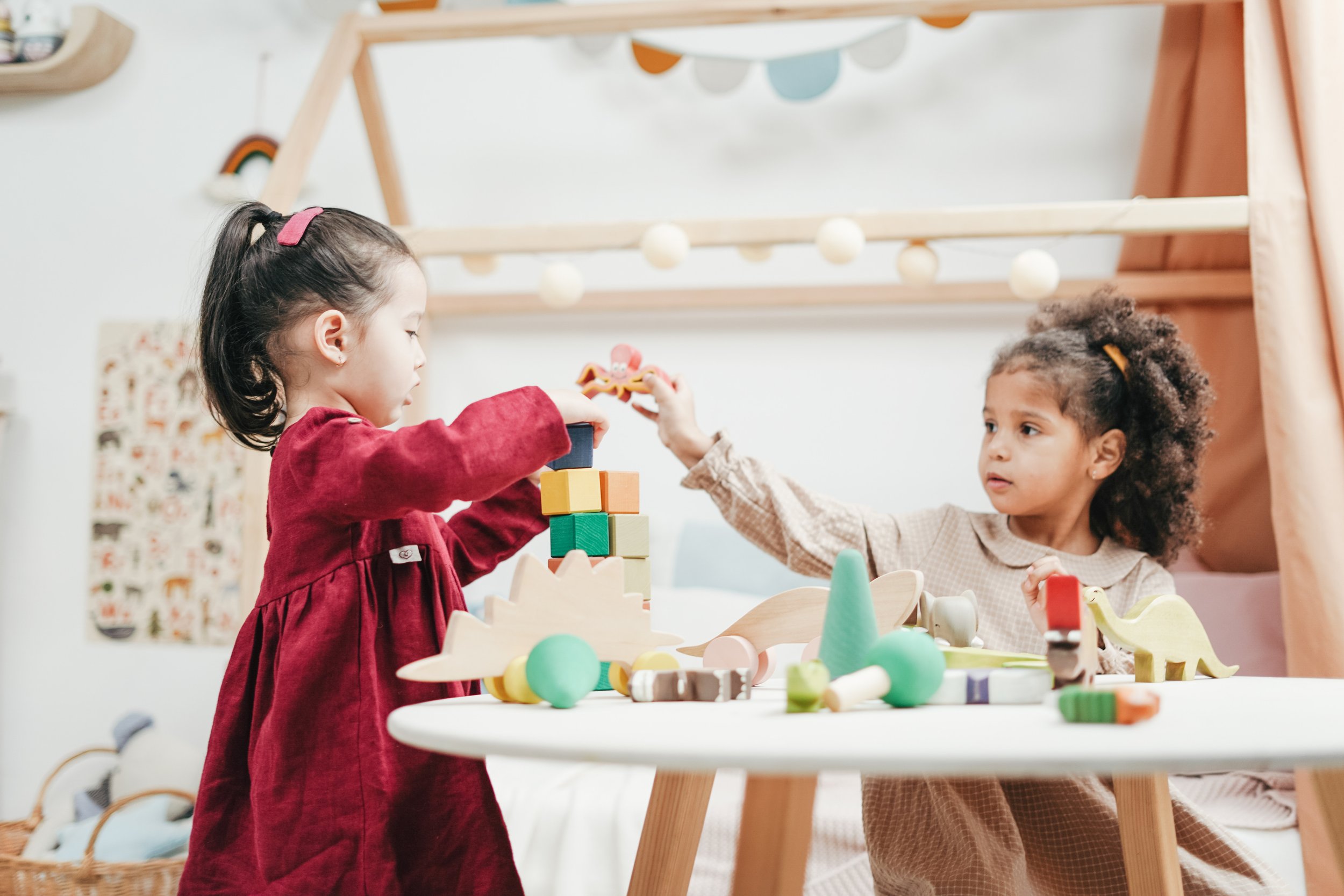
Children learn many valuable skills during the preschool years. They’re learning how to communicate with and listen to others and how to follow directions. They’re developing fine and gross motor skills, and engaging with other children in cooperative play.
The point of preschool is to teach children important skills that will lay the groundwork for their future success. Skills like reading, writing, school readiness, and social skills like how to cooperate with others are all explored in preschool.(1)
4 Types of Play in Early Childhood
Play is absolutely essential to your child’s learning and development!(18)
Preschoolers learn through fun and games! When children play, they are developing their cognitive, linguistic, physical, social and emotional skills.(18)
There Are Several Different Types of Play, but They Often Overlap(6)
1. Dramatic Play involves dressing up in costumes, playing pretend, and acting out stories. It helps children explore self-empowerment, make choices and express their feelings.(10)
2. Manipulative Play involves building something (e.g. with Legos), putting a puzzle together, or stringing beads to create a necklace.(6) It teaches children about sequencing, patterns, order, colors and textures, and how to make comparisons.(7) It also helps children to practice their decision-making skills, analyze and solve problems, and learn about cause and effect.(7)
3. Physical Play involves being physically active and developing gross motor skills. Preschoolers should get at least 3 hours of physical activity per day.(9)
4. Creative Play involves using art supplies to create while developing fine motor skills. Holding writing utensils takes strength and coordination! Through creative play, your child will practice holding writing utensils and writing their letters and their name.(1)
Play is so vital to early childhood development that sustained, moderate to severe play deprivation in childhood (between the ages of 0 and 10) has been shown to have serious negative consequences. (19) Depression, fragile and shallower relationships, reduced self-control, a propensity for addiction and difficulty adapting to change later in life are linked to play deprivation in the early years.(19)
2 Stages of Play: Cooperative Play vs. Associative Play
You may remember from this blog post that there are 6 stages of play. Preschoolers move from associative play into cooperative play between the ages of 4 and 6.(20)
Associative play, which is stage 5 of 6, is when children play with each other but aren’t working together to reach a common goal.(14) Cooperative play, the last and final stage, is when your child is interested not just in playing, but in cooperating with other children to accomplish a goal. There will likely be a division of labor, rules, assigned roles and organization as they work together toward that goal.(14)
So what does this look like in practice? It’s the difference between playing side by side in a sandbox, talking with other children while working on their own sandcastles (associative play), and working together to build one magnificent sandcastle (cooperative play).
Cooperative play is a learned skill requiring self-regulation and the ability to balance individual needs and wants with the needs and wants of the group.(14) Preschool is a great place for your child to practice and build his or her cooperative play skills.
Learning Happens Inside and Outside the Classroom
Literacy and Language Skills for Preschoolers
Have you ever noticed how your preschooler’s classroom is filled with simple images with the object name displayed? You might notice a bus icon, a cat, the sun, a ball — this is to help your child make connections between the object and the letters and words.(1) Every day your preschooler is becoming aware of letters, numbers, shapes and symbols. Whether they’re sitting on the alphabet rug for circle time, singing songs or reciting rhymes, your child’s literacy skills are growing.(1)
Math Skills for Preschoolers
Your preschooler is also practicing their basic math skills by learning to count, identify patterns, and group similar objects together. Older preschoolers will be able to answer questions like, “How many toy cars are on the floor?” and group objects that go together, like books or blocks. (13) To nurture counting skills, ask your preschooler questions like, “How many apple slices are on your plate?” or “How many steps is it from here to the car?” To grow their sorting skills, have your preschooler help you sort laundry, putting all the red clothes in a pile or matching each family member’s socks.(13)
Science Skills for Preschoolers
Science skills are also introduced at this age, and your preschooler is probably already a natural scientist, curious about the world and eager to explore. Encourage your child to interact with and learn about nature, ask questions and conduct experiments, and even talk with them about scientific concepts.
Cooking is a great example of how to incorporate scientific exploration into play. If you invite your child to help you bake something, let them practice skills like measuring and mixing ingredients.
Tricky Preschooler Behaviors
Preschool isn’t all fun and games. And preschoolers can present some challenging behaviors. This is to be expected! All preschoolers act out sometimes.
Tantrums
In a perfect world, the tantrums will have stopped by the time your child is 4-years-old. Typically, tantrums do decline with age. If your preschooler is having frequent tantrums, they have not quite learned how to cope with frustration and regulate their feelings.(17) Talk to your pediatrician if you suspect underlying causes of tantrums in your older child, such as a sensory processing issue, a speech delay or an underlying mental health disorder.(17)
Fighting
If you notice your child is about to start fighting with a sibling over a toy, try diverting their attention before the fighting starts, or offer choices so your children can proactively be involved in the decision-making of what happens next. (4)
Lying
If you catch your preschooler lying, you may be worried you’re raising a devious child. But the truth is — pun intended — that between the ages of 4 and 5, what’s real versus fantasy is still a bit blurry.(15) Preschoolers’ memories are short. Your child may have forgotten she’s done something wrong. Or she’s convinced herself she didn’t do the “bad” thing (like accidentally break mommy’s vase).(15)
Interested in Learning More?
Check out this podcast episode for more information on preschooler play, learning and behavior! We also talk about what to do if your child is potty trained but too shy to use the toilet at school and how to handle lying, bossiness, and playground aggression.
Equip yourself with knowledge and tools to help your child thrive. And be sure to subscribe to the Genius Little Minds podcast so you never miss an episode!
References
https://www.scholastic.com/parents/school-success/school-success-guides/guide-to-preschool.html
https://raisingchildren.net.au/preschoolers/behaviour/understanding-behaviour/preschooler-behaviour
https://www.first5california.com/en-us/articles/developmentally-appropriate-behavior-preschooler/
https://www.scholastic.com/parents/family-life/parent-child/preschool-struggles.html
https://childmind.org/article/can-help-kids-self-regulation/
https://www.wgu.edu/blog/dramatic-play-what-is-why-important2111.html#close
https://raisingchildren.net.au/preschoolers/play-learning/getting-play-started/preschoolers-at-play
https://rainforestlearningcentre.ca/teaching-useful-calendar-concepts-in-preschool-and-daycare/
https://www.kidcentraltn.com/development/4-5-years/brain-development--preschool-3-5-years.html
https://www.parentingforbrain.com/extreme-tantrums-in-4-year-olds/
https://www.psychologytoday.com/us/blog/optimized/202104/the-impact-play-deprivation

Early Childhood Development: Your Inquisitive and Active 4 Year Old
You may be excited to spend time with your four-year-old because they’re just so darn fun! Whether you’re doing art projects together, playing age-appropriate games, or enjoying outdoor pastimes like catch, you’ve noticed how active, chatty, and interested in the world your four-year-old is.

You may be excited to spend time with your four-year-old because they’re just so darn fun! Whether you’re doing art projects together, playing age-appropriate games, or enjoying outdoor pastimes like catch, you’ve noticed how active, chatty, and interested in the world your four-year-old is.
Early Childhood Development: Your 4 Year Old Preschooler and What to Expect
Vocabulary Development
You may have noticed that your child loves to talk! Some children are naturally chatty and enjoy having back-and-forth conversations or telling stories.(1) You might find your conversations are getting more interesting (and funny!) as well, as on average, a four-year-old will know roughly 1,500 words!(6) Your exchanges may include longer, more complicated and varied phrases, which is fun for both of you!
Motor Skills Development
As your child is growing, their motor skills are improving, so they can be more active than ever. Running, jumping and climbing might be favorite things to do at the playground or park! You may notice they’re using their hands when they talk, gesturing, or making noises to express themselves.(5) Skills like walking down steps, kicking a ball, playing catch, balancing on one foot, running and jumping have become easier.(5) Their fine motor skills, like cutting (with child-safe scissors) and writing their name, are also improving.(5)
Growing Curiosity About the Body
Your child is also likely asking endless questions, some which may make you uncomfortable. It’s normal and common for preschoolers to ask questions like, “Where do babies come from?” or ask about and touch their genital area.(1) Playing doctor with other children their age where they look at each other’s genitals might seem alarming to parents, but it’s developmentally normal.(1) (This should not happen with older children.) Facilitate your child’s learning in an age-appropriate way, like with a book on the body that’s written for pre-schoolers.(1)
As for tough questions about the body or topics you might deem inappropriate (like how babies are made), it’s important you answer their questions calmly and matter-of-factly.(1)
Early Childhood Development: 4-Year-Old Milestones
Social/Emotional Checklist(3)
Offers comfort when someone is sad or hurt
Enjoys being a “helper”
Wants to please and be like his or her friends(4)
Knows how to modify their behavior based on the situation (uses their “inside voice” in a place of worship or library, for example)
May be eagerly cooperative at times and demanding at other times(4)
Avoids danger
Asks to play with other children
Plays pretend
Has developed a sense of their gender identity(1)
Language/Communication Checklist(3)
Can answer simple questions such as “What is a lunch box for?”
Will share at least one thing that happened during the day such as, “I played with Jeremy”
Can string together a sentence of four or more words
Has back-and-forth conversations(2)
When they talk, a stranger can understand what they’re saying (most of the time)
Can sing along to a few words of a song, or memorize and recite a few words of a story or rhyme (2)
Knows between 1000 to 2000 words(2)
Movement and Physical Development Checklist(3)
Is able to hold a pencil or crayon between finger and thumb as opposed to a fist
Prints some letters(4)
Can copy geometric patterns, such as a triangle(4)
Can serve himself some food or water with adult supervision
Is able to unbutton some buttons on clothing and catch a large ball the majority of the time
Swings, climbs, hops, somersaults, and can stand on one foot for 10 seconds or longer(4)
Cognitive Checklist(3)
Follows multi-step directions (for example, when instructed, is able to pick up their toys, put them away in their toy bin, and pick out a book to read together)(2)
Can draw a person with three or more body parts
Is able to identify colors, shapes, numbers, and letters (2)
Can count to ten(4)
Can recall big parts of a simple story they’re told or read(2)
Knows what comes next in a story they know well
Can make predictions about what comes next in an unfamiliar story(2)
Is beginning to understand the concept of time(2)
Has a vivid imagination(2)
What You Can Do to Encourage Healthy Development in Your 4-Year-Old
Make Time for Play
Preschoolers learn so much through fun and games. Check out this blog post on the different types of play in early childhood and how they encourage your preschooler’s development! Play deprivation in early childhood has been linked to depression, reduced self-control, shallower and more fragile relationships, a propensity for addiction, and difficulty adapting to change later in life.(7) I can’t stress enough how vital play is to your child’s well being! Making time for arts and crafts, dress-up, dancing, imaginary play or outdoor play has tremendous benefits for your child.
Be Active Together
Preschoolers should spend at least 3 hours a day doing some kind of physical activity.(8) Yes, three hours! It may sound like a lot, but your four-year-old needs to burn all their pent up energy and grow their muscle strength! Playing on the playground, running in the backyard or at the park, or playing children’s games like “Duck, Duck, Goose” are great ways to bond with your child and help them (and you!) be active.
Know When to React Neutrally
Is your preschooler talking about having a “boyfriend” or a “girlfriend” at school? This might seem alarming to parents, but it’s developmentally normal.(1) Preschoolers don’t attach the same meaning to “boyfriend” or “girlfriend” that adults do, so it’s best to react to these types of declarations in a neutral way (not encouraging it but not showing concern, either).
Remember Their Development Stage
There are many wonderful things about preschoolers. But they can also be demanding, selfish, moody, and try your patience (regularly!). Remember that you’re not alone if your child exerts independence in ways that are frustrating, fights with siblings, has difficult habits (like food refusal) or behaves aggressively toward family members when they’re being moody.(9)
Every Stage Comes With Joys and Challenges
Each step of the way, you have the opportunity to help your child learn and grow. Subscribe to my newsletter for more helpful parenting tips, and don’t miss the other blogs in the infant and early childhood development series!
References

World Kindness Day: 11 Activities You Can Do with Your Child to Cultivate Kindness
Kindness is a skill that we have to teach our children. Just like we teach them how to ride a bike or how to do addition, they also need direction on how to be thoughtful to others.
While most children have a strong sense of empathy and compassion, kindness is the process of putting those feelings into action. It’s taking our feelings a step further and doing something nice that will make someone else happy.
The best way that children learn this is through practice. We need to work alongside them to help them think of ways to be kind and then follow through with that plan. If you’re needing some more ideas on how to practice kindness with your child, you’re in the right place!

Kindness is a skill that we have to teach our children. Just like we teach them how to ride a bike or how to do addition, they also need direction on how to be thoughtful to others.
While most children have a strong sense of empathy and compassion, kindness is the process of putting those feelings into action. It’s taking our feelings a step further and doing something nice that will make someone else happy.
The best way that children learn this is through practice. We need to work alongside them to help them think of ways to be kind and then follow through with that plan. If you’re needing some more ideas on how to practice kindness with your child, you’re in the right place!
Why Kindness?
We know that kindness makes others feel good, but did you know that it has positive benefits for the giver too?
Kindness improves a person’s physical and mental health.(1) Teaching children kindness sets them up for wellness throughout their life.
There are six main ways that kindness impacts our bodies, generating oxytocin, increasing energy, elevating happiness, extending the lifespan, producing pleasure, and creating serotonin.(2)
Oxytocin is sometimes referred to as the love hormone because it generates feelings of love, happiness, and closeness with those around us. It also lowers blood pressure and improves overall heart health. Being kind produces oxytocin in the body.
I think that we can all agree that we’d like a little more energy to get through our day. Participants in one study reported that acts of kindness made them feel more energetic, stronger, and calmer.(3)
Another study showed that those who gave financially to charitable organizations were happier than those who didn’t.(4) Those who volunteered reported lower incidences of heart disease, aches and pains, and premature death.(3)
Brain scans have shown that not only does the brain of the person on the receiving end of an act of kindness light up, but so does that of the giver.(5) Some have labeled this pleasure the ‘helper’s high.’
Finally, kindness produces serotonin. Serotonin is a hormone in the brain that makes us feel calm and happy. It also aids in the healing of wounds.
Kindness Activities to Do with Your Kids
So, now you know all the amazing benefits of kindness. Are you ready for some ideas on how to implement more acts of kindness into your life and your kids’ lives so that everyone can reap these benefits? Here are 11 great ideas!
Volunteer at an animal shelter - Whether it’s just one afternoon a month or twice a week, your local animal shelter could likely use the help. Call and ask if you can help walk animals or help clean around the facility.
Visit the elderly - Your local nursing home would probably love to have some young, friendly faces coming to visit. There may still be some COVID-19 precautions in place, so if you can’t go in person, have your children make cards to send instead.
Join a family fun run that donates the money raised to charity - Exercise, family fun, and doing good all wrapped into one. It doesn’t get much better than that!
Volunteer at a food bank - The local food pantry may need help gathering donations, organizing the shelves, or distributing the food to community members. Call the director and ask where they most need help.
Write a kind note to a friend or family member - We want to speak encouraging and positive affirmation often to our kids. We also want them to learn how to give compliments to others. Let your children pull names out of a hat to decide which family member they’ll write an encouraging letter to.
Draw a picture for your teacher - Encourage your child to draw or color a personalized picture for their teacher. If they’re a bit older, have them add a short note of encouragement as well.
Host a lemonade stand for a local charity - Let your child pick a local charity that they want to raise money for and set up shop! It doesn’t have to be lemonade that they sell. It could be cookies or artwork or anything else they would like to.
Bake treats for local firefighters, police officers, and other first responders - It’s important to recognize the individuals that give so much to keep the community safe. Bake some tasty treats with your child and then deliver them in person to say thank you to the officers.
Donate outgrown clothing or toys - Work with your child to teach them how some of the toys that they no longer play with could bring a lot of joy to another child. Let them pick what they donate so that they understand the importance of giving to others.
Create a compliment board in your home - In a place that everyone sees every day, hang up a whiteboard or corkboard. Keep markers or small pieces of paper nearby and encourage your children to add small compliments to it whenever they feel like it. This is a great way to keep them actively thinking about being kind.
Read books about kindness - Kindness doesn’t always happen overnight. Some children may need more guidance on how to think of acts of kindness and carry them out. There are many great books out there that can give them ideas.
World Kindness Day is coming up on November 13th. That’s a great chance to implement some kindness practices in your life. If you want more resources for World Kindness Day, check out School of Kindness.
Being kind isn’t always the easy option. We know that as adults and our children think it, too. However, it’s still important to strive to be kind, for our own health and the health of those around us. Together, we are all better.
Be sure to subscribe to my newsletter to stay up to date on all my latest blog posts. My podcast, Genius Little Minds, is also full of information on child mental health.
References
https://www.randomactsofkindness.org/the-science-of-kindness
Raising Happiness: 10 Simple Steps for More Joyful Kids and Happier Parents by Christine Carter Ph.D.
https://www.naturespath.com/en-us/blog/17-activities-kids-practice-kindness-compassion/
https://biglifejournal.com/blogs/blog/kids-kindness-activities

What is My Preschooler Thinking About? How Does My Preschooler’s Brain Work?
The brain is the most complex and fascinating organ in the human body. There are so many parts working together to allow your preschooler to walk, talk, play, and feel.
The left side of the brain, for example, is responsible for speech and logical thinking. It’s literal and logical and loves order and organization.(3) When your preschooler is working on a puzzle, for example, it’s a great left brain exercise!(11)
The right side of the brain is responsible for spatial thinking, reading nonverbal cues, and processing emotions. (3,4) Rather than being detail-oriented like the left brain, it cares about the big picture. Think of it as the more emotional and experiential of the two hemispheres.(3) Playing a matching game with your child is a great right brain exercise!(11)

The brain is the most complex and fascinating organ in the human body. There are so many parts working together to allow your preschooler to walk, talk, play, and feel.
The left side of the brain, for example, is responsible for speech and logical thinking. It’s literal and logical and loves order and organization.(3) When your preschooler is working on a puzzle, for example, it’s a great left brain exercise!(11)
The right side of the brain is responsible for spatial thinking, reading nonverbal cues, and processing emotions.(3,4) Rather than being detail-oriented like the left brain, it cares about the big picture. Think of it as the more emotional and experiential of the two hemispheres.(3) Playing a matching game with your child is a great right brain exercise!(11)
When children are very young, they’re right-hemisphere dominant, especially in their first three years of life.(3) Have you noticed how young children are so good at being focused in the present moment? They’re taken with the most ordinary things — the color of the fall leaves on the ground, a lady bug crawling on a bench, a tremendously smooth rock. Everything seems to delight and surprise them. Until, of course, a wave of very big emotions crashes over them and the tears or tantrums start.
When children become emotionally flooded, their right brains are working in overdrive.(3) Their more logical left brain isn’t working in sync with the right hemisphere.(3)
When the Right Brain is Working in Overdrive: Connect and Redirect(3)
If your child comes to you with big feelings — and they might seem illogical, ill-timed or blown out of proportion to you — rather than trying to “logic” them out of their tears and hurt, allow your child to “feel felt”. The concept of “Connect and Redirect” is from Dan Siegel and Tina Bryson’s book, The Whole Brain Child. Connect to your preschooler’s flooded right brain with empathy and loving support. The act of acknowledging your child’s big feelings is actually what will soothe them and steer the conversation toward more solid, logical ground.
So speak in a nurturing tone of voice. Offer comforting physical touch. And listen without judgment. This empathy will go a long way in restoring calm and helping your preschooler mover on with their day.
Connect and Redirect in Practice
We don’t want our children to be drowning in feelings all the time, but we also don’t want them living in an emotional desert. That’s why we care about integration, which is when all of the parts of the brain to work together in harmony.
Using the Connect and Redirect method, once you’ve connected to your child’s right brain, you can redirect the conversation with the more logical left brain.
For example:
If your preschooler is furious he can’t go to school barefoot, starting your response with the logical reply that going to school with shoes on keeps him safe will likely cause more outrage or protestation.
To adults, saying, “Put your shoes on now so you don’t step on something dangerous,” is very logical. But for your preschooler, this isn’t going to calm the storm.
Connect and Attune First.
Try saying something like, “You’re frustrated because you want to go to school barefoot!” This acknowledges their feelings — frustration — helping them feel seen and heard.
Often children are so frustrated with adults because they get told ‘no’ all the time. Their feelings get belittled or bulldozed on accident when we’re in a rush and trying to get out the door to get to school on time. But remember, time passes a lot more slowly for a preschooler. Slow down to truly connect.
Then Offer a Logical Explanation and Make a Plan Together.
Once your child is a bit calmer, they’re more primed to hear reason and logic. You could say something like, “Our house is a safe place to walk barefoot. When we get home from preschool today, would you like to walk around barefoot together?”
This offers up an explanation while also presenting a new plan without saying “No” outright.
Why Oh Why Is My Preschooler Constantly Asking “Why?”
A question for the ages! Toddlers and preschoolers are known for their incessant curiosity. And when “Why?” keeps on coming, you know their left brain is starting to ramp up. They’re looking for answers, they want to know about cause and effect relationships, and they want to understand the connections between things.(3) A whole day with your preschooler might feel exhausting to you because all they do is ask why, why, and WHY! And want to know more, more, more!
And not all of their questions will be polite! If you’re the parent of a preschooler, I’m sure you’ve been mortified by a question your child asked loudly in public.
Why Is My Preschooler Obsessed With Death?
Is your preschooler displaying (what you consider to be) an unusual amount of interest in death? It doesn’t mean they’re going to be interested in the macabre forever! This is actually a very normal part of preschooler development.
They won’t yet understand the 4 subconcepts of death(10):
Non-functionality — When you die, your body stops working.
Universality — All living things die.
Irreversibility — You can’t come back to life once you’re dead.
Inevitability — Death is unavoidable.
They’ll only understand the first. And while you may not want to confront your own mortality at 7 am on the way to school or in the checkout line at the grocery, this curiosity really is normal, especially at this age.(10)
So if your child does come to you asking about death, respond as simply and clearly as you can. You don’t need to go into detail, but try not to brush off their questions, even if they make you uncomfortable.(10)
What Are Some of the Negative Effects of Screen Time on Child Development?
Children age 8 and younger typically spend two hours a day (on average) looking at a screen.(6)
Most scientist and doctors will tell you that screen time alters children’s brains. Some argue that screens help prepare children’s brains for the fast paced, high stimulus world we live in.(6)
But screens give off a lot of information and visual input. And the faster the visual stimuli is moving and changing, the faster your brain has to work to keep up and process it.(6)
And when that screen is taken away, there’s some cognitive slowing that happens afterward.(6)
You know that look your child gets after they’ve watched cartoons or played on the iPad for a few hours? The daze that follows is the cognitive slowing that happens after overstimulation.(6)
The American Academy of Pediatrics recommends we not let children between the ages of 2 and 5 exceed one hour of screen time per day.(6) One study found that children who looked at screens for more than one hour per day had lower levels of white matter integrity in the brain.(6,7) White matter supports literacy skills and language development.(7)
The stimuli from screen time can be total sensory overload — all the colors and sounds and story lines can be a lot for a young child to try to process — causing stress hormones like cortisol to be released. The reward system also gets activated by screen time, flooding the brain with dopamine, getting children used to and seeking immediate gratification.(6)
As with anything, be mindful about how much screen time your preschooler is getting.
Interested in Learning More?
Check out this podcast episode for more information on your preschooler’s amazing cognitive development. We also talk about how to help your child remember their experiences and what to do if your preschooler talks incessantly or starts using their baby voice again.
Equip yourself with knowledge and tools to help your child thrive. And be sure to subscribe to the Genius Little Minds podcast so you never miss an episode!
References
Siegel, D. J., & Bryson, P. H. D. T. P. (2012). The whole-brain child. Random House.
https://www.medicalnewstoday.com/articles/321037#functions-of-each-hemisphere
https://jamanetwork.com/journals/jamapediatrics/fullarticle/2754101
https://www.verywellfamily.com/4-year-old-developmental-milestones-2764713
https://www.nytimes.com/2019/04/16/parenting/kids-talking-about-death.html
https://www.mentalup.co/blog/right-brain-left-brain-development-methods

Early Childhood: Your Creative and Playful 3 Year Old
Three-year-olds are such curious, playful, imaginative individuals!
Seeing your child grow right before your very eyes is wonderful and exciting. And watching them interact with you and others is such a gift.
Conversations have started to feel more interesting as your preschooler can say longer sentences and have more back-and-forth interaction with you. They also continue to come into their own, engaging in problem-solving and imaginative play.

Three-year-olds are such curious, playful, imaginative individuals!
Seeing your child grow right before your very eyes is wonderful and exciting. And watching them interact with you and others is such a gift.
Conversations have started to feel more interesting as your preschooler can say longer sentences and have more back-and-forth interaction with you. They also continue to come into their own, engaging in problem-solving and imaginative play.
Early Childhood Development: Your Young Preschooler at 3 Years Old
Vocabulary Development
Speech is yet another thing that children develop at their own pace. But a child between the ages of 3 and 4 will typically be able to say between 500 and 900 words!(2) By now, they’ll be able to talk in longer sentences of roughly 4 to 5 words, leading to real conversations with you.(4)
In preschool, your 3-year-old will be building reading and vocabulary skills. They’ll learn simple rhymes, poems, or songs and name colors and objects in their classroom.(3) They’ll also build fine motor skills as they create arts and craft projects and practice writing letters and their name.(3)
Your 3-year-old will also begin to understand the size differences between “little” and “big,” understand long sentences, and even know prepositions such as “on,” “under,” and behind!(2) Discuss what they did yesterday versus what they are doing today to encourage their grasp on the past tense.
Growing Imagination
As your child’s imagination is growing and expanding, they’ll go on many wonderful adventures! They might sail the high seas in a cardboard box, or traverse a jungle across your kitchen. And while your preschooler’s growing imagination brings many wonderful moments of joy and play, it can also spark some fears.
Don’t be alarmed if your child also begins to display a fear of the dark or monsters under the bed as their imagination expands.(10) Because your child has likely seen television, movies, and been in the care of others by this age, their imagination will take flight sometimes. This can activate anxiety or fear. The best thing to do is acknowledge your child’s very real fear, but reassure them that the monsters are not real.
Early Childhood Development: 3-Year-Old Milestones
Social/Emotional Checklist(1)
Quickly calms (within 10 minutes) after you leave (such as for preschool drop-off)
Is interested in playing with other children
With support, can problem solve
Displays affection and concern for others without being prompted(7)
Copies others (e.g., runs when friends or other children run)(7)
Displays a wide range of feelings(7)
Enjoys routines (and may get upset with a major change in routine)(7)
Language/Communication Checklist(1)
Asks questions such as, “who,” “what,” “where,” “why,” and “how”
Can name the action they see in a picture when asked (such as “sleeping”)
Can say their first name when asked
Is able to have short conversations with you (at least two back-and-forth exchanges)
Speaks well enough that other people understand them (most of the time)
After you read a book to them, they can retell the story(4)
Movement and Physical Development Checklist(2)
Can run, jump, and walk up stairs without help
Can ride a tricycle
Is able to wash and dry their hands
Is able to use a fork and spoon well(1)
Can dress himself or herself(1)
Can string items together (like macaroni)(1)
Able to hold a pencil, marker or crayon to color and draw(4)
Cognitive Checklist(1)
Can draw a circle when shown how
Doesn’t touch a hot stove when warned not to
Uses imagination to play and create stories(7)
May be afraid of monsters under the bed or the dark(9)
What You Can Do to Encourage Healthy Development in Your 3-Year-Old
Encourage Problem Solving
Offer support, but don’t solve every problem for your child. Instead, encourage problem-solving and a can-do attitude. Ask questions to help your 3-year-old not only comprehend the problem or situation they’re facing, but also to help them think of solutions to try.(1)
For example, if you have a little extra time on a grocery run with your child, use the opportunity to engage in problem solving.(5) Try saying something like, “To bake cookies we need to buy butter, sugar, and flour. We have butter and flour in the cart. What are we missing?”
Model Problem Solving
You have the opportunity to be a wonderful role model for your child. Show them how you problem solve to encourage them to do it in their own lives as they grow up.
For example, perhaps you accidentally knock over a glass of milk, and it spills onto the floor. Do your best to remain calm. Take a deep breath. If your child is nearby, you could say something like, “Oops! I spilled some milk. How should I clean it up?”(5)
Don’t expect yourself to be perfect. Accidents happen. Some teachable moments will be missed opportunities. But try to give yourself the space (at least some of the time) to make and acknowledge your mistakes out loud to model problem solving in action.(5)
Ask Your Child Open-Ended Questions
Asking open-ended questions is a wonderful way to stimulate your child’s creativity, stretch their reasoning abilities, and foster independence and curiosity.(6) Questions that have a one word answer, such as, “What animal is that?” certainly have their place in your child’s development. But make space for more open-ended questions too, like, “Can you tell me about your stuffed animal?”(6)
Open-ended questions may be met with a pause as your child mulls things over. Be patient and give them time to respond. You might just be delighted by what they tell you!
Here are some other examples of open-ended questions you can ask:(6)
Can you tell me about what you saw?
What did you see happening at the park/zoo/grocery store/mall?
Do you have any other ideas?
Can you help me think of a new way to do this?
What happened at the beginning of the story? What about the middle or end?
Create Space for Imaginative Play
Imaginative play is such a beautiful part of childhood. When your preschooler is playing pretend, creating stories about made up characters, turning everyday objects into parts of their magical world, or imagining themselves as an astronaut or a wizard, anything feels possible. And the freedom that comes with imaginative play allows them to explore emotions, develop empathy, learn negotiation and problem-solving skills, and develop their language and abstract thinking capabilities.(8)
If space allows, offer a place for a small stash of props or safe objects your child can play with such as empty boxes, clothes, stuffed animals, household utensils or plastic tools, markers, construction paper and tape. Then step back and watch your child’s imagination come to life.
Every Stage Comes With Joys and Challenges
Each step of the way, you have the opportunity to help your child learn and grow. Subscribe to my newsletter for more helpful parenting tips, and don’t miss the other blogs in the infant and early childhood development series!
References
https://www.cdc.gov/ncbddd/actearly/milestones/milestones-3yr.html
https://www.stanfordchildrens.org/en/topic/default?id=the-growing-child-3-year-olds-90-P02296
https://www.scholastic.com/parents/school-success/school-success-guides/guide-to-preschool.html
https://www.verywellfamily.com/3-year-old-developmental-milestones-2764712
https://www.rasmussen.edu/degrees/education/blog/problem-solving-for-preschoolers/
https://www.decal.ga.gov/documents/attachments/Questions_Children_Think.pdf
https://helpmegrowmn.org/HMG/DevelopMilestone/3Years/index.html
https://www.babycenter.com/child/3-years-old/your-3-3-4-year-old-pretend-play_10329670
https://www.healthywa.wa.gov.au/Articles/A_E/Child-development-3-4-years
https://www.firstfiveyears.org.au/child-development/when-your-child-has-a-fear-of-the-dark

How Long Does Potty Training Take? Let’s Dive in to the 3 Day Method
Potty training is a major milestone and a huge sign of growth and development!
Using the toilet is a learned skill. It takes physiological, cognitive, verbal and social readiness to be able to do it.(2) For something we all do every day, probably without really thinking about it, it takes an amazing amount of work for small children! And teaching a child to use the toilet really is a skill worth celebrating.
You know that your child already knows how to pee and poop. But in order for them to be potty trained, they need to be able to recognize the physical sensation of having to go to the bathroom. They also need to be able to tell you so that with help, they can make it to the toilet.(2)

Potty training is a major milestone and a huge sign of growth and development!
Using the toilet is a learned skill. It takes physiological, cognitive, verbal and social readiness to be able to do it.(2) For something we all do every day, probably without really thinking about it, it takes an amazing amount of work for small children! And teaching a child to use the toilet really is a skill worth celebrating.
You know that your child already knows how to pee and poop. But in order for them to be potty trained, they need to be able to recognize the physical sensation of having to go to the bathroom. They also need to be able to tell you so that with help, they can make it to the toilet.(2)
Using a toilet and bathroom hygiene are important skills to learn! When you potty train, you help your child develop their independence and increase their confidence. You also teach them related hygiene skills like flushing and washing their hands.(4)
Poop and pee may not be your favorite topic of polite discussion. But explaining bodily functions in plain terms to your toddler sure does help with potty training!
At What Age Do You Start Potty Training?
Infants can’t use the muscles needed to control their bladder and rectum, which is why we don’t try to potty train them!(3) This capability doesn’t arise until a child is about 18 months old.(3) But age doesn’t necessarily indicate readiness.
Between the ages of 20 and 30 months is usually what parents find works best, although every child is different.(1) Prior to 20 months your child is still working on other skills, such as eating, walking, and overcoming separation anxiety. So adding potty training into the mix might just be too much.(1)
But if your child happens to initiate the process or display an interest in using the toilet, follow their lead. Don’t ignore their questions about the potty or tell them they’re too young for it.(1) Allow them to be curious and take the opportunity to teach them about toilet habits.
The longer your toddler wears diapers and the older they get, the harder it is to manage their behavior. This is why many parents find it’s best to potty train their child before they turn 3.(1) Around age 3 is when children start to individuate.(1) They realize they have free will, the ability to make choices, and also display more of their personality. And once that happens, potty training can become a bit more of a battle.(1)
Signs Your Child is Ready for Potty Training
Potty training is a process and determining readiness is not always easy.
But your toddler might be ready to start potty training if they(2):
Tell you when they have to go to the bathroom
Let you know when they’ve peed or pooped in their diaper
Hide when they’re about to have a bowel movement (behind the couch, or they go in another room to poop in their diaper)
Can pull down their diaper without help
Some children don’t give a lot of indications, though, so just remember that every child is unique! Your child may hate diaper changes or ask to use the potty every once in a while, even if she’s not ready for full-blown potty training yet.
How to Potty Train in 3 Days
Also known as the Bare Bottom Method, this method is highly popular and praised by parents from all over the world.
To use this method, you’ll need three consecutive days to be at home potty training your child. This, of course, can be a challenge for working parents and caregivers.(4) For parents who work Monday through Friday, I suggest you try to tackle potty training on a three or four day weekend so you can be at home with your toddler. (4) You’re going to be spending all weekend indoors, basically glued to your toddler’s hip as you walk them to and from the potty! So plan ahead as best as you can.
Here are some tips to plan ahead before you start the process:
Do the food shopping ahead of time. Stock up on juice boxes as you’re going to encourage your child to drink more than usual.
Do the laundry and any house cleaning or errands ahead of time.
If there are older siblings in the house who won’t be involved in the potty training process, try to set up play dates or care for them. That way you can give your full undivided attention to potty training your toddler.
Let your child pick out “big kid underwear” at the store because it’s time to say “bye bye” to diapers.
Day 1
Let your child spend the day bare-bottomed.(4) The idea is that it’s easier for them to sense when they have to go or are going to the bathroom when they have no clothes on. Explain to your toddler that there’s no diaper to catch the pee or poop anymore, so they have to put it in the potty instead.(5)
Closely watch your child for signs that they may have to use the bathroom. When you notice that they need to go, take your child immediately to use the toilet.(4) Even boys will learn to sit on the toilet at first because they simply don’t have the aim to pee standing up yet. Save that for another day!
Remain emotionally neutral when making comments about your child’s potty training progress. If they have an accident, remain calm. Try saying, “You peed on the floor. Let’s clean it up together.”(4)
When they do go in the toilet, congratulate them. Try saying, “You just peed in the toilet. That’s where pee and poop belongs!”(4) Teach them how to flush. Remember to have them wash their hands afterward!
Some children feel uncomfortable with lavish praise or over-the-top parental excitement. Others respond well to that. Your toddler may respond well to rewards like stickers, lollipops, or little trinkets for using the potty. But maybe they won’t! As with anything, every child is different. You know your child best!
Set a timer every 20 minutes to do a check-in with your child on whether or not they have to use the potty. (4) After they drink a juice box, for example, remind them it’s time to try to go pee. They may refuse, but ask them to try anyway. (5)
Nap Time
Whether you want to put your toddler in diapers or pull-ups when they sleep during the three-day potty training is up to you. Some parents choose to potty train for everything all at once – daytime, naps, nighttime – they just find it’s easier that way. Other parents and caregivers decide to potty train in stages.
Days 2 & 3
You’ll basically follow the same process that you did on day one. Let your child be bare-bottomed all day. There’s still going to be a lot of back and forth to the bathroom, roughly every 20 minutes, to practice using the potty.
After potty training, it’s a good idea to dress your child in clothing that’s easy to remove. Try pants that are easy to pull down, have an elastic waist, and aren’t fussy. Avoid clothing that requires more work like tights or shirts with snaps at the crotch.
Interested in Learning More?
Check out this podcast episode for more information on potty training. We also talk about what to do if you can’t take off work to potty train your child and how to handle accidents that happen long after potty training is over.
Equip yourself with knowledge and tools to help your child thrive. And be sure to subscribe to the Genius Little Mindspodcast so you never miss an episode!
References
https://podcasts.apple.com/us/podcast/the-oh-crap-potty-training-podcast/id1627503268
https://www.healthychildren.org/English/ages-stages/toddler/toilet-training/Pages/default.aspx
https://www.verywellfamily.com/three-day-potty-training-tips-4071189
https://www.parenting.com/toddler/potty-training/how-3-day-potty-training-method-works/

What is Obsessive-Compulsive Disorder? With 3 Paths to Recovery
If you’re noticing signs of Obsessive-Compulsive Disorder (OCD) in your child or if they’ve recently been diagnosed with OCD, it can be difficult to know what to do.
This mental illness is often misunderstood because of its representation in the media. It’s often described as simply liking a clean room or keeping things a certain way. Clinical OCD is much more intense than this. It often needs professional intervention for the person to be able to live a normal life.
So, what are the signs and symptoms of OCD in children? How can you help after a diagnosis of childhood OCD? It’s all outlined here.

If you’re noticing signs of Obsessive-Compulsive Disorder (OCD) in your child or if they’ve recently been diagnosed with OCD, it can be difficult to know what to do.
This mental illness is often misunderstood because of its representation in the media. It’s often described as simply liking a clean room or keeping things a certain way. Clinical OCD is much more intense than this. It often needs professional intervention for the person to be able to live a normal life.
So, what are the signs and symptoms of OCD in children? How can you help after a diagnosis of childhood OCD? It’s all outlined here.
Signs and Symptoms
The hallmark symptom of OCD is ritualistic behaviors. These ritualistic behaviors are done repeatedly and excessively. Some ritualistic behaviors include washing hands, rechecking items like ovens or door locks, putting things in a particular order, counting the same set of objects, repeating certain words or phrases, or separating food on a dinner plate.
OCD behaviors are different for every individual. This list of behaviors is not exhaustive. Any behavior that is done over and over excessively may be a sign of OCD.
Other emotional symptoms of OCD include:
Intense worry or fear about having things in a particular order
Extreme fear of germs, dirt, or bodily waste
Constant doubts about something being done, like the door being locked or the oven being turned off
Strong need to have tasks done perfectly
Compulsion to touch or count objects
Destructive thoughts
Lack of self-esteem or self-confidence
Difficulty concentrating at school or home
A sense of panic if they aren’t able to perform their rituals exactly as they’d like to
A sufferer of OCD may also experience physical symptoms from their mental state. These include:
Racing heart
Headaches or stomachaches
Shaking and trembling
Difficulty breathing
Feelings of weakness
Intense fatigue
Sweating
Difficulty sleeping
When these symptoms begin to interfere with a child’s ability to function normally is when they need professional help.
Risk Factors
Many of the risk factors of OCD are very similar to other anxiety disorders. The four risk factors are predisposition, genes, environment, and biological processes.
Predisposition refers to the fact that some children are less capable of handling stress well and are more prone to anxiety. Genes, or a family history of OCD, make a child more likely to develop the disorder.
Certain environments may be a factor in the development of OCD. Some of these situations include parental divorce, a death in the family, the birth of a sibling, moving, attending a new school, or experiencing trauma.
Specific biological processes have been suspected to be linked to OCD. These processes are an imbalance of serotonin or a strep infection.
Ways to Help Your Child
So, what if you’ve already seen the signs and received a diagnosis of OCD for your child? Here are some steps you can take to help them.
Learn More
It’s very difficult to help someone with an issue that you do not understand. So, learning more is the first step.
OCD Awareness Week is fast approaching. In 2022, it will be celebrated from October 9th to the 15th. The International OCD Foundation hosts the event, providing videos to watch and events to participate in.
The theme this year is The Road to Reclaiming Your Life. This theme encompasses the idea that with the right treatment and support from those around a person, full recovery from OCD is possible.
Learning more about OCD is beneficial for everyone–not just those suffering from the disease. Understanding better the experiences of those with OCD gives us compassion and ways to help them succeed.
All events are free, and you can click here to check it out.
Speak to a Mental Health Professional
The first line of treatment for OCD is most often therapy. Cognitive-Behavioral Therapy (CBT) in particular is very effective in treating OCD.
CBT helps a child recognize what their thought patterns are and how those thought patterns may be affecting their behavior. By changing their thoughts, they are able to change their actions.
When treating compulsive behaviors, CBT often employs Exposure Response Prevention. This technique supports children while they face their fear of not giving in to compulsive urges. Children slowly work through more and more difficult and scary scenarios. Eventually, they can resist engaging in all of their previous compulsive behaviors.
This approach, while effective, takes a lot of work. It can help if children can see that the hard work is worth it. My upcoming book, Khloe Kitten Is Afraid of Germs!, does just that.
Khloe Kitten experiences compulsive urges around germs, like many of those who suffer from OCD do. She wants to go down the slide like all her other friends do, but she has too much fear. She employs Graded Exposure to slowly expose herself to germs and overcome her fear and behavior.
As your child works through a stepladder approach in therapy, they will be able to see themselves in Khloe Kitten. They may be working on different compulsive behaviors, but they will recognize her feelings and fear.
A child will know that if Khloe Kitten can do it, they can do it too. They also may better understand what their therapist is asking them to do.
Also, each book comes with an About Anxiety page, a Coping Strategies page, and a Stepladder page for parents. Each page will equip you with more information to help your child.
A therapist may also employ other strategies of CBT to help your child. These could include role-playing exercises, teaching positive self-talk, introducing relaxation techniques, and talking through how their thoughts or fears are irrational. Your therapist will create a unique treatment plan for your child.
Medication
If various types of therapy don’t bring enough relief for your children, medication may be a helpful option. Anti-anxiety medications should only be used under the supervision of a pediatrician and psychologist.
Obsessive-Compulsive Disorder can be frustrating and confusing for children and parents alike. However, with the right treatment and support, it’s possible for most children with OCD to lead a productive life.
To learn more information about various mental health illnesses in childhood, be sure to subscribe to my newsletter or check out my podcast, Genius Little Minds.
References
https://adaa.org/sites/default/files/How-to-Help-Your-Child-A-Parents-Guide-to-OCD.pdf
https://childadolescentpsych.cumc.columbia.edu/professionals/research-programs/y-team/ocd-treatment
https://www.psychiatry.org/patients-families/ocd/what-is-obsessive-compulsive-disorder

Celebrating World Mental Health Day: Plus 10 Mental Health Tips
October is here and with its arrival comes World Mental Health Day on October 10th.
Have you been curious about where to get resources for World Mental Health Day for your home or classroom? Or are you just looking for tips on how to support your child’s mental well-being?
You’re in the right place! I’ve outlined great answers to both questions below.

October is here and with its arrival comes World Mental Health Day on October 10th.
Have you been curious about where to get resources for World Mental Health Day for your home or classroom? Or are you just looking for tips on how to support your child’s mental well-being?
You’re in the right place! I’ve outlined great answers to both questions below.
What Is World Mental Health Day?
Organizations around the world recognize that meeting mental health needs is just as important as any other need. It’s just as important as food, water, clothing, and shelter. While you can’t always see a child’s poor mental health, it impacts their life in monumental ways.
Because of the magnitude of importance about this topic, there is not just one organization that sponsors events and provides resources for World Mental Health Day. There are a variety to choose from.
Some organizations that you can check out are the United Nations, the Mental Health Foundation, the World Health Organization, and the World Federation For Mental Health. The theme that was chosen this year by the World Federation for Mental Health is ‘Make Mental Health & Well-Being for All a Global Priority.’ It is widely recognized that especially after the COVID-19 pandemic, many people need more mental health support.
Many of these websites provide printable and digital resources that educate on mental health. Some will have guest speakers or will host community events around the globe.
Focusing on mental health is important for everyone in every place. So, no matter where you and your child are, there is sure to be a way that you can learn and grow from World Mental Health Day.
Ways to Help Your Child with Their Mental Health
Beyond just the big event, what are some ways that you can support your child’s mental health every day?
1. Read Books About Identifying Various Emotions
Books can be a great way to start a conversation about what emotions that your child may be feeling. Kids can see how the characters label their emotions and how they cope with them in healthy ways. Many books focus on a specific emotion, so if your child struggles with one emotion, like anger, in particular, there is likely a book out there that you can read together.
2. Help Them Learn how to Relax and Perform Self-care
School, social pressures, and navigating all the challenges of growing up may cause stress in your child. They need to know how to unwind and relax in order to nurture positive mental health.
Help them find relaxing activities that they enjoy like reading, taking a walk, or drawing. They may also find that more strenuous activities like running or playing a sport help clear their mind. It doesn’t really matter what the activity is. They just need a healthy way to recharge.
3. Keep the Line of Communication Open
Ask your child often about their friends, how their school work is going, and what is new in their lives. As you keep track of soccer practices and dance lessons and their favorite lunch, you may think that you know everything about them. However, you may be surprised with what you learn by asking these simple questions.
Staying in tune to our children’s lives helps us be the first to know when something seems amiss or when they may be needing more support. (1) We want our children to feel safe coming to us whenever they have a problem. That is more likely to happen if there’s already a pattern of open communication in place.
4. Model Healthy Coping Skills
It’s easy to feel like we should never be mad, frustrated, or sad around our children. Sometimes we just put on a happy face because it’s easier. Yet, this is not always in our children’s best interest.
It’s good when they see you frustrated in traffic, but you take calming deep breaths. Or maybe they see you upset when your favorite snack is all gone, but then you calmly chose another option. These may seem like really small things, nonetheless, our children are always watching. They are learning coping skills every time they watch you handle your feelings in a productive way.
5. Create Household Routines and Stick to a Sleep Schedule
Children feel more secure and function better when they know what to expect. This is why routines and schedules can be beneficial for children.
A sleep schedule is particularly important because not getting enough high-quality sleep is a risk factor for many mental illnesses.(2) Make sure that your child is getting enough hours of sleep at night and is sleeping soundly.
6. Give Them Encouragement and Support
Remind your child often how proud you are of them. Children need to hear that they are loved and that you are always there for them. It’s important to show this with your actions, but it’s also important to say it with your words.
7. Encourage Daily Movement and Healthy Habits
A healthy body supports a healthy mind. Encourage your child to get their body moving for at least 30 minutes a day. There are lots of fun ways to make this happen. They could do anything from jumping jumps to kicking a ball around the yard to play at the park.
Also, make sure that your child is eating well-balanced meals and getting all the vitamins and nutrients that they need. Healthy food will fuel their mind and body to help them function at 100%.
8. Watch for Changes in Mood or Behavior
Much like we talked about earlier, you want to understand well how your child is feeling on any particular day. Watch for sudden, drastic changes in their moods or behaviors. This could be a sign of an event that needs to be addressed.
You may also notice slow, more permanent changes over time. While kids' personalities change as they grow, this is referring to increased sadness, anxiety, or other negative emotions for extended periods of time. These may be signs of a mental health struggle.
9. Nurture Their Self-esteem
Help your child feel comfortable with who they are. (3) One way to build self-esteem is to give your child the power to make decisions whenever possible. This sense of accomplishment and power to be independent will do wonders for their self-confidence.
10. Get Professional Support if You Need it
It’s never too early or too late to reach out for help. If you feel like you can’t give your child all of the support that they need, consider talking with a mental health professional. Therapy can be incredibly beneficial not just after the onset of mental illness but even before. A therapist will be able to give you strategies and tips for preventing your child from slipping further into poor mental health.
Now, these tips don’t just apply to children. They are good mental health practices for anyone. We all need to take care of ourselves before we can take care of others. In the same way, World Mental Health Day can be beneficial for anyone. So, let’s go take care of our mental health!
For more information on child mental health, be sure to check out my podcast, Genius Little Minds, and subscribe to my newsletter.
References

How to Get Your Toddler to Sleep: Routine Charts, Sleep Regression and Reassuring Check-Ins
Putting a toddler to bed can be tricky.
And if your toddler is between the ages of 2 and 4, they’ll likely need about 10 to 14 hours of sleep in a 24-hour period.(4)
So how can you make naps or bedtime a treat, not a battle?
It may take some trial and error, and it will definitely take a whole lot of patience and love. But after experimenting with different approaches, you’ll get your toddler’s nap and bedtime routines down pat.

Putting a toddler to bed can be tricky.
And if your toddler is between the ages of 2 and 4, they’ll likely need about 10 to 14 hours of sleep in a 24-hour period.(4)
So how can you make naps or bedtime a treat, not a battle?
It may take some trial and error, and it will definitely take a whole lot of patience and love. But after experimenting with different approaches, you’ll get your toddler’s nap and bedtime routines down pat.
First things first, let’s make sure your toddler’s room is set up safely so they can sleep soundly. They are, after all, notorious explorers. So all that baby proofing you did may need to be kicked up a notch once you have an active toddler.
Making Your Toddler’s Bedroom Safe
Your baby is no longer, well, a baby! Luckily your toddler is no longer at risk for SIDS,(1) but he is more agile and active. So let’s discuss how to create a safe sleeping space as your little one grows.
Double check that your toddler’s crib isn’t near anything he or she can pull on like blinds, cords, or hanging mobiles. Ensure that objects like plants, books, or picture frames aren’t nearby for your curious toddler to push or pull into his crib or on the floor. And don’t keep anything in the crib that could help your toddler climb out. As you already know, toddlers love to explore! He’ll be tempted to stand on stuffed animals, crib bumpers, or pillows to help him climb out of his crib.
Let’s save the big adventures for when mom or dad are around to supervise, shall we?
When Should You Switch to a Toddler Bed?
About one-third of toddlers move to a toddler bed when they’re between the ages of 18 months and 24 months. (2) Another third will transition between the ages of 2 and 2.5.(2) But many sleep experts recommend that you wait until your child is 3 years old (or close to it) before transitioning to a toddler bed.(3)
When you decide to transition your child from a crib to a bed is a personal choice. But if your toddler isn’t attempting to escape his crib, it might be wise to wait as long as you can before transitioning to a bed. Research shows that toddlers in Western countries who sleep in cribs are more likely to have earlier bedtimes and take less time to fall asleep than those who sleep in a bed.(3) They also wake up fewer times in the night and stay asleep for longer stretches of time.(3)
Place the crib mattress on the lowest setting to try to keep your toddler from climbing out of his crib and going on unsanctioned nighttime strolls. But if that doesn’t work and he’s still able to climb out, you may need to transition to a toddler bed.
Create a Toddler Bedtime Routine Chart
Children often struggle with time management. (Who am I kidding, even adults struggle with this!) So having a picture chart of your child’s bedtime routine taped up somewhere where they can see it might be helpful. The picture chart can include things like, “take a bath” and “brush your teeth” and “put on your pajamas” so they know what to do when. After you give them a bath, ask them if they remember what’s next in their routine. If they don’t, remind them to reference the routine chart!
Let your toddler pick their own pajamas and stuffed animal to sleep with as part of their bedtime routine. Giving them the choice might make them happy, and it also gives them the opportunity to practice autonomy.
Most kids like to be read a story or sung a lullaby before bed. Allow your toddler to pick the book, but you pick how many you’re going to read from or how many songs you’re going to sing. Keep firm with this boundary so your child knows what to expect.
How to Tackle Toddler Sleep Regression
Sleep regression is common among children and can happen at 12, 15, and 18 months.(16) It’s also common when your child is 2 and 3 years old.(16) Usually sleep regression only lasts a few weeks. It’s essentially a disruption in your child’s regular sleep schedule so they’re waking up in the night, rising super early in the morning, or refusing naps.(16) It’s unpleasant for parents because it means you’re dealing with an unusually fussy or cranky toddler. And it also will probably disrupt your sleep schedule as well.
Sometimes separation anxiety can cause sleep regression. Toddlers go through this just like babies do. You may find your toddler becomes more clingy or cries for you more often at bedtime because they don’t want to be away from you.(16) Nightmares, potty training, teeth coming in, and other changes that happen during toddlerhood can all play a role in your toddler’s sleep regression.(16)
The faster you can identify the sleep regression, the faster you can address it.
If your toddler is afraid of the dark, for example, can a night light comfort him? What about leaving a light on in the hall? A toddler who is switching from a crib to a bed may go through a longer sleep regression because it’s a big transition. Make sure to also limit screen time and TV before bed as well so you’re not overstimulating your toddler’s brain before bed.
If your child is nervous about sleeping alone, try tucking them in and letting them know you’ll check on them in a couple of minutes.(17) When you do a check-in, it’s brief, no more than 1 to 2 minutes.(17) If your child calls out in the night, don’t reward it with too much attention. Be reassuring but firm. Resist the urge to let your toddler into your bed.(17) You’re keeping a boundary – your toddler has to stay in bed – but you’re also being tender and showing them you’re confident they can handle sleeping alone.
Pretty soon you’ll be able to do brief check ins from the door, and eventually, you won’t have to do check ins at all.
Sleep regressions can also show up as nap refusal.
Just because your toddler is putting up a fight at nap time doesn’t mean you should get rid of naps altogether just yet.(15) Typically, a child won’t need to stop napping until they’re about 4 or 5.(13) 60% of 4-year-olds still take naps and 30% of 5-year-olds still take naps, compared to only 10% of 6-year-olds. If your young toddler is refusing naps, it may be because she’s overtired rather than no longer needing her afternoon snooze. Or she may just not want to miss out whatever fun she thinks the family is having. But it’s best to stick to the nap schedule, despite her protests.(13)
Interested in Learning More?
Check out this podcast episode for more information on toddler sleep, including research about how cribs can support your toddler’s sleep quality and how toddler sleep schedules vary from culture to culture.
Equip yourself with knowledge and tools to help your child thrive. And be sure to subscribe to the Genius Little Minds podcast so you never miss an episode!
References
https://www.sleepfoundation.org/children-and-sleep/when-to-switch-to-toddler-bed
https://my.clevelandclinic.org/health/articles/14302-sleep-in-toddlers--preschoolers
https://harmonylearning.com.au/17-calming-activities-before-bedtime/
https://my.clevelandclinic.org/health/articles/14302-sleep-in-toddlers--preschoolers
https://www.babysleepsite.com/sleep-training/baby-toddler-sleep-cultural-differences/
https://www.healthyway.com/content/global-bedtime-rituals-for-the-littles/
https://www.sleepfoundation.org/children-and-sleep/when-do-kids-stop-napping
https://www.babysleepsite.com/toddlers/5-things-about-2-year-old-toddler-sleep/
https://www.whattoexpect.com/toddler/sleep/toddler-sleep-regression#what
https://www.pampers.com/en-us/toddler/sleep/article/teaching-sleeping-habits-toddler-sleep-training

What to Feed Your Toddler and When! Plus: How to Deal With Picky Eaters
Does your toddler change their mind about foods at the drop of a hat? One day they love peas and carrots and the next they’re looking at them with utter disgust? Welcome to toddlerhood and the joys of trying to get your little one to eat!
Feeding a toddler can feel – like many things at this age – overwhelming or frustrating.
Assuming your toddler doesn’t have any known allergies, they can eat from all the basic food groups. If your family has a history of food allergies, talk to your child’s pediatrician about how to start introducing foods to your toddler.(1)

Does your toddler change their mind about foods at the drop of a hat? One day they love peas and carrots and the next they’re looking at them with utter disgust? Welcome to toddlerhood and the joys of trying to get your little one to eat!
Feeding a toddler can feel – like many things at this age – overwhelming or frustrating.
Assuming your toddler doesn’t have any known allergies, they can eat from all the basic food groups. If your family has a history of food allergies, talk to your child’s pediatrician about how to start introducing foods to your toddler.(1)
Dairy Foods for Toddlers
Before your baby turns one, breast milk or formula is best.(2) But once your child hits the 12-month mark, you can start to introduce whole milk.(2) When your toddler turns two, you can switch to reduced-fat milk.(2) If your family has a history of obesity, high cholesterol, or heart disease, ask your child’s pediatrician about switching to reduced-fat milk earlier.(2)
Your toddler might enjoy:(1)
Milk
Yogurt
Diced or grated cheese
Cottage cheese
Pudding
Cheesy scrambled eggs or cheesy omelet
Getting Toddlers to Eat Fruits and Veggies
You can introduce raisins once your toddler is 18 months or older. Since raisins tend to clump together, try feeding them to your toddler one at a time and in small portions. 2 tablespoons or less is usually what’s recommended.
A whole world of foods opens up once your toddler’s teeth come in! Dice crunchy vegetables into bite-sized chunks (about the size of a frozen pea is a good rule of thumb). Start with 1 to 2 tablespoons of diced fruit or veggies and then add a tablespoon for each year of your child’s age.(2)
Your toddler might enjoy:
Raisins
Fresh fruit
Canned fruit
Diced carrots
Diced green peppers
Sliced grapes
Sliced cherry tomatoes
Sliced celery
Sliced cucumber
Veggie quesadilla
But don’t be surprised if your toddler becomes less and less excited about eating their vegetables as they get older! Listen to this podcast episode for more information on why toddlers tend to turn up their noses at vegetables. You might just be surprised by what you find out!
Protein Foods for Toddlers
Cut proteins into small, bite-sized pieces to reduce the risk of choking. Nut butters like peanut butter should be thinly spread on crackers or bread because of the sticky texture, rather than given in large spoonfuls.
Your toddler might enjoy:
Meat
Poultry
Fish (carefully remove any bones)
Eggs
Beans
Tofu
Nut butters
Whole Grains for Toddlers
You may have to get creative with feeding your toddler. Try making meal times fun by making happy face pancakes or letting them sprinkle seasoning on their food. A little bit of effort can go a long way in getting a toddler excited about mealtime!
Your toddler might enjoy:
Oats
Whole grain bread
Buckwheat pancakes
Cereal
Crackers
Pretzels
Pasta
Rice
Bagels
Tortillas
What About Allergens?
You may have heard that the American Academy of Pediatrics now recommends for infants to eat high-allergen foods as early as 4 to 6 months old if your family doesn’t have a history of food allergies.(2) If you do have a family history of allergies, consult with your toddler’s pediatrician before introducing the most common high-allergen foods, including: wheat, soy, tree nuts, peanuts, milk, eggs, corn, seeds, shellfish or fish.(2)
It’s wise to introduce new foods one at a time so it’s easy to track if your toddler does have an allergic reaction or if a food doesn’t agree with them.(2)
How to Deal With a “Picky Eater”
Many parents complain that their children are picky eaters. If you have a toddler, I’m sure you’ve engaged in a battle of wills about whether or not they’ll eat something you’re serving for dinner. But I encourage you to try not to label your children as “picky eaters” – you might just find that the label sticks. Try not to refer to your child as such if you don’t want them to identify with this label as they get older.
As many as 50% of children between the ages of 2 and 4 years old are perceived as “picky eaters” by their parents,(3,7) so please know this is a very common behavior amongst young children. I’m sure I don’t have to tell you that family conflicts, behavior problems, tantrums, and fighting between parents about how to deal with their child’s picky eating are all common consequences of children refusing certain foods.(3)
Neophobia is the reluctance to taste or try new foods.(4) And there’s more and more evidence suggesting that texture, taste, appearance and the smell of the food all influence whether a child will want to eat it or not.(4)
The truth is, more often than not, it’s just hard to get children to eat their veggies, so please know you are not a bad parent if you struggle with this.
Avoid Power Struggles at Meal Time
Have you ever put something in front of your toddler and had them refuse it? It can be incredibly frustrating when your child turns up his or her nose at the meal you’ve graciously prepared for them. And on top of your frustration, you’re also worried about whether or not they’re getting the nutrition they need to grow a healthy, strong body.
Many parents and physicians believe in allowing your toddler the option to refuse foods they’re served. That’s right – it’s your job to provide the healthy meals, but it’s not your job to force them to eat it. Toddler stomachs are small! So let your toddler choose what and how much they actually want to eat.(9) You can still serve them the same thing you’re having for dinner, but allow your toddler to make a choice about what and how much of it they eat rather than engaging in a power struggle over the meal.
It’s also normal for your toddler’s appetite to vary from day to day. Try to look at their nutrition broadly rather than meal by meal.
Many of us may have been taught to “eat everything off the plate” before we could be excused when we were children. But it’s important to teach your child to learn how to recognize and respect their bodily cues telling them when they’re hungry or full.
Interested in Learning More?
Check out this podcast episode for more information on toddler eating behaviors, including research that explains why it can be so difficult to get your toddler to eat!
Equip yourself with knowledge and tools to help your child thrive. And be sure to subscribe to the Genius Little Minds podcast so you never miss an episode!
References
https://www.babycenter.com/toddler/feeding/age-by-age-guide-to-feeding-your-toddler_1736045
Werthmann, J., Jansen, A., Havermans, R., Nederkoorn, C., Kremers, S., & Roefs, A. (2015). Bits and pieces. Food texture influences food acceptance in young children. Appetite, 84, 181–187. https://doi.org/10.1016/j.appet.2014.09.025
Coulthard, H., & Thakker, D. (2015). Enjoyment of tactile play is associated with lower food neophobia in preschool children. Journal of the Academy of Nutrition and Dietetics, 115(7), 1134–1140. https://doi.org/10.1016/j.jand.2015.02.020
https://www.fspediatrics.com/docs/Feeding-toddlers-at-the-table-handout.pdf
https://www.sciencefocus.com/the-human-body/why-do-children-dislike-vegetables/
Carruth, B. R., Ziegler, P. J., Gordon, A., & Barr, S. I. (2004). Prevalence of picky eaters among infants and toddlers and their caregivers' decisions about offering a new food. Journal of the American Dietetic Association, 104(1 Suppl 1), s57–s64. https://doi.org/10.1016/j.jada.2003.10.024
https://www.todaysparent.com/kids/kids-health/age-by-age-guide-to-feeding-babies-toddlers-and-kids/

Navigating Social Anxiety with Selective Mutism: Using a CBT Approach
A diagnosis of social anxiety with selective mutism (SM) can be hard to navigate.
Especially if you’re an extrovert or you just enjoy social interactions, it can be hard to put yourself in the shoes of a child that feels intense anxiety in those same circumstances. Or your child may not be able to articulate their feelings and tell you exactly what’s wrong when you go out in public.
This article will not only give you a better idea of how to spot this disorder but also the best methods for treating it.
Let’s dive into it.

A diagnosis of social anxiety with selective mutism (SM) can be hard to navigate.
Especially if you’re an extrovert or you just enjoy social interactions, it can be hard to put yourself in the shoes of a child that feels intense anxiety in those same circumstances. Or your child may not be able to articulate their feelings and tell you exactly what’s wrong when you go out in public.
This article will not only give you a better idea of how to spot this disorder but also the best methods for treating it.
Let’s dive into it.
Signs and Symptoms
So, how can you spot a child that may be struggling with social anxiety with selective mutism? The symptoms are quite similar to many anxiety disorders with the differentiator being that the anxiety is brought on or worsened by social situations.
The ‘selective’ in selective mutism means that it only happens in certain situations. The child is physically capable of speaking and forming words, but they feel such intense anxiety in certain situations that they are unable to speak.
This disorder can also involve intense fear even when just thinking about or anticipating social situations. So, parents may notice that their child stops speaking while at home when they know that they will be leaving soon for some social event.
This can seem confusing at first since their home also seems to be their safe place. Sometimes it is necessary to take a step back and examine the full situation to understand how a child may be feeling.
Other emotional symptoms of this disorder include:
Intense anxiety or panic in or about social situations
Refusal to participate in social situations
Temper tantrums
Fear of embarrassment or judgment
Expecting the worst possible consequences during social situations
Inability to interact with strangers
Lack of self-confidence
Difficulty concentrating in various settings
n addition to these emotional symptoms, a child may also experience various physical symptoms independently or as a result of their anxiety. These include:
Heart palpitations or a racing heart
Trembling
Difficulty breathing
Feelings of weakness
Excessive sweating
Fatigue
Headaches
Stomachaches
Difficulty sleeping
When any of these symptoms begin to interfere with a child’s ability to function normally, help from a professional is needed.
Causes and Risk Factors
The causes and risk actors of SM are similar to those of many other anxiety disorders. The three main risk factors are a predisposition, genetic influences, and a child’s environment.
Predisposition is the fact that some children, because of their personality or other factors, are more likely to develop SM and are less capable of handling stress in a healthy way. It may take less severe events to trigger the onset of anxiety episodes or the disorder as a whole.
Our genetic makeup also influences mental health. If a child’s parents or other people in their family tree have mental illnesses, specifically anxiety disorders, then a child is more likely to develop SM.
Certain environmental factors can also bring on a mental health crisis. These factors could include embarrassing social situations, overly controlling parents, others in their home having a mental illness, attending a new school, or being bullied. Any event that brings trauma can also bring on an anxiety disorder.
None of these factors mean that a child will for sure develop social anxiety with selective mutism, but they do make it more likely to happen.
Treatment Options
If your child is struggling with symptoms of social anxiety or has been diagnosed with social anxiety with selective mutism, there are multiple treatment options that you can consider.
Cognitive-Behavioral Therapy
Cognitive Behavioral Therapy (CBT) is the most recommended and evidence-backed form of treatment for anxiety disorders. CBT helps children identify their thought patterns and recognize how those thoughts may be helping or hurting them.
CBT can guide a child to see how what’s happening inside their heads translates into their behavior. A mental health professional will help a child use relaxation techniques, role-playing, and positive self-talk to help them face and conquer their fears.
One of my upcoming children’s books addresses social anxiety with selective mutism in specific. Darcy Deer Is Afraid to Talk, Sometimes! follows Darcy Deer as he wants to perform in the school play but is very worried that he won’t be able to say his lines. Darcy uses a science-proven, stepladder approach to face his fears.
A stepladder approach, or Graded Exposure, slowly and systematically helps a child face their fears and learn to manage the symptoms of their anxiety. It involves gradually taking on tasks that cause increasingly more anxiety. Throughout the process, a child would use the coping skills that they learned in therapy.
A child that is receiving CBT for a diagnosis of social anxiety with selective mutism will relate to Darcy Deer. They will see the hard work that he is putting into managing his symptoms. This might help them feel less alone and more confident in their ability to overcome their own anxiety.
Darcy Deer Is Afraid to Talk, Sometimes!can also be a great resource for parents. Each book contains an About Anxiety page, a Coping Strategies page, and a Stepladder page. This information will you better understand your child and give you concrete ways to help them
Darcy Deer Is Afraid to Talk, Sometimes!will be available late 2023.
Anti-Anxiety Medication
In some cases, a child may not respond as well as hoped to CBT. If therapy options have been exhausted, your child may be prescribed anti-anxiety medication. Medication can be very helpful for some children, but the benefits and risks should be weighed carefully by the parents and a child psychiatrist before medication is given.
Social anxiety with selective anxiety can be tricky to navigate and understand. Oftentimes, figuring out exactly what’s wrong is the biggest obstacle. With the right support and therapy, almost all children are able to cope with this disorder and even push beyond it and thrive.
For more tips and insight on child mental health, be sure to subscribe to my newsletter or check out my podcast Genius Little Minds.
References

Toddler Development: Your Chatty and Curious 31 to 36 Month-Old
How fast children grow! Your child is already almost three years old. You may be wondering where the time goes.
At this stage, you probably can’t get your toddler to stop asking questions and asserting his independence! And with good reason. There are many things your toddler can do by himself at this age and the wide world fascinates him.
Watch in amazement as your toddler tackles so many tasks all on his own! He can ride a tricycle, put on his shoes, brush his teeth and say his name.
You’ve done such a great job helping him grow. And the learning will only continue. The world delights and surprises him at every turn.

How fast children grow! Your child is already almost three years old. You may be wondering where the time goes.
At this stage, you probably can’t get your toddler to stop asking questions and asserting his independence! And with good reason. There are many things your toddler can do by himself at this age and the wide world fascinates him.
Watch in amazement as your toddler tackles so many tasks all on his own! He can ride a tricycle, put on his shoes, brush his teeth and say his name.
You’ve done such a great job helping him grow. And the learning will only continue. The world delights and surprises him at every turn.
Let’s see what else you can expect from your 31- to 36-month-old and how you can encourage his healthy development.
Toddler Development: Your Toddler from 31 to 36 Months
Vocabulary Development
Your 36-month-old can already say 900 to 1000 words!(1) This probably doesn’t come as too much of a shock—I bet you can’t get your three-year-old to stop talking! You’ve done such a great job facilitating your toddler’s vocabulary development by reading, singing, and talking to them. Give yourself a pat on the back and keep engaging with them as they grow.
At this age, your toddler wants to know how everything works. You’ve probably noticed your toddler asks a ton of questions. Some of them you may not know how to answer! Don’t be afraid to encourage their exploration further. Head to the library to pick up a children’s book on the topic of their choice. Read it together and talk about what you learned.
Potty Training
If your child wasn’t previously ready to use the potty, don’t worry. 18 to 36 months is a big age range to start toilet training. Many children don’t start potty training until they’re on the older end of the spectrum.(2) The “right time” varies widely from child to child. Using the toilet is a skill your child has to learn, just like having to learn to walk, talk, and use a spoon or a cup!(2)
You can tell your child is ready for potty training if they:(2)
Begin to show an interest (e.g. they want to be dry and clean, they want to wear “big kid” underwear, they wonder what happens when you go to the bathroom)
Stay dry for two hours or longer when they’re awake
Wake up with a dry diaper
Are aware when they need to go (e.g. they pee/poop in private or point to their diaper as they’re going)
Show independence by saying they can do it themselves (e.g. feeding, dressing)
Can follow directions and communicate well with you
Are able to sit still
Can run and walk well
Can undress themselves
It can be challenging to know when your toddler is ready to start potty training. But if you keep an eye out for the signs outlined above, you’ll be well on your way. Going to the bathroom independently on the toilet is an exciting skill to develop! Waiting until your child is emotionally and physically ready will put them on a successful path for potty training.
Toddler Development: Milestones from 31 to 36 Months
Social/Emotional Checklist(3)
After you leave your child (e.g. for a childcare drop off) they calm down within 10 minutes of your departure
Notices other children and plays with them
Language/Communication Checklist
Has conversations with you (you take turns speaking in at least two back-and-forth interactions)
Asks questions like, “why?” and “what?” and “where?”
Speaks well enough that others understand what they’re saying most of the time
Names what’s happening in a picture book when prompted (e.g. “Running!”)
When asked, says their name
Movement and Physical Development Checklist
Can use a fork
Dresses him or herself some of the time
Can string items together (e.g. beads)
Cognitive Checklist
Able to draw a circle when shown how
Doesn’t touch hot or dangerous objects when warned (e.g. a hot stove)
What You Can Do to Encourage Healthy Development in Your 31- to 36-Month-Old
Encourage Free Play
Having the freedom to express creativity through play is very important for your child’s development. Allow your child to follow his or her interests on a regular basis when they’re playing.(3) Research shows that free play, whether with friends or alone, improves children’s social skills, teaches them to be more resilient, and reduces anxiety.(7) When engaging in free play, your child should be allowed to choose where they play (within reason), what they play with (as long as it’s safe), and what kinds of subjects they explore.(4) Because every child is unique, self-expression will come out in free play in varied ways.(4) Some children will choose to color. Others will play with Legos. The sky’s the limit with free play! Free play also encourages problem-solving skills in addition to boosting creativity.(4)
Teach Empathy
Give your child a chance to practice recognizing how other people feel. Show them pictures of children expressing a variety of emotions.(7) This will help them learn to identify fear, anger, sadness, frustration, joy, etc. in others. Teach your child about these emotions and give them the language to label them. Walk your child through what they can do if they see another child expressing those emotions. For example, if another child looks sad, you might ask, “Why do you think he feels sad? What could you do to help her feel better?” Teaching empathy takes time and lots of practice. But it is so worth it.
Name Their Feelings
Often children throw tantrums because they don’t feel heard, seen, understood, or listened to. If your child starts to cry because they can’t get their sweater on, resist the urge to say, “Stop crying.” Instead, name what they’re likely feeling. “You’re feeling frustrated because your arm won’t go into your sweater! Getting dressed can be hard sometimes. Would you like help?” By validating your child’s feelings, they’ll feel understood. You’re also giving them a valuable lesson in recognizing how they feel. Over time, they’ll be able to identify how they’re feeling and where those feelings arise in their body.
Continue to Set Clear Boundaries
Communicate limits to your child consistently so your expectations are clear. But do this in your normal voice! Being firm and clear does not mean having to yell. When possible, give clear and firm warnings, such as, “In five minutes it will be time to leave the park and go home for dinner.” If your toddler tests that limit, explain what the consequence will be and stick to it. “If you don’t get off the slide right now, you won’t be allowed to play with your musical book later.”
Every Stage Comes With Joys and Challenges
Each step of the way, you have the opportunity to help your child learn and grow. Subscribe to my newsletter for more helpful parenting tips, and don’t miss the other blogs in the infant and early childhood development series!
References
https://edn.ne.gov/cms/developmental-milestones-31-through-36-months
https://www.verywellfamily.com/signs-your-toddler-is-ready-to-potty-train-290259
https://www.cdc.gov/ncbddd/actearly/milestones/milestones-3yr.html
https://www.unicef.org/parenting/child-care/what-is-free-play
https://www.theparentline.org/infant-toddler-development/31-36-months/
http://thedanishway.com/do-you-know-why-free-play-is-important-for-your-children/
Alexander, J. J., & Sandahl, I. (2016, August 9). The Danish Way of Parenting: What the Happiest People in the World Know About Raising Confident, Capable Kids (1st ed.). TarcherPerigee.

Stages of Play: Funny Things Toddlers Do That Are Actually Play Schemas
Have you ever wondered about the funny things toddlers do?
Maybe you’ve chuckled because your toddler carries rocks around in her purse or insists on playing with a potato instead of other children.
What looks like plain old silliness to you is actually the exploration of play schemas!
Play is how your child learns.(1) And it’s so important for healthy brain development that it’s actually been recognized as a basic human right all children should have access to by the United Nations Office of the High Commissioner for Human Rights.(2)

Have you ever wondered about the funny things toddlers do?
Maybe you’ve chuckled because your toddler carries rocks around in her purse or insists on playing with a potato instead of other children.
What looks like plain old silliness to you is actually the exploration of play schemas!
Play is how your child learns.(1) And it’s so important for healthy brain development that it’s actually been recognized as a basic human right all children should have access to by the United Nations Office of the High Commissioner for Human Rights (2)
That’s right – play has been deemed a right that all children should have access to in addition to rest, leisure, and love.(2)
Parten’s 6 Stages of Play
Children actually progress through 6 stages of play development during early childhood.(3)
These 6 stages are defined as follows:
1. Unoccupied Play (0-3 months)
This is when your baby learns how their body moves and explores the things around them.(3)
2. Solitary Play (0 – 2 years)
In solitary play, your child entertains himself by playing alone. He’s not interested in playing with others just yet.
3. Onlooker or Spectator Play (2 years)
If your toddler is content to just watch other children play at the park, she’s engaging in onlooker play.
4. Parallel Play (2+ years)
This is when children play beside each other but aren’t yet playing with each other.
5. Associative Play (3-4 years)
Your child is (finally!) showing an interest in playing with peers, indicating a significant shift in their development.
6. Cooperative Play (4+ years)
Cooperative play involves playing with others and working toward a common objective or purpose, like building a snowman or finishing a puzzle together.(5)
Each play stage has different benefits. Listen to this podcast episode for more information!
Toddlers and Sharing
Sharing is a big concern parents have. No one wants to raise the most selfish kid on the playground! But sharing is a skill that must be learned. Most children don’t develop this skill until they are 3 and a half or four years old.(6) So please don’t expect your young toddler to know how to share!
You can teach your older toddler to share by modeling it. Play cooperative games together and do things together that require taking turns.(7) Walk your toddler through the steps by saying things like, “It’s your turn to place a block on the tower, then it’s my turn to place a block. Then it’s your turn again! When we share the blocks, we both get to have fun.”
Practice, practice, practice, and don’t forget to be patient – with both yourself and your kiddo.
Types of Schemas in Play
Your toddler probably engages in some pretty funny, frustrating, and undesirable behaviors. When they do things that drive you mad – like repeatedly throwing food off of their high chair, for example -- you may think they’re just misbehaving or being “bad” when really, they’re exploring a play schema.
Trajectory
When you’re trying to serve your family dinner, it can be hard to share your toddler’s enthusiasm for throwing food all over the floor. Understandably so! But your toddler is curious about how things fall, wondering if their pasta will bounce, smash, or splatter when it drops. So what seems like a misbehavior on the surface is actually them engaging in what’s called the trajectory schema. They’re learning all about how objects fall and move.
Try This: Toss colorful scarves up in the air
Connecting
Does your toddler love Lincoln Logs or laying train tracks? In the connecting schema, your child is learning all about how things tie together or connect.
Try This: Make paper chains
Transporting
If your toddler is constantly carrying odd things around the house… a bag of rice, dirty socks, a potato… (I’ve heard it all!) they’re exploring the transportation schema.
Try This: Have them help by carrying (light and unbreakable!) groceries into the house
Positioning
In the positioning schema, your child is learning how to line things up and put them in groups. If your child is arranging his toy cars by color and size, he’s exploring this schema.
Try This: Line up leaves you find at the park
Enveloping
Children explore the enveloping schema by wrapping things – or themselves – up! So if your child enjoys wrapping toys up in blankets or covering himself in cream, you know what schema he’s exploring through play.
Try This: Wrap up a doll or teddy bear in bandages while playing doctor
Enclosing
This schema is all about creating boundaries and containing things within a defined space. If your child enjoys playing inside boxes or filling cups with water during bath time, they’re likely exploring this schema.
Try This: Color inside a shoebox or cardboard box
Rotation
If your child is obsessed with rolling around on the floor or being swung around, then they’ve discovered the rotation schema.
Try This: Turn keys in locks
Orientation
The world is so fascinating from different angles! Your toddler may want to sit on your shoulders, stand on a chair, or look at the world upside down when exploring this schema.
Try This: Toddler gymnastics
Transforming
If your toddler is fascinated by smashing Play Doh or watching ice melt, then the transforming schema has captured your toddler’s attention! They’re exploring how materials change, like going from a solid to a liquid and back to a solid again. Enjoy their curiosity while it lasts!
Try This: Add food coloring to water
Messy Play for Toddlers
It’s important for toddlers to explore with their senses! Research shows that motor and visual skills in early childhood are related to math and language skills as a child grows up.(7) So simple activities that build fine and gross motor skills are important.
Create a defined messy play area for your toddler so they know what’s okay and what isn’t. For example, you set out a tarp with supplies to signal the beginning of messy play. When it’s time for the tarp and supplies to be put away, messy play ends.(7) An organized environment makes messy play safer and sets up appropriate expectations for your toddler.
You may be thinking, “My child hates getting dirty! Messy play sounds like an absolute nightmare!” Some children are more sensitive to sensory input than others and don’t enjoy messy play.(7) And that’s OK! Every toddler is different and has different tolerance levels. Support your children in their exploration. Don’t force sensory play with textures they don’t enjoy.
Your toddler may prefer messy play that doesn’t make their hands wet, for example, so playing with loose papers or other textured materials that aren’t sticky will be more enjoyable for them.(7) Even walking barefoot in the grass or playing in a sandbox can be a wonderful sensory experience! It doesn’t have to be complicated to be impactful.
Try This: Make a dry sensory box with felt, feathers, grass, pom poms, or any other safe materials that interest your child.
Don’t Forget to Have Fun!
Remember, your little one won’t be little forever. Cherish these memories. Slow down your day. Marvel with your toddler at all the amazing, beautiful things life has to offer.
Interested in Learning More?
Check out this podcast episode for more information on toddler play! Learn more in-depth information about the stages of play and the seemingly odd ways your toddler may be exploring play schemas. Get even more ideas for sensory play that doesn’t involve food (to reduce food waste), and what to do if your toddler refuses to play outside — or with other kids.
Equip yourself with knowledge and tools to help your child thrive. And be sure to subscribe to the Genius Little Minds podcast so you never miss an episode!
References
https://educate.bankstreet.edu/cgi/viewcontent.cgi?article=1006&context=faculty-staff
https://www.ohchr.org/en/instruments-mechanisms/instruments/convention-rights-child
https://pathways.org/kids-learn-play-6-stages-play-development/
https://www.healthline.com/health/childrens-health/cooperative-play
https://www.zerotothree.org/resources/1964-helping-young-children-with-sharing
https://eclkc.ohs.acf.hhs.gov/publication/designing-messy-play-infants-toddlers

“Creating Hope Through Action”: Understanding and Preventing Suicide in Children
Suicidal thoughts and ideation are always serious problems. If you or your child are struggling with suicide, reach out for help right away by calling a suicide hotline or reaching out to a mental health provider.
Suicide is a tough topic. It’s even tougher when we’re talking about suicide in childhood.
However, it’s an important one to understand because prevention means that precious, young lives are saved.
So, what are the signs of suicidal thoughts or behaviors in children? How can you help a child who is thinking about suicide? Let’s dig into it.

Suicidal thoughts and ideation are always serious problems. If you or your child are struggling with suicide, reach out for help right away by calling a suicide hotline or reaching out to a mental health provider.
Suicide is a tough topic. It’s even tougher when we’re talking about suicide in childhood.
However, it’s an important one to understand because prevention means that precious, young lives are saved.
So, what are the signs of suicidal thoughts or behaviors in children? How can you help a child who is thinking about suicide? Let’s dig into it.
Prevalence of Suicide in Children
Unfortunately, suicide among children is far more common than people often think.
While it’s difficult to know exactly how often suicide happens in every country, worldwide, it is estimated for 15- to 19-year-olds, suicide comes in as the 4th leading cause of death.(3)
The World Health Organization estimates that 700,000 people worldwide commit suicide every year.(4) About 11.5% of those are committed by individuals 24 or younger.(5)
Suicide prevalence and information does vary from country to country. One survey in Great Britain found that by the age of 17, 7% of children had attempted suicide.(8)
In the United States, the Center for Disease Control has reported that suicide is the eighth leading cause of death among five- to eleven-year-olds.(1) Even worse, suicide is the second leading cause of death for 15- to 24-year-olds.(2)
Indicators of Suicidal Thoughts or Ideation
So, how can we be on the lookout for symptoms of suicidal thoughts or ideation?
Being attuned to your child’s mental health and mood is the best way to prevent suicide. If you are aware of what’s going on with your child, you will be much more likely to notice when something is off.
Some signs that you can be on the lookout for include:
Feelings of persuasive sadness or anger (2)
Problems with attention and hyperactivity
Increased stress or pressure to succeed
Feelings of self-doubt
Changes in sleeping or eating habits
Physical symptoms like stomach aches or headaches
Children may make comments like, “I wish I was dead,” or “Soon, I won’t be a problem for you.” They may exhibit an unusual interest in death or dying, asking you questions or seeking out books or media to view on the topic.
You may also notice that they’ve recently withdrawn from activities with friends or family. They might have stopped doing things that they enjoy.
Often, children will also have problems at school before a suicide attempt. This could be simple disciplinary problems or issues with friends. It could also be more extreme like recently being suspended or expelled.
Risk Factors
While everyone should remain vigilant for suicidal inclinations in any child, there are some risk factors that make a child more likely to experience suicidal thoughts.
First and foremost, suicide is a sign of poor mental health. Any child that is struggling with a mental health disorder like depression or attention-deficit hyperactivity disorder is more likely to attempt suicide.(1)
Other risk factors include:
Being male (6)
Traumatic events like abuse or neglect
Parental divorce or custody disputes
Parental substance abuse
Family history of suicide
School problems like expulsion or changing schools
History of suicidal thoughts or behavior
Prior psychiatric hospitalization
Any suicide attempt deserves a full intervention and treatment. A recent study showed that young children who attempt suicide are six times more likely to attempt suicide again in their adolescent years. They need proper help to get on the right path.(7)
How to Help
Starting a conversation about how your child is feeling is a great first step. Ask questions like, “How are you feeling today? You seem a bit sad.” Try not to put thoughts in their head but make them feel comfortable enough to tell you how they’re really feeling. Be sure to tell them that you care about them deeply.
Seek out professional help when traumatic situations happen or you notice your child is struggling. There are family-based interventions and trauma-informed approaches that can help everyone in your family process traumatic events better. Remember, while it’s never too late to seek out help, early intervention is almost always easier and more successful than later intervention.
Take any suicidal statement seriously. While it can be easy at times to write off what children say as a vivid imagination or that they don’t know what they’re talking about, suicide is one topic that never falls into either of those categories. If you ever hear a child make suicidal statements, seek help for them immediately.
World Suicide Prevention Day - September 10th
Every year the International Association for Suicide Prevention hosts World Suicide Prevention Day. This year, events will run on September 10th.
There are many organizations and groups worldwide that will host walks, speeches, and other events to help spread awareness about suicide prevention.
If you are looking for more resources to deepen your knowledge about suicide prevention, this event can be a great resource. You can also look up what events may be happening near you by visiting their website here.
Creating Hope Through Action
The theme picked this year is an indicative of the changes that children today needed. Suicide rates among all people, even the youngest populations, are on the rise. We need change.
Events like these let those that are struggling with suicidal thoughts know that we care about them, that there is hope for tomorrow. Every action that you take and every word that you speak about suicide prevention gives hope to someone who is desperately looking for someone to help them.
“By encouraging understanding, reaching in and sharing experiences, we want to give people the confidence to take action. To prevent suicide requires us to become a beacon of light to those in pain.
You can be the light.”
You can be light and hope to a child struggling with suicide by reaching out, checking on them, and getting them the help that they so desperately need.
We’re in this together. Together we can make changes to our mental illness services, approaches to trauma, and general mental health practices to positively impact suicide rates.
It’s possible. We can change the world one child at a time. Let’s go create hope through action.
For more tips and insight on child mental health, be sure to subscribe to my newsletter or check out my podcast Genius Little Minds.
References